

When clients report water appearing in their compressed air system, the consequences are often already visible. Corroded equipment, compromised product quality, or repeated tool failures. In UK industrial environments, moisture is one of the most common and damaging compressed air issues, driven by the physics of compression and the country’s consistently high ambient humidity.
In Design Air’s experience supporting industrial clients across Scotland, moisture problems are rarely caused by a single fault. They result from how compressed air is generated, cooled, dried, drained, and distributed throughout the system. This guide explains why water forms in compressed air, why it reaches the point of use, and how correct dryer selection, drainage, and pipework design prevent contamination before it leads to downtime or non-compliance.
Why does water appear in compressed air systems?
Water formation is a result of thermodynamic changes during the compression cycle. Ambient air always holds a degree of moisture known as relative humidity.
The Saturation Paradox
The ability of air to hold water vapour depends on the temperature and pressure. When you compress one cubic metre of air to 8 bar, its volume goes down by a factor of eight. The density of the water vapour goes up by the same amount as this compression. The air reaches a saturation point if the temperature stays the same while the pressure goes up. Liquid condensate will form and fall out of the excess moisture.
Impact of Scottish Humidity
The UK maritime climate has a lot of humidity in the air. In places like Glasgow and Edinburgh, the relative humidity is often more than 80%. In these conditions, a 55 kW compressor can make more than 250 litres of water in one day. Without active management, this amount of liquid will overload the system.
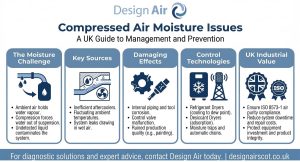
Why is water reaching my air tools?
The presence of water in pneumatic tools indicates a failure in the moisture removal process. Several mechanical and environmental factors contribute to this issue.
Condensate Drain Failure
Faulty drains are the most common cause of water in air lines. Drains are located on aftercoolers, receiver tanks, and filters. If a drain becomes blocked with rust or oil sludge, liquid water cannot exit the system. The water then travels downstream into the air dryer or the distribution network. During site audits, Design Air (Scotland) Ltd frequently identifies failed or incorrectly installed drain valves as the primary cause of recurring moisture complaints. Operators must use the manual test button on electronic water drains (EWD) to verify discharge regularly.
Dryer Overload and Capacity Mismatch
If the inlet temperatures or flow rates are higher than what the air dryers are designed to handle, they won’t be able to get rid of moisture. The temperature at the inlet of most refrigerated dryers is set to 38°C. If the compressor aftercooler is dirty, air can get into the dryer at 50°C or higher. Higher temperatures hold a lot more moisture, which makes the dryer work too hard to cool down. Also, a bypass valve that is only partially open lets untreated, wet air mix with dry air in the main header.

How do you select the correct air dryer?
Dryer selection must be based on the required Pressure Dew Point (PDP) at the coldest point in the system. The PDP is the temperature at which water will begin to condense within the pressurised system.
Refrigerated Air Dryers
Atlas Copco Refrigerant Dryers are the standard choice for general industrial applications. These units cool the air to approximately +3°C. This temperature prevents condensation in indoor pipework where ambient temperatures remain above freezing. They are energy-efficient and suitable for ISO 8573-1 Water Classes 4 to 6.
Desiccant Air Dryers
If you need air that is very dry, you must use a desiccant dryer. These systems use adsorption to get dew points as low as -40°C or -70°C. This level of dryness is necessary for making drugs, processing food, and any outdoor air lines in the UK, where winter temperatures drop below +3°C.
How does pipework design prevent water issues?
Proper distribution infrastructure acts as the final barrier against liquid contamination. Prevention requires specific engineering configurations to manage residual liquid.
- Swan Neck Take-offs: Air drops must exit from the top of the main header. This prevents liquid water at the bottom of the pipe from entering the drop and reaching the tool.
- Drip Legs: Vertical pipes should extend past the take-off point to form a collection pocket. These pockets must be fitted with automatic drains to clear accumulated condensate.
- Pipe Gradients: Horizontal mains must be installed with a 1:100 (1%) slope. This gradient directs residual moisture toward low-point drainage areas and prevents pooling.
- Air Velocity Control: Keeping air velocity in main headers below 6–7 m/s reduces turbulence. Excessive velocity will sweep moisture past drip legs and into sensitive equipment.
- Modular Aluminium: Systems like AIRnet don’t rust. Aluminium doesn’t make rust flakes that block drains and valves like galvanised steel does.
What are the risks of poor moisture control?
Unmanaged moisture leads to high operational costs and legal non-compliance. Compressed air is the “fourth utility” and requires the same maintenance rigour as electricity or gas.
Equipment Damage and Product Spoilage
Pneumatic cylinders and valves rust on the inside when they get wet. Water can cause problems with the finish of a surface when spray painting. Moisture helps microbes grow in food production lines. To make sure you follow ISO 8573-1 standards, you need to check the air quality often.
The “Death of Desiccant”
If you don’t pre-filter your desiccant dryer well enough, the system will fail. The compressor can spray oil aerosols on the desiccant beads. This coating prevents the beads from adsorbing water vapour. This failure is irreversible and requires a complete replacement of the desiccant media.
Environmental Regulations and Penalties
Compressor condensate is a dangerous mixture of oil and water. In the UK, it is against the law to dump untreated condensate into the foul sewer. This can lead to environmental fines and other actions against operators. Before throwing away oil, businesses must use oil/water separators to lower the oil content to less than 20 ppm.
Expert Perspective: Solving Moisture Issues at the Source
Moisture issues are entirely solvable when diagnosed through a systemic engineering lens. Success depends on matching drying technology to the lowest ambient temperature and ensuring every drainage point is functional. Relying on a dryer alone is insufficient if the pipework or drainage infrastructure is compromised.
If water contamination has caused downtime or damaged production equipment, Design Air (Scotland) Ltd provides a 24/7 Compressor Repair Service. We support industrial sites across Glasgow, Edinburgh, and the Central Belt.
To make sure your system stays dry, efficient, and up to code, call Design Air today to set up a compressed air moisture audit or an ISO 8573 air quality test.