
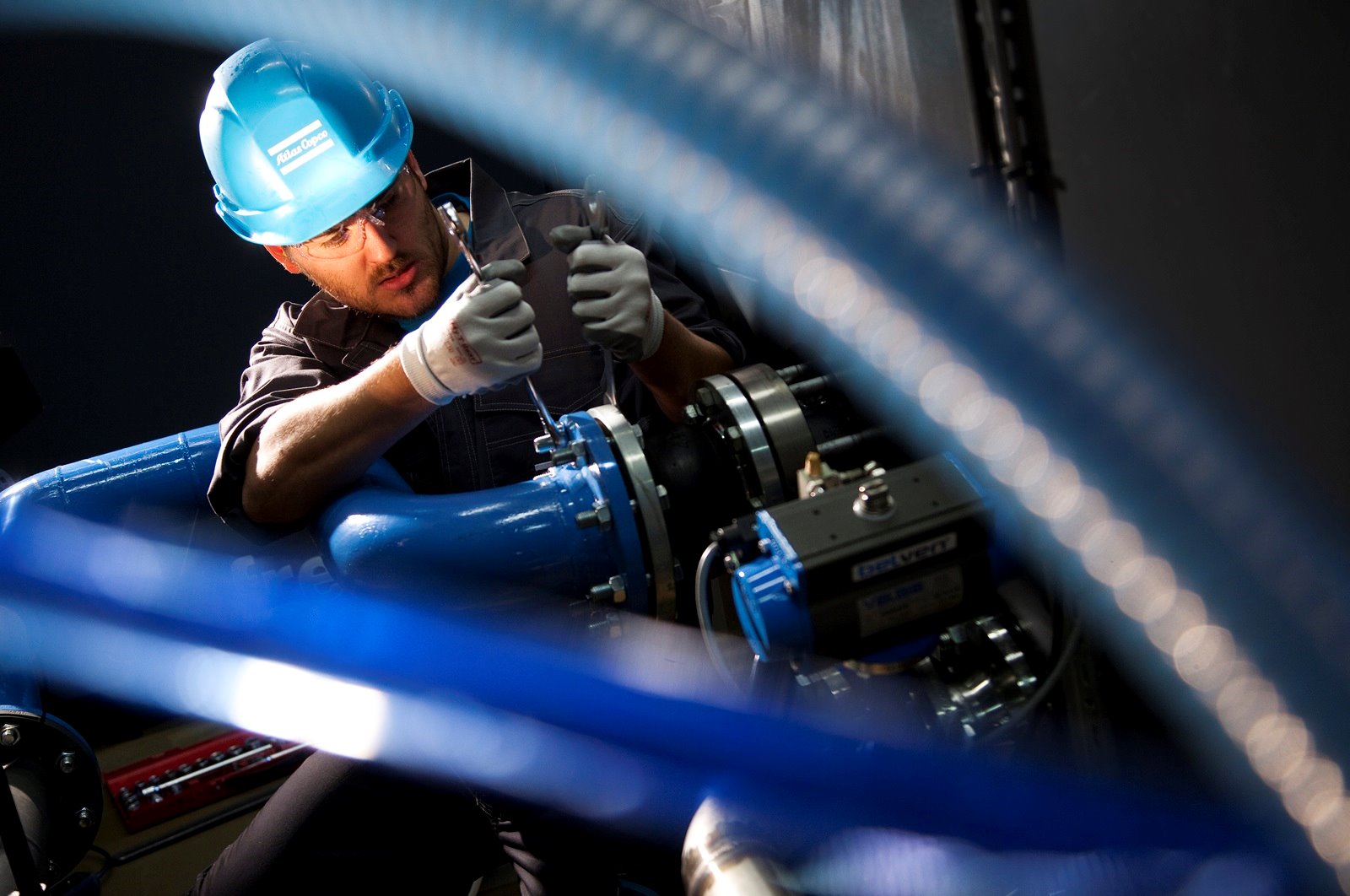
For a Maintenance Engineer in Lanarkshire, a critical moment, 20 minutes before a shift changeover, became a major snag: his 1-inch impact wrench failed to loosen a stubborn flange bolt. The root cause was a hidden lapse in system discipline. The drop line gauge read a meagre 62 PSI, far below the 90 PSI the tool demanded, a setting that had been neglected for years.
Choosing the Right Pressure for Your Air Tools is not a set-it-and-forget-it task; it requires ongoing, rigorous system management. At Design Air, we tackle this exact scenario weekly for businesses throughout Scotland. We bring over 200 years of combined experience as Atlas Copco Premier Distributors to ensure your tools operate at their required specifications.
This guide covers pressure fundamentals, demand calculation, pressure loss, financial impact, and compressor technology selection.
Why Correct Air Pressure Is a System Problem, Not a Settings Problem
The compressor’s discharge pressure and the pressure arriving at your tool are two different values – often separated by a significant, unmeasured drop. Raising the main pressure setting to fix a struggling tool is the most common and most costly mistake in compressed air management.
Understanding the Difference Between Pressure (PSI) and Flow (CFM)
Pressure (PSI/Bar) is the force available to perform work. Flow (CFM/l/s) is the system’s capacity to sustain that work continuously. Boyle’s Law governs the relationship: when volume decreases, pressure rises proportionally. When tool demand exceeds the compressor’s replenishment rate, pressure drops at the point of use.
The True Cost of “Turning Up the Pressure”
Raising system pressure creates artificial demand – every unregulated leak and tool consumes more air than it needs. For every 1 bar (14.5 PSI) of excess pressure, energy consumption increases by around 7% (Health and Safety Executive (hse.gov.uk)). A 75kW compressor running 4,000 hours annually wastes around £3,587 per year from just one bar of over-pressurisation.
Electricity already is 80% of a compressor’s total lifecycle cost. The root cause is almost always leaks, pipework restrictions, or incorrect sizing – not the pressure dial.
Our process always begins with a full system analysis, because fixing tool performance means looking far beyond the tool itself.
How Do You Determine the Correct Pressure and Flow Requirements?
Every pneumatic tool has two non-negotiable numbers: its required operating pressure and its air consumption rate. Both are found on the manufacturer’s data plate or in the tool manual. These figures are your starting point for sizing any compressed air system correctly.
Consulting the Tool Manual: Your Source of Truth
System pressure is set by the single tool with the highest PSI requirement – pressure is not additive. If a sandblaster needs 7 bar and an impact wrench needs 6.2 bar, the system runs at 7 bar. Flow requirements are additive.
Total CFM equals the sum of all tools operating simultaneously.
Calculating Total System Demand and Duty Cycles
Duty cycle changes everything. A tool consuming 10 CFM but running for only 15 seconds per minute has an effective demand of just 2.5 CFM. Sizing a compressor on the sum of all tool ratings – ignoring use factors – produces a massively oversized machine that cycles constantly, wastes energy, and accelerates mechanical wear.
For reference, a 1-inch impact wrench requires 90-100 PSI, consumes 10-15 CFM, and has a 25% use factor.
If you’re working with older equipment or overlapping duty cycles, our compressed air energy audit provides a data-logged profile of your plant’s true air demand.

What Causes Pressure Loss Between the Compressor and the Tool?
Pressure drop is the cumulative resistance of all components between the compressor discharge and the tool inlet. A system with more than 10% pressure drop is considered inefficient and is costing you money every hour it runs.
Identifying Leaks: The Silent Profit Drain
Leaks are always on. In a typical unmaintained facility, they consume 20-30% of total compressor output. A single 3mm leak at 7 bar costs a UK business over £1,000 per year in wasted electricity.
A 10mm leak costs upwards of £36,000 annually. Our engineers use ultrasonic leak detection to pinpoint leaks in running, noisy factories – without a shutdown.
The “Dirty Thirty”: Why the Last 10 Metres Matter Most
The final 30 feet (10 metres) of the air line – hoses, quick-couplers, and Filter-Regulator-Lubricator (FRL) units – is frequently the biggest source of pressure drop. A single restrictive quick-coupler can introduce a 0.5 bar (7 PSI) drop on its own. A clogged filter element adds another 0.3-0.7 bar.
The entire system pressure gets raised to compensate for a £10 fitting.
Pipework, Filters, and Air Quality
Poor air quality, as defined by ISO 8573-1 – the international standard for compressed air purity classes – clogs filter elements and fouls tool internals, producing symptoms that mimic low pressure. AIRnet aluminium pipework from Atlas Copco eliminates the internal corrosion that rough steel pipes accumulate over time, maintaining low frictional losses for decades.
The Financial and Performance Impact of Incorrect Pressure
Running your compressed air system at the wrong pressure has three direct consequences: higher energy bills, shorter tool life, and increased safety risk. Each one is measurable.
How Over-Pressurisation Wastes Thousands in Energy
At 17.08 pence per kWh – the average UK manufacturing electricity price in 2025 – the cost of excess pressure compounds quickly. A 160kW compressor running 6,000 hours wastes around £11,478 per year from a single bar of over-pressurisation. For businesses subject to ESOS (Energy Savings Opportunity Scheme) compliance, pressure optimisation is not optional – it’s a reportable efficiency measure.
The Link Between Pressure, Tool Life, and Safety
Running tools above their specified PSI accelerates wear on vanes, seals, and bearings. It also pushes components beyond their design limits, creating a risk of catastrophic failure. The common assumption is that buying a modern VSD compressor solves waste automatically.
It doesn’t. A VSD unit interprets pressure drop from unresolved leaks as legitimate demand and increases motor speed to compensate – efficiently and continuously – masking the problem while still wasting thousands annually.
To optimise your system pressure properly, the system must be clean before the compressor technology is upgraded.
Matching Compressor Technology to Your Pressure Needs
Once the system is clean and demand is accurately profiled, compressor technology selection becomes straightforward. The goal is matching motor output to actual demand, not peak theoretical demand.
VSD Technology for Stable Pressure and Maximum Efficiency
Traditional fixed-speed compressors swing between ~1.0-2.0 bar across their load/unload cycle, creating pressure fluctuations that affect tool consistency. The Atlas Copco GA VSD+ Series – which uses an Interior Permanent Magnet (iPM) motor and vertical drive train – maintains system pressure within ±0.1 bar (1.5 PSI) and reduces energy consumption by 50% compared to traditional fixed-speed idling models. The GA FLX Series offers a dual-speed bridge for facilities not yet ready for full VSD investment.
Intelligent Control Systems for Precise Management
The Elektronikon Nano controller manages individual compressor parameters, including dual pressure setpoints, allowing reduced night-time pressure during low-demand periods. For multi-compressor sites, the Equalizer 4.0 / Optimizer 4.0 coordinates up to 6 compressors, running only the most efficient combination to meet live demand. SMARTLINK remote monitoring provides real-time pressure alerts, enabling proactive management before a pressure drop becomes a production stoppage.
Our efficient air compressor range is specified to match your exact CFM and PSI requirements.
Before you call anyone, walk to your most problematic air tool and photograph the data plate. Note the required PSI and CFM. That single action starts the process. When you’re ready, book a no-obligation compressed air energy audit with the Design Air team – serving Airdrie (Main Depot), Glasgow, Edinburgh, Dundee, Fife, Stirling, and Perth – and find out exactly how much you could save.
Frequently Asked Questions
What PSI Should I Run My Air Tools At?
Always run air tools at the PSI specified on the manufacturer’s data plate or in the tool manual. Most industrial pneumatic tools need 90 PSI (6.2 bar). Running above this rating wastes energy and accelerates wear on internal components, including vanes, seals, and bearings.
Is 125 PSI Enough for Air Tools?
Yes. A compressor rated at 125 PSI exceeds the 90 PSI requirement of most standard pneumatic tools. The additional capacity accommodates system pressure drop. Always fit a regulator at the point of use to step pressure down to the tool’s correct rated operating pressure.
Will a 100 PSI Air Compressor Run an Impact Wrench?
Yes, a 100 PSI compressor can run most impact wrenches. This typically needs 90 PSI. The more critical factor is CFM. The compressor’s output at 90 PSI must exceed the wrench’s CFM requirement – typically 10-15 CFM for a 1-inch model – to maintain continuous performance.
Does Running Air Tools at the Wrong Pressure Affect PSSR Compliance?
Yes. Systematically over-pressurising your network to compensate for pressure drops can push components beyond their safe operating limits. This conflicts with your Written Scheme of Examination (WSE) under PSSR 2000 and can invalidate safety valve settings, creating a significant legal and safety exposure.