

A Lanarkshire bodyshop’s Workshop Manager faced a costly error 20 minutes into a Monday morning two-stage respray: the pressure dropped below 6 bar as a third spray gun was activated, resulting in a damaging fish-eye finish and forcing a £3,500 job to be stripped and restarted. Crucially, the compressor itself wasn’t broken; it was simply the wrong equipment for the task.
This comprehensive guide is designed to prevent similar failures by detailing the essential differences between piston and rotary compressors. We will cover key factors such as duty cycle, air quality, energy consumption, and UK legal compliance to help you select the appropriate machine for your specific needs.
The Core Difference: How Piston and Rotary Screw Compressors Work
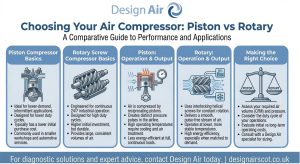
A piston compressor uses a crankshaft-driven piston moving linearly inside a cylinder. The downward stroke draws air through an intake valve. So the upward stroke compresses it until pressure overcomes the discharge valve.
The result is pulsating air output that needs a large receiver to buffer the flow.
Reciprocating Piston Compressors: The Basics
The Atlas Copco LE/LT Series uses this reciprocating mechanism. It’s mechanically simple, capable of high pressure ratios, and well-suited to intermittent workshop use. Cooling relies on air-cooled fins on the cylinder head.
Discharge temperatures regularly reach 149°C to 204°C at the cylinder head, according to the Compressed Air and Gas Institute (CAGI) technical handbook.
That heat isn’t just a byproduct of working hard. At those temperatures, lubricating oil degrades rapidly, causing valve carbonisation – carbon deposits that prevent inlet and discharge valves from sealing. The compressor then runs continuously but can’t build pressure, eventually burning out the motor entirely.
Rotary Screw Compressors: Continuous Flow Technology
A rotary screw compressor uses two counter-rotating intermeshing helical rotors. Air is trapped at the inlet, carried along the rotor length, and compressed continuously as the inter-lobe volume decreases. There are no reciprocating masses, no valve clatter, and no pulsation.
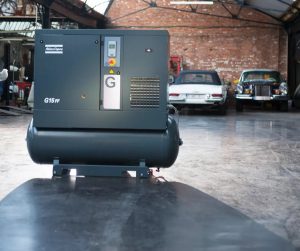
The Atlas Copco GA Series injects oil directly into the compression chamber to absorb heat. Discharge temperatures stay between 77°C and 93°C – roughly half the thermal load of a piston unit. Cooler air holds less moisture, and the oil-separation system keeps carry-over below 3 ppm under normal operating conditions.
Understanding this mechanical difference is the starting point. Matching it to your site’s actual demand profile is where our expertise with the Atlas Copco LE/LT and GA ranges becomes directly relevant.
What is a Compressor’s Duty Cycle and Why Does It Matter?
Duty cycle is the percentage of time a compressor can run at full load without overheating or mechanical failure. It’s the single most misunderstood specification in compressor selection, and getting it wrong is the most common cause of premature failure we see.
Understanding Duty Cycle: Intermittent vs. Continuous Demand
Piston compressors carry a typical duty cycle of 60% to 70%. In practice, that means a maximum of 35 to 40 minutes of run time per hour. Rotary screw compressors are engineered for 100% continuous duty – 24 hours a day, seven days a week.
Exceeding a piston’s duty cycle causes rapid oil degradation and valve carbonisation. But there’s an equally damaging failure mode at the other end: an oversized piston compressor that cycles on and off too frequently never reaches optimal operating temperature. Water condenses in the crankcase, dilutes the oil, and destroys crankshaft bearing surfaces.
That’s a terminal failure requiring full machine replacement.
How Duty Cycle Impacts Compressor Sizing and Performance
Because a piston unit needs rest time, it must be oversized relative to actual demand. A piston compressor typically delivers 1.4 to 1.9 litres per second per kW of Free Air Delivery (FAD). A rotary screw delivers 1.9 to 2.4 l/s per kW – meaning a 5.5 kW screw compressor can match the FAD output of a 7.5 kW piston unit, based on CAGI performance data.
| Metric | Piston Compressor | Rotary Screw Compressor |
| Duty Cycle | 60% – 70% | 100% |
| FAD per kW | 1.4 – 1.9 l/s | 1.9 – 2.4 l/s |
| Typical Lifespan | 10,000 – 15,000 hrs | 40,000 – 60,000+ hrs |
| Noise Level | 80 – 90 dB(A) | 62 – 75 dB(A) |
Incorrectly matching the duty cycle to the application is the leading cause of early compressor failure. Our Compressed Air Energy Audit measures your actual demand profile precisely, so the machine specified fits the job.
Air Quality and Noise: The Hidden Costs of the Wrong Compressor
The air leaving your compressor carries contaminants that your downstream equipment, your product, and your workforce are directly exposed to. ISO 8573-1:2010 – the international standard for compressed air purity – classifies air quality by particulates, moisture, and oil concentration.
Oil Carry-Over, Moisture, and ISO 8573-1 Compliance
High discharge temperatures in piston compressors mean the air holds significant water vapour. When that hot air enters cooler distribution pipework, moisture drops out as liquid – corroding steel pipes, damaging pneumatic actuators, and ruining paint finishes. Standard oil-injected piston compressors without downstream treatment can exceed 10 mg/m³ of oil at discharge.
ISO 8573-1 Class 1 permits a maximum of 0.01 mg/m³.
The assumption that downstream filters on an oil-injected machine deliver “technically oil-free” air is a liability, not a solution. A single saturated or bypassed filter element releases a slug of aerosolised oil directly into the production line. Under BRC Global Standard for Food Safety Issue 9, Clause 4.6.1, which constitutes a Category 1 non-conformance – triggering a full product recall and potentially destroying brand reputation.
Noise Levels and Workplace Safety
An open-frame piston compressor operates at 80 to 90 dB(A). An enclosed rotary screw runs at 62 to 75 dB(A). Because the decibel scale is logarithmic, a machine at 85 dB(A) is over four times louder than one at 63 dB(A) – not marginally louder.
For food, pharmaceutical, or electronics applications where oil contamination is unacceptable, the Atlas Copco SF/SF+ Series delivers certified Class 0 oil-free air. We conduct certified ISO 8573-1 air quality testing to validate your system and confirm compliance.
Which is More Energy Efficient: Piston or Rotary Screw?
Energy accounts for 70% to 80% of a compressor’s total lifetime cost. With UK non-domestic electricity averaging 22.2p/kWh in Q1 2024 (Ofgem), a 15 kW compressor running 6,000 hours per year costs around £19,980 in electricity alone at full load. The compressor technology you choose determines how much of that figure is avoidable.
The True Cost of Compressed Air: Why Energy is 80% of the Total
Fixed-speed compressors – both piston and entry-level rotary screw – operate on a load/unload cycle. When system pressure reaches its upper setpoint, the motor keeps running but produces no air. During this unloaded phase, the machine still consumes 25% to 30% of full-load power.
Fixed-Speed vs. Variable Speed Drive (VSD) Technology
Variable Speed Drive (VSD) technology uses an inverter to adjust motor speed in real time to match actual air demand. The Atlas Copco GA VSDs Series eliminates unloaded running entirely, delivering energy savings of up to 60% versus fixed-speed equivalents. A 15 kW Atlas Copco GA 15 VSDs running 6,000 hours per year saves around £5,900 annually compared to a fixed-speed unit, based on a 35% average load variation.
The biggest VSD savings aren’t always in high-volume factories. A workshop with fluctuating tool use – grinders, sanders, spray guns – has a more volatile demand profile than a factory running a constant process. Dismissing VSD as “too industrial” for a bodyshop or small garage could mean wasting thousands annually.
For a detailed breakdown of how to calculate your own running costs, see our guide on compressor energy consumption.
ESOS Regulations and Your Legal Duty to Audit
Under the Energy Savings Opportunity Scheme (ESOS) Regulations, large UK businesses are legally required to conduct energy audits every four years. A compressor upgrade to VSD technology directly supports ESOS compliance and shows measurable efficiency improvement. Our energy audits provide a detailed report showing the exact return on investment based on your real-world usage data.
Maintenance, Lifespan, and UK Legal Compliance: What You Need to Know
Maintenance costs are frequently underestimated at the point of buy. The comparison isn’t just about service kit prices – it’s about frequency, downtime, and the legal framework that governs every pressurised system in your facility.
Comparing Service Intervals and Lifetime Costs
Piston compressors need oil changes every 500 to 1,000 hours, plus periodic valve plate and piston ring replacement. Rotary screw compressors need oil changes every 4,000 to 8,000 hours, with separator element replacement at around 4,000 hours. A rotary screw air-end typically lasts 40,000 to 60,000 hours before a major overhaul – equivalent to 20 to 30 years of single-shift operation, per Atlas Copco service documentation.
A piston unit typically reaches end-of-life at 10,000 to 15,000 hours.
The Elektronikon Nano controller and remote monitoring via SMARTLINK simplify maintenance scheduling on Atlas Copco machines, flagging service intervals and fault codes before they become unplanned stoppages. Our compressor service plans cover both piston and rotary screw equipment across all Atlas Copco ranges.
Your Legal Obligations Under PSSR 2000
The Pressure Systems Safety Regulations 2000 (PSSR) need any compressed air system exceeding 250 bar-litres to have a Written Scheme of Examination (WSE) in place. The threshold is calculated by multiplying the vessel volume in litres by the safety valve set pressure in bar. A standard 270-litre receiver at 10 bar equals 2,700 bar-litres – ten times the legal threshold.
The common assumption is that PSSR compliance is the inspector’s responsibility. It isn’t. Under PSSR 2000, the user and owner of the system carries the legal duty to have a WSE in place and to confirm examinations are carried out.
A lack of a valid WSE can invalidate your insurance and, in the event of a fatality, expose the business to criminal prosecution under corporate manslaughter legislation. PUWER 1998 and COSHH Regulations 2002 also apply – covering equipment safety and the correct disposal of oil-contaminated condensate, respectively. Full details are available from the Pressure Systems Safety Regulations 2000 (PSSR) (hse.gov.uk).
As a certified Competent Person under PSSR 2000, we draft Written Schemes of Examination and carry out statutory inspections across Scotland.
Before you call us, take 60 seconds to check the data plate on your current compressor. Note the kW or HP rating and the FAD in l/s or cfm. That single piece of data will make the conversation far more productive.
Stop guessing and start measuring. Book a no-obligation site survey with one of our factory trained engineers at Design Air – serving businesses from our Airdrie Main Depot across Glasgow, Edinburgh, Dundee, Fife, Stirling, Perth, Hamilton, Kilmarnock, Livingston, Paisley, and throughout Scotland.
Frequently Asked Questions
Which is Better, a Piston or a Rotary Compressor?
Neither is universally better – they suit different applications. Piston compressors work well for intermittent, low-demand use in small workshops. Rotary screw compressors are the correct choice for continuous industrial use where reliability, air quality, and energy efficiency directly affect production output and operating costs.
What Are the Disadvantages of Piston Compressors?
The main disadvantages are a 60% to 70% duty cycle, high noise levels of 80 to 90 dB(A), lower FAD per kW, and hot, wet discharge air that damages tools and finishes. They also need more frequent mechanical servicing, including valve plate and piston ring replacement.
Are Rotary Compressors Better?
For industrial applications, yes. They run at 100% duty cycle, operate at 62 to 75 dB(A), deliver more air per kW, and produce cooler, cleaner output. The higher buy price is typically offset within two to three years through lower energy consumption and significantly reduced maintenance frequency.
What Are the Disadvantages of Rotary Compressors?
The primary disadvantage is a higher upfront cost compared to a piston unit of similar power output. They also perform poorly when run for very short periods, as insufficient operating temperature causes moisture to condense in the oil – leading to emulsification and accelerated internal wear.