
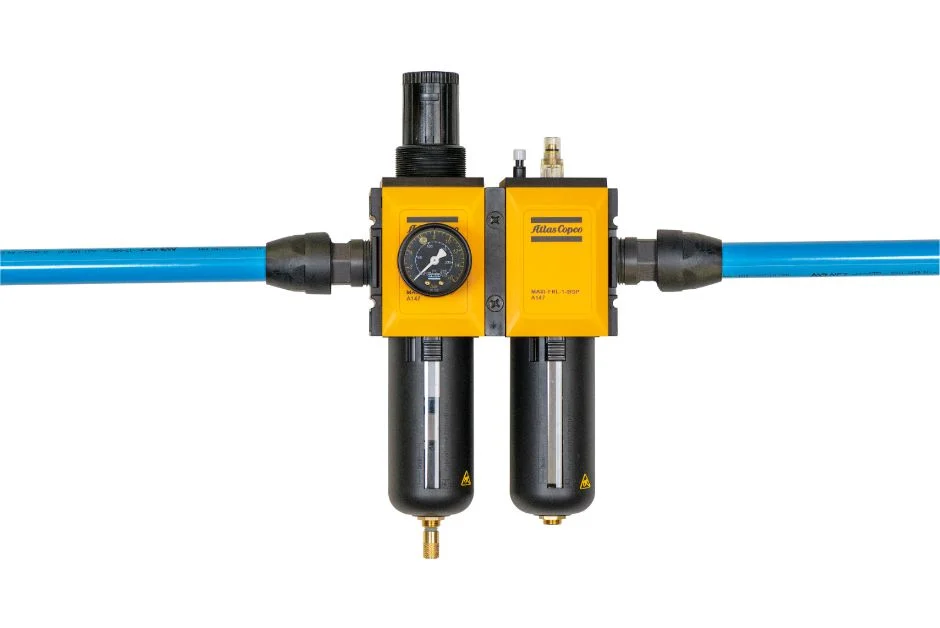
A Production Engineer at a Scottish food processing plant traces intermittent actuator failures on a packaging line – not to faulty actuators, but to unregulated line pressure running 1.5 bar above the manufacturer’s specification. The result: inconsistent cycle times, premature seal wear, and a growing reject rate.
Why air regulators are essential in compressor systems comes down to one fact: compressors generate high, unstable pressure, and every downstream tool needs something precise and controlled.
At Design Air, Atlas Copco Premier Distributors, operating since 2003, we’ve diagnosed this exact scenario across Scotland’s manufacturing sector. So this guide covers the cost of unregulated air, how regulators work mechanically, what VSD technology adds, and your compliance obligations under PSSR 2000.
Why Trust Design Air with Your Pressure Regulation?
Decades of Hands-On Experience
Design Air has operated since 2003, and our system designers hold the Diploma in Compressed Air Management (dipCAM), awarded by the British Compressed Air Society (BCAS). The dipCAM needs demonstrated competency across ISO 11011 audit methodology – it’s not a short course.
Authorised Atlas Copco Premier Distributor
As an authorised Atlas Copco Premier Distributor, we specify, install, and service the full range of Atlas Copco compressed air equipment across Scotland.
The core problem is straightforward. A compressor generates high, fluctuating pressure at its discharge. Pneumatic tools need a stable, lower pressure.
The air regulator bridges that gap. Without one, every actuator, tool, and air leak in the system consumes more air than it needs.
This creates what the industry calls Artificial Demand. Many engineers assume that running the system at a higher “safety margin” pressure stops tools from starving. It doesn’t – it forces every component in the system to consume excess air.
Per data from The Carbon Trust (carbontrust.com), every 1 bar reduction in system discharge pressure reduces compressor energy consumption by around 7%. On a 75 kW machine running 6,000 hours per year, running one bar higher than necessary adds roughly £2,500 to £3,500 in avoidable annual energy cost – before accounting for accelerated seal and valve wear across every downstream actuator.
Our approach starts with an accurate diagnosis of your system’s real pressure requirements.
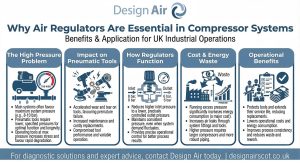
How Do We Diagnose and Solve Pressure Control Issues?
Identifying the True Cost of Unregulated Air
Symptoms of poor pressure control include inconsistent tool performance, high energy bills, and frequent component failure. Our compressed air energy audit uses data logging and flow monitoring to pinpoint Artificial Demand and pressure drop across the system – giving you a measured baseline before any changes are made.
Relieving vs. Non-Relieving Regulators
Selecting the wrong regulator type is a common and costly mistake. A relieving regulator vents excess downstream pressure to the atmosphere through a small exhaust port – typically sized to handle 1 to 5% of rated flow at setpoint. This is the standard choice for general pneumatic tool applications, eliminating the need for a separate relief valve on every branch circuit.
A non-relieving regulator traps excess downstream pressure rather than venting it. These are mandatory where the regulated gas is classified as hazardous under DSEAR 2002. Venting even 0.1 bar of overpressure in a confined space can displace enough oxygen to drop the atmosphere below the 19.5% O₂ threshold – the lower limit for safe working.
The assumption that a regulator is a “fit and forget” component is wrong. Internal elastomeric seals and diaphragms are wear parts. A regulator suffering from pressure creep – caused by a worn poppet seal – will slowly allow high inlet pressure to bleed downstream when tools are idle.
Overnight, this can exceed the burst pressure of plastic tubing or damage sensitive instruments, triggering a line shutdown on the morning shift.
Matching the regulator type to the application and inspecting it regularly prevents this failure mode entirely.

How Does an Air Regulator Actually Control Pressure?
The Mechanics of Force Balance
A mechanical pressure regulator operates on the principle of force balance. The operator sets the desired downstream pressure by compressing an adjusting spring. This creates a downward force against a flexible diaphragm.
Opposing this is the upward force generated by downstream air pressure acting on the diaphragm’s surface area.
The governing equation is: Fa = Fp + (P2 × SA) – where Fa is the adjusting spring force in Newtons, Fp is the return spring pre-load, P2 is the downstream pressure in Pascals, and SA is the effective diaphragm area. A typical ¼-inch regulator has an SA of around 12 to 15 cm². When a tool activates and downstream pressure drops, the spring force dominates, opening the poppet valve.
As pressure returns, the valve modulates to a closed position.
Atlas Copco VSD Technology and the Elektronikon® Nano™
Point-of-use regulators control pressure at individual workstations. System-level pressure is a separate challenge – and that’s where Variable Speed Drive (VSD) compressors change the calculation entirely.
A fixed-speed compressor loads and unloads between two pressure limits, creating a band of fluctuation. A VSD compressor, managed by the Atlas Copco Elektronikon® Nano™ controller, adjusts motor speed in real time to match actual demand, maintaining system pressure within 0.1 bar of the setpoint.
The Elektronikon® Dual Pressure Bands feature allows a second, lower pressure setpoint – typically 0.3 to 0.5 bar below the working band – to activate automatically during pre-set non-production windows, cutting unloaded running losses without manual intervention.
The common assumption is that the compressor’s pressure setting equals the pressure delivered to the tool. It doesn’t. Pressure drop across dryers, filters, and long pipe runs means the compressor controller only sees pressure at its discharge outlet.
To compensate for a 1 bar drop, operators often raise the compressor setpoint by 1 bar – increasing whole-system energy use by around 7% – when a correctly placed point-of-use regulator could have solved the problem for a single workstation at zero additional energy cost.
What Results Can You Expect from Proper Pressure Regulation?
Slashing Energy Costs with The 7% Rule
The 7% Rule is the starting point for any pressure reduction business case. Every 1 bar reduction in system discharge pressure reduces compressor energy consumption by around 7%. On a large installation, this is not a marginal saving.
Reducing Waste from Air Leaks
The rate of air loss through a leak is proportional to the pressure. Reducing system pressure from 8 bar to 7 bar reduces flow through existing leaks by over 10%. A single 3mm hole in an air line at 7 bar costs a business over £1,000 per year in wasted electricity alone.
Our compressed air leak detection service quantifies this waste in pounds and pence, using ultrasonic detection to find leaks that are invisible and inaudible during normal operation.
Improving Product Quality and Tool Lifespan
The assumption that the highest cost of an air leak is wasted electricity misses the second-order effect. Feeding a leak adds running hours to the compressor. A single 3mm leak can add over 1,000 running hours to a compressor’s annual duty cycle.
On an Atlas Copco machine, this can trigger an additional preventive maintenance visit and accelerate the timeline for an air-end replacement, turning a £1,000 energy problem into a £10,000+ capital expenditure problem.
Stable, correct pressure also improves the consistency of pneumatic torque wrenches, paint sprayers, and actuators – reducing product defects and rework. Documented pressure-reduction measures are a compliance asset for ESOS Phase 3 and for ISO 50001 energy management certification.
Ensuring Compliance and Safety with Expert Regulation
Navigating the Pressure Systems Safety Regulations (PSSR) 2000
PSSR 2000 applies to any pressure system containing a relevant fluid at a pressure above 0.5 bar gauge. A Written Scheme of Examination (WSE) is mandatory for any pressure vessel exceeding 250 bar·litres – a threshold met by most industrial installations, including a 50-litre receiver at 5 bar gauge.
The WSE must identify every part of the system subject to pressure, including vessels, pipework, and protective devices, such as pressure regulators and relief valves. The assumption that PSSR compliance is just about the annual receiver inspection is incorrect. Failure to include a critical point-of-use regulator in the WSE can invalidate the entire scheme.
If that regulator fails and causes an injury, the HSE will treat it as a systemic compliance failure, not an isolated component fault, with significant fines and potential prosecution for the Dutyholder.
Meeting Air Quality Standards (ISO 8573-1)
For food and beverage manufacturers, ISO 8573-1:2010 Class 2:2:1 – often required for direct food contact air – mandates a particle size of ≤1 µm, a pressure dewpoint of ≤-40°C, and a total oil content of ≤0.01 mg/m³. These limits are defined in BCAS Best Practice Guideline 102 and must be reflected in your HACCP plan.
As a certified Competent Person under PSSR 2000, we can draft your WSE and supply the correct airline accessories and regulators to keep your system compliant.
Before you call us, run this three-step check: find the pressure rating printed on your pneumatic tool, check the gauge on the FRL unit supplying it, then note the pressure shown on your compressor controller. If the compressor pressure is more than 1.5 bar above the tool’s requirement, you have a measurable savings opportunity. Book a no-obligation system pressure assessment with one of our factory trained engineers at Design Air, serving Airdrie, Glasgow, Edinburgh, Dundee, Fife, Stirling, Perth, and across Scotland.
Frequently Asked Questions
What is the purpose of the regulator on an air compressor?
A regulator reduces the high, unstable pressure from the compressor receiver to a lower, constant pressure suitable for downstream equipment. This protects tools from over-pressurisation, improves operating consistency, and reduces energy consumption by matching delivered pressure to the actual requirement.
Do I need an air regulator for my compressor?
Yes. Operating pneumatic tools directly from the compressor receiver without a regulator is unsafe and inefficient. A regulator is required for pressure control, personnel safety, and equipment protection. It also reduces energy consumption by preventing the system from running at unnecessarily high pressure.
What is artificial demand in a compressed air system, and how does a regulator prevent it?
Artificial demand is the excess air consumed by tools and leaks due to system pressure being higher than necessary. A regulator prevents this by supplying air at the minimum pressure the application needs. Per The Carbon Trust, every 1 bar reduction in pressure cuts compressor energy consumption by around 7%.
Are air pressure regulators covered by PSSR 2000?
Yes. As protective devices within a pressure system, regulators fall under PSSR 2000 and must be identified in the Written Scheme of Examination. Omitting a regulator from the WSE can invalidate the entire scheme and expose the Dutyholder to HSE enforcement action if a failure causes injury.
How often should an air pressure regulator be serviced or replaced?
Annual inspection is the minimum recommendation, carried out as part of your system service. In clean, dry systems, a quality regulator can last several years. Pressure creep, external leaks, or an inability to hold a steady setpoint are signs that immediate attention or replacement is needed.