

When an industrial air compressor trips its circuit breaker, the shutdown is doing exactly what it was designed to do: prevent serious electrical or mechanical damage. In most cases, however, a breaker trip is not the fault itself but a warning sign that the compressor or its supporting infrastructure is operating outside safe electrical limits.
Across UK industrial sites, repeated breaker trips are commonly linked to electrical imbalance, excessive starting loads, or mechanical resistance that forces motors to draw more current than intended.
This guide explains the electrical and mechanical faults that cause compressors to trip breakers, how UK regulations govern safe operation, and how modern control and drive technologies reduce the risk of nuisance trips and unplanned downtime.
Why does an air compressor trip the circuit breaker?
An air compressor trips its circuit breaker when the electrical current draw surpasses the predetermined amperage rating of the device. The breaker serves as a safety sentinel for the motor and the facility. Specific triggers for disconnection include short circuits and grounded motor windings. Mechanical overloads that force the motor to draw excessive amperage also cause trips.
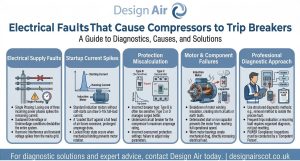
What electrical faults lead to breaker trips?
Industrial compressors rely on complex electrical systems. These systems must maintain specific current and voltage parameters to operate safely.
Short circuits and ground faults
Short circuits occur when a live conductor makes contact with a neutral wire or another phase. Ground faults occur when current leaks to the earth through the motor frame or metal conduit. These faults cause an instantaneous spike in current.
Primary causes include:
- Breakdown of motor winding insulation.
- Water ingress within terminal boxes.
- Insulation wear caused by machine vibration.
Inrush current and startup dynamics
Industrial induction motors require a significant surge of electricity to overcome stationary inertia. This inrush current reaches 5x to 10x the rated full-load current (FLC). If the circuit breaker is incorrectly sized, it will disconnect during the acceleration phase. UK industrial standards typically require Type C or Type D breakers. These are designed to accommodate high startup loads without nuisance tripping.
Phase loss and imbalance
Three-phase systems are sensitive to supply irregularities. Single phasing occurs when one of the three power lines is lost. This is often due to a blown fuse or loose connection. If a motor continues to operate on two phases, the current in those phases rises significantly. Phase currents typically increase to approximately 2.4x normal operating levels. This results in rapid overheating.
Capacitor deterioration in single-phase units
Small workshops using single-phase reciprocating compressors often experience trips due to capacitor failure. A degraded start or run capacitor prevents the motor from reaching operational speed. This causes the motor to remain in a “locked rotor” state. The motor draws maximum current until the breaker trips.
How do mechanical failures trigger electrical trips?
Mechanical resistance within the compressor air-end directly increases electrical demand.
Failed unloader and check valves
The unloader valve ensures the compressor starts without internal pressure. If this valve sticks in the closed position, the motor must start against a full head of air. This is a “loaded start.” It forces a prolonged inrush period that trips the breaker. Similarly, a failed check valve allows air from the receiver tank to press back against the rotors. This often leads to an immediate locked-rotor trip upon startup.
Oil separator and filter restrictions
A clogged oil separator element increases internal discharge pressure. For every 1 bar of additional pressure generated to overcome restrictions, the motor requires approximately 7% more shaft power. A restricted separator pushes the motor into its service factor range. The motor draws current beyond its nameplate rating, causing mid-cycle trips.
High oil viscosity and ambient temperature
In unheated Scottish facilities, lubricating oil thickens during the winter months. Increased oil viscosity creates mechanical drag on the rotors during a “cold start.” This translates to higher initial amperage draw. Conversely, high ambient temperatures reduce motor cooling efficiency. This leads to thermal overload trips.

Which UK regulations govern compressor electrical safety?
Maintaining electrical stability in compressed air systems is a requirement under UK health and safety frameworks.
BS 7671 (IET Wiring Regulations)
Installation and maintenance must comply with BS 7671. This includes verifying the Earth Fault Loop Impedance Zₛ. This ensures that protective devices disconnect within the 0.4 seconds required for safety. Using a Type B breaker where a Type C or D is indicated is a common cause of tripping.
PSSR 2000 and PUWER 1998
The Pressure Systems Safety Regulations 2000 (PSSR) mandate that protective devices are maintained in good working order. This includes circuit breakers and pressure switches. Under the Provision and Use of Work Equipment Regulations 1998 (PUWER), equipment must be inspected by a “Competent Person.” Frequent trips followed by repeated resets indicate that the system is operating outside its intended safety margins.
How do Atlas Copco systems manage electrical faults?
Atlas Copco systems use integrated electrical monitoring to detect abnormal conditions. These include abnormal current draw, phase loss, and voltage imbalance.
Elektronikon® controllers and SMARTLINK
The Elektronikon® controller provides real-time monitoring of motor parameters. It identifies phase imbalances and overcurrent events. The system often triggers a controlled shutdown rather than a hard electrical trip. SMARTLINK remote monitoring logs these events. Technicians use these recorded fault codes to diagnose electrical issues accurately.
Variable Speed Drive (VSD) technology
Atlas Copco VSD and VSD+ compressors eliminate high inrush currents. The drive gradually ramps the motor to the required speed. This keeps the starting current at or below 100% of the full-load current. This prevents the surges that typically trip breakers in facilities with limited electrical capacity.
| Component | Failure Mode | Effect on Electrical System |
| Unloader Valve | Stays closed | Motor starts under load; prolonged inrush current |
| Check Valve | Fails to seal | Backpressure forces the motor into the locked rotor state |
| Motor Winding | Insulation breakdown | Ground fault; instantaneous high-current trip |
| Oil Separator | Clogged/Saturated | 7% increase in current draw per 1 bar pressure drop |
Professional Diagnostic Methodology
Recurring breaker trips indicate a fault that requires structured diagnosis. Investigation should be conducted by a competent service provider. To isolate the fault, technicians often use the “removal method”:
- Disconnect the motor from the air-end.
- Start the motor in a no-load state.
- If the breaker trips, the fault is electrical. This involves the motor, cabling, or starter.
- If the motor runs normally, the investigation shifts to mechanical binding or valve failure.
Frequent trips followed by repeated resets indicate that the system is operating outside its intended safety margins. For assistance with identifying the root cause of electrical instability, you can consult with the technical team at Design Air (Scotland) Ltd regarding routine compressor maintenance or our 24/7 compressor repair service. Proactive monitoring and the use of genuine air compressor spare parts help ensure your equipment remains within its Safe Operating Limits.