
On-site gas generation
Atlas Copco Nitrogen Generators
Compared with delivered nitrogen bottles or bulk tank top-ups, on-site nitrogen generation can produce industrial gas at a fraction of the cost, using either spare capacity from your existing compressed air supply or a new standalone system.
Design Air checks your usage, flowrate, purity, pressure, feed-air quality and running costs, then shows whether on-site generation will save money before you commit.

99.999%
nitrogen purity available
up to 50%
energy saving with VCS
3-60 mo
finance options
~1.5yr
typical return on investment
Is it worth it?
How to tell if on-site nitrogen generation pays off
1. Work out your average nitrogen usage and flowrate
The first step to determine if on site Nitrogen Generation is worthwhile for you is to try and determine how much industrial gas you are using. An easy and quick way to determine your average usage is totally up the total m3 of Nitrogen you have used over a given process period (either add up the total m3 of bottles used or look on your bill for total delivered m3) and divide this by the total number of hours the gas was in use over this period.
So, for example, let’s say you used 2 x 146m3 bottle banks per week for a laser cutter, and the Nitrogen was in use 8am-5pm Monday to Friday. This would equate to an average usage of 292m3 / (9hrs x 5 days) = 6.48m3/hr average gas usage.
2. Calculate your existing nitrogen supply costs
Next, you should try to determine how much you are currently spending with your industrial gas suppliers per month on average.
This should be easy enough to determine by reviewing the regular bills you receive from your current provider supplier. Typically, you will find that you incur more than just the cost of the gas itself; the “true cost” includes many ancillary fees:
- Costs for Nitrogen Gas Supply (cost per m3)
- Rental Costs for Bottle Banks / Bulk Storage Solutions
- Delivery Costs and transport fees
- Order process and processing fees and environmental levies
- Hidden waste costs (e.g., “boil-off” from liquid tanks, or returning high-pressure cylinders with 10% of the industrial gas remaining to prevent contamination)
So for our example above of using 1 x bottle bank per week, over one month, you could be looking at;
- £5,920 for 8 x Nitrogen Bottle Bank (2 per week)
- £644 for monthly rental of Nitrogen Bottle Bank
- £420 for delivery / uplift of 4 x Nitrogen Bottle Banks
So you could be looking at a monthly cost of £6,984 per month and £83,808 per year based on our example to buy in 2 x Nitrogen MCP per week (accurate as of April 2024).
3. Specify a solution and find your return on investment
The final step should be to get in touch with us with your findings. This along with some information on the industrial process that uses Nitrogen (such as your required purity and pressure) should help us to very quickly specify and quote for a suitable Nitrogen generation solution. This information will also help us to determine what your annual running costs would be for our offered products and as a result what your expected return on investment will be.
Why Design Air
Why choose us for on-site nitrogen
Feasibility study
We establish your average flowrate, required purity, pressure, feed-air quality, current nitrogen spend and payback period before recommending a generator.
Pay monthly
Finance over 3 to 60 months. On suitable sites the monthly payment is lower than the cost saving, so you save from month one.
Expert installation and UK compliance
We design the whole installation around the compressor, air treatment, generator, storage and pipework, with PSSR and Written Scheme of Examination requirements considered from the start.
Service and maintenance plans
Comprehensive plans cover filter changes and sensor calibration with genuine Atlas Copco parts, preventing unplanned downtime and simplifying budgeting.
Lowest total cost of ownership
Atlas Copco generators have some of the lowest air-to-nitrogen ratios on the market, using less feed air than equivalents to produce the same flow.
The range
Our range of Atlas Copco gas generation solutions
Premium-efficiency and standard industrial units to match your flow, purity and budget.
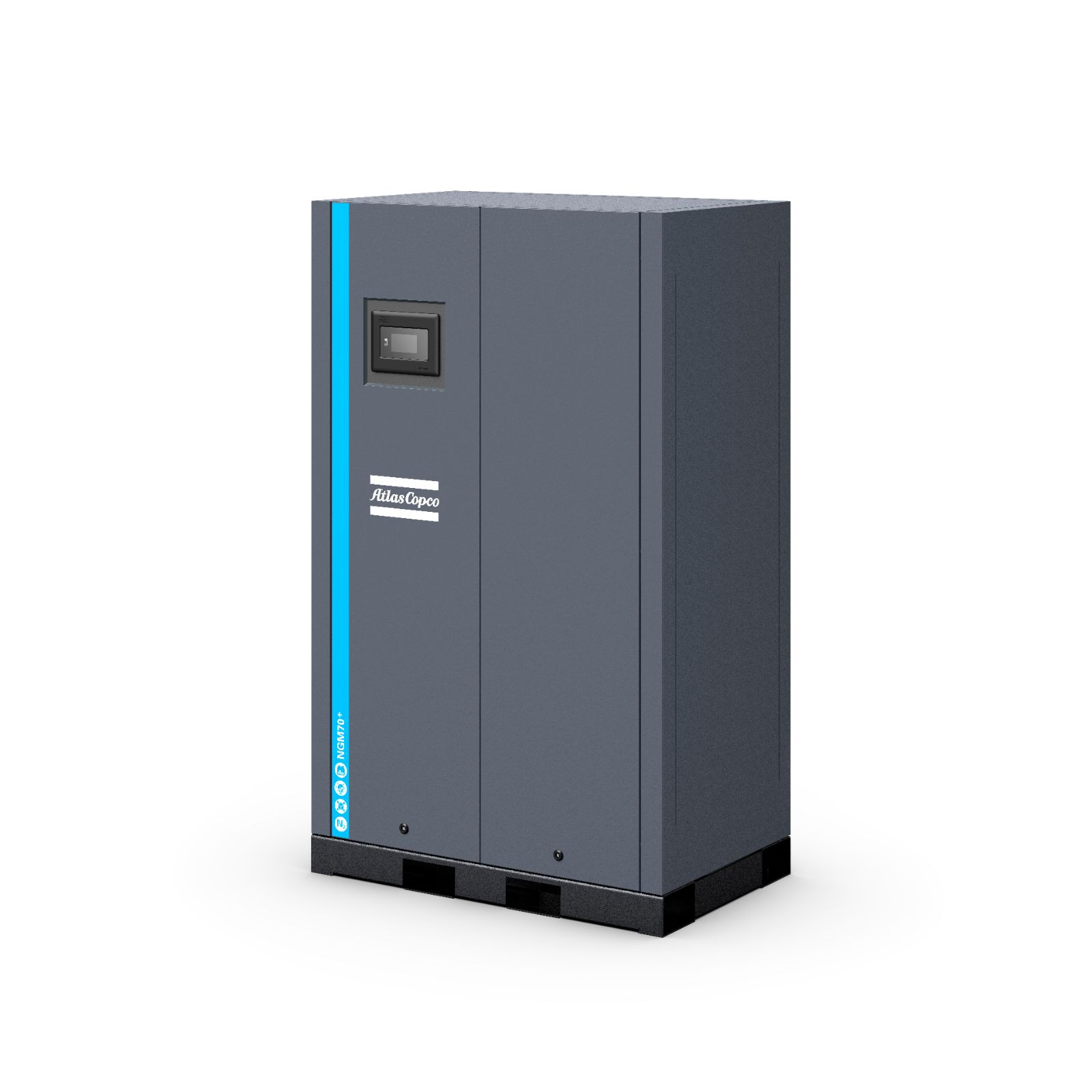
Membrane (NGM range)
Membrane nitrogen generation for steady industrial demand.
- 95-99.5% purity
- 5.8-306.3 m³/hr
Key details
- Purity range 95 to 99.5%
- Flow range 5.8 to 306.3 m³/hr
- Premium NGM+ series for higher efficiency
- Compact NGMs series, ideal for replacing single cylinders

PSA (NGP range)
Pressure swing adsorption for high purity across a wide flow range.
- 95-99.999% purity
- 5-1,499 m³/hr
Key details
- Purity range 95 to 99.999%
- Flow range 5 to 1,499 m³/hr
- Industry-leading NGP+ with Variable Cycle Saver (VCS)
- Up to 50% energy saving at reduced demand
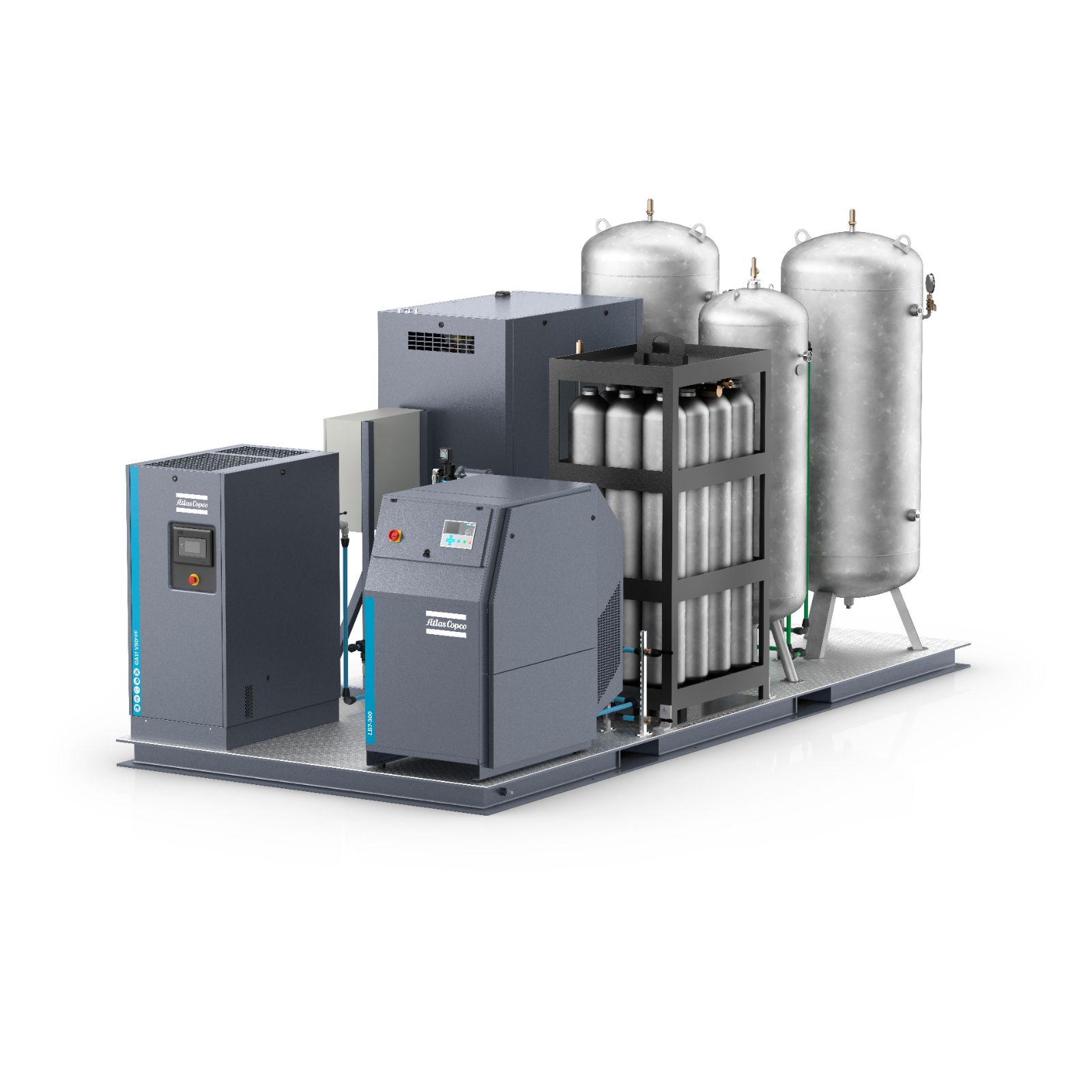
High pressure skids (HPN2)
All-in-one plug-and-play skids for high-pressure applications like laser cutting.
- 95-99.999% purity
- 9.9-101 m³/hr
- 40-300 bar
Key details
- Purity range 95 to 99.999%
- Flow range 9.9 to 101 m³/hr
- Pressure up to 40-300 bar(g)
- Compressor, dryer, filters, generator and booster in one skid

24/7
remote monitoring
Intelligent control
Automated control and remote monitoring
Atlas Copco generators are managed by the Elektronikon Touch controller, which optimises performance, monitors feed-air quality to protect the system, and verifies nitrogen purity in real time.
Every solution is compatible with SMARTLINK remote monitoring, so you (and us, with your permission) can check status 24/7 from any device. It enables proactive service and sends alerts before a fault leads to downtime.
Talk to an engineer
Free feasibility study
Find out what you could save
Tell us your bottle counts, bulk tank invoices, nitrogen usage, purity and pressure. We will size a generator, estimate running costs and show the likely return on investment, with no obligation.
Nitrogen generator FAQs
Common nitrogen generation questions
What are the benefits of on-site nitrogen generation?
On-site nitrogen generation, particularly through industrial gas solutions, offers a plethora of advantages across various industry sectors. Optimised for efficiency, reliability, and cost-effectiveness, these solutions revolutionise the supply of nitrogen, providing a steady stream of high-purity nitrogen gas tailored to specific needs. Let’s delve into the benefits:
1. Cost Efficiency: On-site nitrogen generation eliminates the need for purchasing bottled nitrogen or liquid deliveries and eliminates the hassle of managing rental contracts and delivery schedules. With a nitrogen generator, businesses can significantly reduce their industrial gas costs by producing gas on-demand at a much lower cost per unit of traditional supply methods. This cost saving becomes even more pronounced over time as the initial investment in the generator is quickly offset by the reduced operational expenses.
2. On-Demand Production: Nitrogen generators offer the flexibility of producing nitrogen gas as needed, eliminating the need for bulk storage and minimizing the risk of running out of gas. Whether it’s a continuous manufacturing process or intermittent usage, on-site generation ensures a constant and reliable nitrogen supply, reducing downtime and optimizing production efficiency. Moreover, users have full control over the flow rate and purity of the generated nitrogen, allowing them to adjust output according to specific requirements.
3. High-Purity Output:
Modern nitrogen generators are capable of producing high-quality nitrogen with purity levels ranging from 95% to 99.999%, meeting the stringent demands of various applications. Whether it’s food packaging, electronics manufacturing, or pharmaceutical production, the high purity nitrogen generated on-site ensures product quality, consistency, and compliance with industry standards. With advanced filtration and separation technologies, nitrogen generators can remove impurities and contaminants from the air, delivering ultra-pure nitrogen suitable for even the most sensitive process applications.
4. Environmental Sustainability: On-site nitrogen generation offers environmental benefits by reducing the carbon footprint associated with transportation, storage, and disposal of nitrogen cylinders. By producing nitrogen gas on-site, businesses minimize the need for fossil fuel-powered delivery trucks and reduce greenhouse gas emissions. Additionally, many nitrogen generators consume less energy compared to traditional cryogenic separation methods, further enhancing their environmental sustainability.
5. Space Optimisation: Nitrogen generators are compact and space-efficient, making them ideal for installations where space is limited. Unlike bulky nitrogen cylinders or cryogenic tanks, which require dedicated storage areas and safety precautions, nitrogen generators can be installed on-site, indoors or outdoors, without occupying valuable floor space. This compact footprint not only reduces storage costs but also enhances workplace safety and organisation.
6. Minimal Maintenance Requirements: Modern gas generation solutions are designed for reliability and ease of maintenance, requiring minimal upkeep compared to traditional nitrogen supply products. With robust construction and automated operation, nitrogen generators have fewer moving parts and lower susceptibility to mechanical failures, reducing downtime and service costs. Routine maintenance tasks such as filters replacement, and system checks can be easily performed by trained personnel, especially as part of a scheduled service plan, ensuring continuous operation and optimal performance.
What is a nitrogen generator and how does it work?
What is a Nitrogen Generator?
A nitrogen generator is a device designed to produce high purity nitrogen gas from ambient air. It’s an efficient and cost-effective alternative to traditional methods of nitrogen supply such as cylinders or liquid nitrogen.
How Does a Nitrogen Generator Work?
- Air: The process begins with the intake of ambient air, which contains approximately 78% nitrogen and 21% oxygen, along with trace amounts of other gases. This air is drawn into an air compressor.
- Compression: The air is then compressed to increase its pressure. Crucially, this compressed air feed must be clean and dry before it enters the generator. It is passed through an air dryer and a series of high-efficiency filters to remove all water vapor, oil aerosols, and particulates, which would otherwise damage the generator’s separation medium.
- Separation: The clean, dry compressed air is directed into a separation module. The two main types of technology are nitrogen membrane and PSA: Membrane: In nitrogen membrane generators, the compressed air is passed through modules containing thousands of tiny, hollow polymer fibers. These fibers allow smaller oxygen and water vapor molecules to permeate through the fiber walls more readily than larger nitrogen molecules, resulting in a stream of high purity nitrogen-enriched gas at the outlet.
- Pressure Swing Adsorption (PSA): In a nitrogen generator with PSA technology, the separation module contains two identical beds of adsorbent material, usually a Carbon Molecular Sieve (CMS). Compressed air is directed through the first bed under pressure. The CMS selectively adsorbs oxygen molecules, allowing the larger nitrogen molecules to pass through as the product gas.
- Product Gas Output: After separation, the nitrogen-enriched gas is collected as the product gas. This gas typically has a purity level ranging from 95% to 99.999%, depending on the specific requirements of the industrial application.
What is the life expectancy of a nitrogen generator?
A high-quality Atlas Copco nitrogen generator is designed for long-term industrial use. With proper service and maintenance, these gas generation solutions can last for 15 to 20 years or more. The longevity of the system depends heavily on the quality of the compressed air supply (ensuring clean, dry air enters the unit) and adherence to a regular service schedule for filters and consumable parts.
What applications is a nitrogen generator used for?
Nitrogen generators play a crucial role across a wide range of industries, offering a reliable and cost-effective source of high purity nitrogen gas. Here are some common applications (though there are various industrial applications):
- Food Packaging: Nitrogen is extensively used in the food packaging industry to displace oxygen and create a modified atmosphere within packages.
- Electronics Manufacturing: In electronics manufacturing processes such as soldering and wave soldering, nitrogen is used as a shielding gas to prevent oxidation and improve solder joint quality.
- Laser Cutting and Welding: High-pressure nitrogen is widely used as an assist gas in laser cutting and welding applications.
- Pharmaceutical Manufacturing: In the pharmaceutical, nitrogen is employed for various applications such as blanketing, purging, and inerting.
- Chemical Processing: Nitrogen plays a critical role in chemical processing applications where inert atmospheres are required to prevent undesired reactions, protect sensitive materials, and maintain product quality.
- Oil & Gas Industry: In the oil and gas, nitrogen is utilized for various well stimulation, pressure testing, and purging applications.
- Laboratory and Analytical Instrumentation: In laboratories and analytical facilities, nitrogen generators provide a convenient and reliable source of high purity nitrogen gas for various applications.
What are the running costs of a nitrogen generator?
Nitrogen generators offer a cost-efficient solution for businesses requiring a steady supply of high purity nitrogen gas. While the initial investment in a nitrogen generator is a significant consideration, it’s essential to understand the ongoing running costs associated with these solutions. Optimized for efficiency and reliability, nitrogen generators offer several advantages that translate into long-term cost savings. Let’s delve into the key factors influencing the running costs:
- Energy Consumption: The primary ongoing cost associated with operating a nitrogen generator is energy consumption. Nitrogen generators typically require electricity to power the air compressor, filtration systems, and other components involved in the gas separation process.
- Maintenance and Service: Another consideration for running costs is maintenance and service expenses. While nitrogen generators require periodic maintenance to ensure optimal performance and longevity, modern solutions are engineered for reliability and ease of maintenance.
- Consumables and Spare Parts: Nitrogen generators may require the periodic replacement of consumable components such as filters, adsorbent materials (in PSA units), seals, and O-rings.
- Nitrogen Purity and Efficiency: The purity level of the nitrogen produced by the generator can also impact running costs.
- Lifecycle Costs: When evaluating the running costs of a nitrogen generator, it’s essential to consider the total lifecycle costs over the solution’s operational lifespan. While upfront capital expenditures are significant, the total cost of ownership includes ongoing running costs, maintenance expenses, energy consumption, and potential upgrades or replacements over time.
Resources
Brochures and downloads
Membrane (NGM) brochures
View brochuresPSA (NGP) brochures
View brochuresHigh pressure skids (HPN2)
View brochuresRequest a free consultation
Ready to generate your own nitrogen?
Tell Design Air your usage, purity, pressure and current supply cost. We will specify the right generator, quote the system and show your return on investment clearly.