
When clients report oil appearing in their compressed air system, the consequences can be severe. Contaminated products, damaged pneumatic equipment, and costly downtime. In oil-injected compressors, oil is essential for cooling and sealing, but it must be reliably separated from the air before it enters the distribution network. When that separation process breaks down, oil carryover becomes a serious operational and compliance risk.
Based on our experience supporting industrial clients across Scotland, oil carryover is rarely random. It is usually triggered by temperature instability, component failure, incorrect oil levels, or extended operation outside the compressor’s optimal load range.
This guide explains the most common causes of oil carryover, how contamination spreads through a system, and the engineering controls required to prevent it before downstream damage occurs.
What is Oil Carryover in Compressed Air Systems?
Oil carryover is the unintended passage of lubricant from the compression chamber into the air stream. In oil-injected compressors, oil is essential for sealing rotor clearances, cooling the air during compression, and lubricating high-speed bearings. A healthy system typically delivers air with an oil concentration of 1–3 mg/m³ before external filtration.
A pressure vessel and a coalescing separator element made of borosilicate glass fibres are used in the internal separation process. Centrifugal force takes out large amounts of liquid oil, while the filter media catches tiny aerosols through direct impact and Brownian motion. When this process doesn’t work, oil gets into the pipes as liquid slugs, mist, or hydrocarbon vapour.
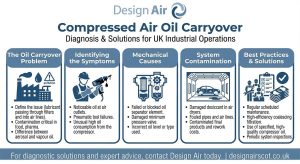
What are the Primary Causes of Oil Carryover?
Most oil carryover incidents happen because of mechanical problems, changes in temperature, or bad maintenance habits. To fix the problem properly, you need to know what caused it.
1. Reservoir Overfilling
Overfilling the oil sump reduces the available volume in the separation zone of the reservoir. When the liquid level is too high, the turbulent surface of the lubricant sits too close to the discharge outlet. This proximity allows liquid oil to be splashed or drawn directly into the separator element. The element becomes overwhelmed by bulk liquid, causing oil to bypass the filter media and enter the air line.
2. Thermal Instability
Elevated operating temperatures above 85–95°C reduce oil viscosity, which increases oil mist and raises the risk of carryover. Thinner oil aerosolises more easily, creating a higher concentration of sub-micron particles that the separator element cannot trap. High temperatures also accelerate oil oxidation and foaming. Foam is significantly lighter than liquid oil and migrates through the separator media into the downstream system.
3. Scavenge Line Failure
The scavenge line returns coalesced oil from the bottom of the separator element back to the compressor intake. If this line becomes blocked by debris or the one-way check valve fails in the closed position, the trapped oil has no exit path. The oil accumulates within the separator housing until it reaches the discharge port. This results in a sudden, massive “slug” of oil entering the air network.
4. Minimum Pressure Valve (MPV) Malfunction
The Minimum Pressure Valve ensures the compressor maintains a baseline internal pressure, typically 4 bar, during operation. This pressure is critical for controlling air velocity through the separator element. If the MPV fails to maintain this pressure, air velocity spikes. The increased speed pulls oil mist through the separator media before it can coalesce into droplets.
5. Extended Light-Load Operation
Variable Speed Drive (VSD) compressors running below 20–30% capacity for long periods increase carryover risk. Low motor speeds result in lower internal temperatures and reduced air velocity. These conditions prevent the centrifugal separation stage and the scavenge system from reaching peak efficiency. Sustained light-load operation allows oil mist to linger in the discharge stream rather than returning to the sump.

What are the Consequences of Oil Contamination?
Oil carryover acts as a chemical solvent and a biological nutrient once it enters the distribution network. The impact varies by industry but consistently increases the total cost of ownership.
- Death of Desiccant: Oil reaching a desiccant dryer coats the adsorbent beads. This blocks the pores of the desiccant and permanently destroys its ability to remove moisture.
- Pneumatic Component Failure: Oil degrades the seals and O-rings in pneumatic cylinders and valves. This causes components to swell or harden, leading to air leaks and sluggish operation.
- The “Fisheye” Problem: In automotive spray painting, microscopic oil droplets repel paint. This creates circular craters known as fisheyes, requiring expensive rework.
- Microbiological Growth: In food production, oil and moisture provide a substrate for bacteria and fungi. This creates a risk of product recalls and legal penalties under the Food Hygiene (England) Regulations 2005.
Technical Specifications for Oil Separation Efficiency
| Component / Parameter | Normal Operating State | Impact of Deviation |
| Discharge Temperature | 85°C – 95°C | Higher temps cause thinning and foaming |
| Differential Pressure ΔP | < 0.8 Bar | High ΔP indicates element failure |
| ISO 8573-1 Class 1 Limit | ≤ 0.01 mg/m³ | Exceeding limit risks product spoilage |
| ISO 8573-1 Class 2 Limit | ≤ 0.1 mg/m³ | Exceeding limit risks equipment damage |
How Can Businesses Prevent Oil Carryover?
Preventative maintenance and the use of genuine components are the most effective ways to manage air quality.
Use Genuine Separator Kits and Lubricants
Atlas Copco GA and VSD+ units require genuine parts to maintain OEM performance. Non-original separator elements often lack the required density of borosilicate fibres, leading to premature saturation. Using Atlas Copco Roto Xtend Duty Fluid is also vital. This synthetic lubricant is engineered to resist foaming during the rapid pressure fluctuations common in VSD machines.
Implement Remote Monitoring and Diagnostics
The Atlas Copco SMARTLINK system tracks filter pressure differentials and thermal trends in real-time. This allows maintenance teams to identify a failing separator or a temperature spike before a major oil blowout occurs. Furthermore, the Elektronikon controller provides specific alarm codes for high differential pressure, allowing operators to replace separators before they reach the end of their 8,000-hour functional life.
Install Downstream Filtration
While the internal separator is the primary defence, coalescing and particulate filters are necessary for high-purity applications. High-efficiency filters (such as the Atlas Copco UD+, DD+, or PD+ series) capture remaining aerosols and vapours. These must be changed at appropriate intervals to prevent the filter itself from becoming a source of contamination.
UK Regulatory Standards for Air Quality
Compressed air quality in the UK is governed by the ISO 8573-1:2010 standard. This framework categorises air by the concentration of particles, water, and oil.
- Class 0: Specified by the user. This is the highest standard, requiring zero oil contamination. It is typically achieved through oil-free compressors like the Atlas Copco ZR or ZT series.
- Class 1: Total oil concentration ≤ 0.01 mg/m³. Required for direct food contact and high-end finishing.
- Class 2: Total oil concentration≤ 0.1 mg/m³. Suitable for indirect food contact and precision manufacturing.
Compliance with the Pressure Systems Safety Regulations 2000 (PSSR) also requires regular inspection of air receivers. Oil accumulation in these vessels increases the risk of “dieseling” or spontaneous combustion, a leading cause of pressure vessel failure.
Diagnostic and Remediation Protocols
If oil is discovered in air lines, a standard filter change is insufficient. A full system recovery plan must be executed to protect downstream equipment.
- System Decontamination: Draining the oil reservoir and cleaning the separator vessel to remove carbonised deposits.
- Scavenge Line Inspection: Clearing the scavenge orifice and replacing the check valve to ensure the return path is functional.
- Filtration Refresh: Replacing all internal and external filter elements, including coalescing stages.
- Air Quality Validation: Performing an ISO 8573 air quality test to quantify oil levels and confirm the system has returned to its target class.
- Engineering Audit: If the cause is unclear, a professional compressor repair service should conduct a diagnostic audit to check MPV settings and motor load profiles.
Expert Perspective: Technically Oil-Free vs Class 0
In a technical sense, oil-free air is very different from certified Class 0 air. Oil-injected compressors use several stages of filtration to make air that is technically free of oil. This setup works, but there is still a risk of oil carryover if a part breaks or maintenance is put off. In industries where risk is unacceptable, like making drugs, oil-free compressors are the only way to guarantee that there will be no oil contamination.
Summary: Maintaining System Integrity
Temperature differences, overfilling, or worn parts are the most common causes of oil carryover, which is a mechanical failure that can be avoided. Following an 8,000-hour service schedule and keeping an eye on system health with SMARTLINK keeps the air clean and protects assets downstream.
Design Air (Scotland) Ltd’s engineers work out of Airdrie and can quickly respond to problems and diagnose them in Glasgow, Edinburgh, and the central belt.
Are you concerned about oil contamination in your production line?
Book an ISO 8573 air quality test to quantify oil levels and confirm compliance before product quality or equipment is affected. Contact us today.