

When a client contacts us about an air compressor that won’t reach or maintain pressure, the impact is usually already being felt on site. Reduced tool performance, rising energy costs, or unplanned production downtime. For most industrial operations, unstable compressed air pressure is not a minor inconvenience but an early warning that part of the system is no longer operating efficiently or safely.
In our experience working with clients across Scotland, pressure problems always come down to one of two issues: the compressor cannot generate enough air, or the downstream system is consuming more air than it should. Leaks, control faults, mechanical wear, and artificially high pressure setpoints are common contributors.
This guide explains how to determine whether the problem lies with the compressor itself or with the wider air network, enabling the appropriate fix before pressure loss escalates into a costly shutdown.
Is the Pressure Problem Supply-Side or Demand-Side?
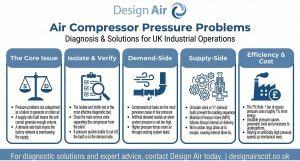
Correctly identifying the source of a pressure drop is the first step toward a solution. Pressure problems are categorised as either a failure to generate air or a failure to retain it. Operators must determine if the compressor is at fault or if the downstream factory network is overdrawing the supply.
The Isolate and Verify test remains the most effective diagnostic tool. You can cut off the compressor from the factory by closing the main service valve that connects the air receiver to the plant distribution network. If the compressor quickly builds up pressure to its cut-off point, the problem is on the demand side.
This indicates the plant is using more air than the compressor can produce, likely due to leaks or new machinery. If the compressor still fails to build pressure while isolated, the issue lies within the compressor unit itself.
The Hidden Cost of Artificial Demand
Artificial demand is a common but often overlooked cause of pressure problems. When the system pressure is set higher than it needs to be to make up for leaks or distribution losses, it uses more air than it needs to. Even though raising the pressure might seem like a quick fix, it actually speeds up wear and tear and isn’t very effective.
The 7% Rule serves as a vital benchmark: every 1 bar (approx. 14.5 psi) of excess pressure increases energy consumption by roughly 7%. High pressure forces more air through existing leaks and creates a higher pressure drop across filters. This creates a cycle where the compressor works harder and costs more to run, yet delivers less effective airflow to the point of use.

Diagnostic Failures in Rotary Screw Compressors
In day-to-day operation, a failure to build pressure in rotary screw machines, such as the Atlas Copco GA series, is frequently a control issue rather than a mechanical failure of the air end. These units rely on complex pneumatic circuits that must be carefully managed.
- Unloader Valve Faults: The unloader valve controls how much air comes in. The compressor will run, but it won’t make any pressure if the valve is stuck in the closed position.
- Y1 Solenoid and Elektronikon Issues: The Y1 solenoid opens the unloader when the Elektronikon controller tells it to. A broken electrical wire or a bad solenoid stops the loading sequence from starting.
- Minimum Pressure Valve (MPV) Failure: The MPV ensures the compressor maintains at least 4 bar internally for oil circulation. If the MPV is stuck open, air escapes to the plant before internal pressure is established. If stuck closed, internal pressure will rise until the safety valve blows, but no air reaches the discharge line.
Common Pressure Faults in Reciprocating Compressors
Rotary machines are used in most modern industries, but many Scottish businesses still need reciprocating or piston compressors. These units build up pressure by moving in a straight line. Most of the time, they fail because of physical wear.
- Valve Plate Wear: When the reed valves get carbonised or worn out, air can get back into the cylinder, which greatly lowers the Free Air Delivery (FAD).
- Gasket Failure: When the head gaskets blow, pressure leaks directly from the compression chamber, which stops the unit from reaching its cut-out pressure.
- Piston Ring Blow-By: Worn rings let air escape from the crankcase. When the motor is running, a common sign of this failure is that air is coming out of the crankcase breather.
Environmental Factors and Filtration Performance
The UK’s weather is different from other places in that it has high humidity and temperature changes throughout the year. This has a direct effect on the health of parts and the stability of pressure.
- Differential Pressure: Filtration is the first line of defence, but clogged intake filters restrict the volume of air the compressor can draw in. A dirty oil separator element acts as a plug, increasing differential pressure by several hundred millibars. This reduces effective airflow and can increase energy consumption by 10–15%.
- Condensate and Oil Emulsification: High humidity causes water to mix with the lubricant. This emulsified oil cannot seal the rotors effectively, leading to internal pressure loss and premature wear.
- Winter Freezing: Frozen condensate in control lines or drain valves is a leading cause of seasonal faults in Scotland. Ice blocks the pneumatic signals required to actuate the unloader valve, preventing the machine from loading during cold starts.
Safety, Compliance, and PSSR 2000
Beyond operational efficiency, maintaining stable pressure is a matter of legal compliance. In the UK, the Pressure Systems Safety Regulations 2000 (PSSR) govern the operation and maintenance of these systems.
A Written Scheme of Examination (WSE) defines the safe operating limits of the system. It is important to remember that pressure problems must never be solved by adjusting safety devices to mask underlying faults. Doing so constitutes both a major safety risk and a legal breach. Non-compliance with PSSR 2000 can result in Health and Safety Executive (HSE) prohibition notices or significant financial penalties for the business.
Professional Support and Maintenance
Professional intervention is often required when isolation tests confirm an internal compressor fault or when safety devices require recalibration. Design Air (Scotland) Ltd is an Atlas Copco Premier Distributor providing 24/7 compressor repair service with a 4-hour response time across the Central Belt.
If the pressure drops and production stops, our teams can use compressed air leak detection tools or emergency hire sets to get your air supply back up and running. Talk to an expert if you keep having problems with pressure. They can help you get things back to normal and make sure you’re following the Pressure Systems Safety Regulations 2000 (PSSR) right away.
Would you like me to make a 12-month schedule for preventive maintenance to help you avoid these pressure-related downtime events in the future?