

Compressed air systems are widely used in industrial settings. And where there is compressed air, you will be sure to find a leak. In fact, compressed air leak detection matters more than most facility managers realise.
Air compressors can perform a wide range of tasks, from the heavy lifting of moving parts around a production line to delicate processing and packaging tasks, or even generating highly pure gases for use in food and pharmaceutical processes. But its versatility also means that every compressed air system will contain multiple points which are susceptible to leaks. Whether it is a loose coupling or a failing seal, leaks in compressed air systems are a constant threat to efficiency.
The Cost of Compressed Air Leaks
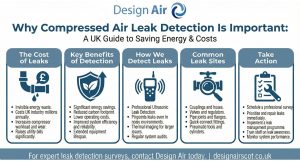
Air leaks can be costly, increasing your energy bills and, if left unaddressed, potentially leading to expensive maintenance expenses. Compressed air leaks waste energy, increase costs, and force compressors to work harder than necessary.
A simplified chain of events is:
- You have a hidden leak somewhere in your system.
- Your compressor works a little harder to compensate and maintain pressure.
- As your compressor works harder to maintain adequate pressure, this increases costs, wear and tear, and breakdown risks.
- Over time, new leaks develop. Eventually, the compressor reaches capacity and system pressure falls, leading you to believe that you require a larger / additional compressors.
Compressed air systems are designed to be robust. Leaks are inevitable, so a good system will tolerate even small leaks. However, even these can be costly. The most direct impact will be the energy loss.
An Atlas Copco study found that a 3 mm air leak will cost around £700–£1,000 a year in wasted electricity and result in 16 tonnes of CO₂ emissions. Overall, leaks can account for 20–40% of total air consumption in poorly maintained systems. This is why effective leak detection is essential.
By using a professional leak detection service, you can avoid declining performance and reduce energy costs, protecting your equipment and your bottom line.
The Safety Risks of Compressed Air System Leaks
The dangers of compressed air can be overlooked: it is just air, after all. However, ignoring air leaks can create hazards for your team.
High-pressure air is powerful, you only need to think about the tools it can power to recognise it is capable of damaging the human body. At high pressures, compressed air is capable of penetrating human skin and causing embolisms, even at lower pressure it can cause abrasions and cause damage to the more delicate parts of the human body like the eyes.
Compressed air can also be hot. Heating is a byproduct of the compression process, and the output from an industrial air compressor without an aftercooler is typically between 80°C and 180°C. Leaks from parts of the system where the air has not cooled can cause serious burns.
Leaks can also create indirect safety risks. Unreliable equipment may increase dangers if they are affected by air pressure drops.
The Environmental Impact of Compressed Air Leakage
The most direct impact will be the energy waste. Compressed air is an efficient way of transferring power, but leaks mean that some of that power is, literally, disappearing into thin air.
Air compressors consume approximately 10% of the UK’s industrial energy, and around 10–30% of that is estimated to be lost to air loss. It means that, collectively, even the smallest of leaks have an enormous impact on the UK’s carbon emissions.
However, leaks can have more direct impacts. Although the leaks are mainly air, other compounds can be present. Ambient pollution will be concentrated in the compressed air. In addition, depending on the system and location of the leak, other pollutants might have been introduced, such as oil from the compressor or corrosion from the distribution system, creating a polluted atmosphere for your workers.
In sectors like food and beverage or pharmaceuticals, hidden air leaks can compromise hygiene standards, risking contamination in sterile environments.

Leak Detection Methods
The old-fashioned ways of looking for leaks can be effective in some situations, but they often fail to identify hidden leaks.
Listening for the Escaping Air
Some leaks, especially larger ones, will be audible. Listening out for the tell-tale hiss generated by escaping air can help you locate individual leaks.
This may help if you only have large leaks, but this situation is rare, and most likely to occur after an accident has knocked and dislodged piping. Typically, if you have large, audible leaks, you will also have smaller, nearly undetectable leaks. Checking for audible leaks is also likely to require shutting off all other equipment except the compressor, which can cause disruption.
Using Soapy Water To Find Leaks
Soapy water can be used to identify leaks, especially around joint fittings and valves – a familiar technique to anyone who has fixed a bicycle puncture.
By providing a visual indication of leaks from the bubbling, soapy water can be used during operations and can help locate smaller, inaudible leaks.
However, for anything but the simplest compressed air systems, it can be impractical due to the sheer amount of pipework to inspect. It is also difficult or impossible to use in areas where the piping is inaccessible.
Ultrasonic Leak Detection Surveys
To locate leaks without disruption, ultrasonic leak detection is the superior method. It can identify and accurately assess every leak by listening for an ultrasonic hiss, which is outside the human range of hearing. Able to ‘hear’ otherwise hidden areas, ultrasonic leak detectors are better than other methods because they can detect leaks in inaccessible piping and joints.
Working in the ultrasonic range, the leak test can be conducted even with the background noise of your normal operations, allowing you to avoid time-consuming and costly disruptions. Advanced ultrasonic detection equipment allows us to find leak points that manual methods miss.
The result is a detailed report of the leaks in your system, including both the leak location and cfm wastage, so that you can prioritise repairs. Every leak is tagged, and the report includes an estimated cost of the energy wasted caused by a leak.
Atlas Copco Leak Detection Solutions
As experts in the field, we utilize industry-leading Atlas Copco leak detection systems to ensure maximum accuracy.
AIRScan Leak Detection
AIRScan uses advanced ultrasonic detection tools to locate leaks across your entire distribution network. This service provides a comprehensive leak audit, pinpointing energy saving opportunities and offering a clear path to reduce energy consumption.
SMARTLINK Remote Monitoring
Atlas Copco’s SMARTLINK platform integrates with your compressors to track performance in real-time. It can detect inefficiencies and issue alerts for leak-related anomalies, ensuring that you can address leaks promptly before they become expensive problems.
VSD Compressors for Leak Compensation
While fixing leaks is the priority, upgrading your equipment can also mitigate losses. An Atlas Copco VSD air compressor (Variable Speed Drive) automatically adjusts motor speed to match air demand. This means that if leaks are present, the VSD compressor minimizes the energy wasted compared to fixed speed compressors, further enhancing vds air compressor energy savings.
Compliance and UK Regulations
Regular leak detection is not just about saving money; it is also about compliance. In the UK, systems must adhere to strict standards:
- ISO 8573-1: Governs compressed air quality. Leaks can introduce contaminants, impacting your ability to comply with Class 0 or Class 1 purity standards.
- ESOS (Energy Savings Opportunity Scheme): For large UK businesses, leak detection contributes significantly to compliance, reducing your carbon footprint and supporting Climate Change Agreements (CCAs).
Start Your Regular Leak Detection Programme
Leaks are inevitable in any compressed air system, and the initial, small leaks will only have a negligible impact on your operations. However, left unaddressed, they can degrade the quality of your compressed air, adding to your costs and increasing the risks of lower productivity and costly breakdowns due to air leakage.
Comprehensive leak detection and repair is the best way to avoid this and maintain your compressor at optimal efficiency. We use the latest ultrasonic air leak detector equipment, allowing us to quickly pinpoint leaks in your system, providing you with a thorough audit. What is more, we can usually conduct an audit without a single second of downtime, so there is no disruption to your business.
Our leak detection solutions are one of our most valued services and, as our customers can attest, an investment in your system. You will save more in energy costs than our regular audit costs.
Design Air is an expert in compressed air, whether it involves installation, servicing, or detecting and fixing leaks. Whatever your compressed air needs,please get in touch and discover how Design Air can assist you with reliable air leak detection systems.