
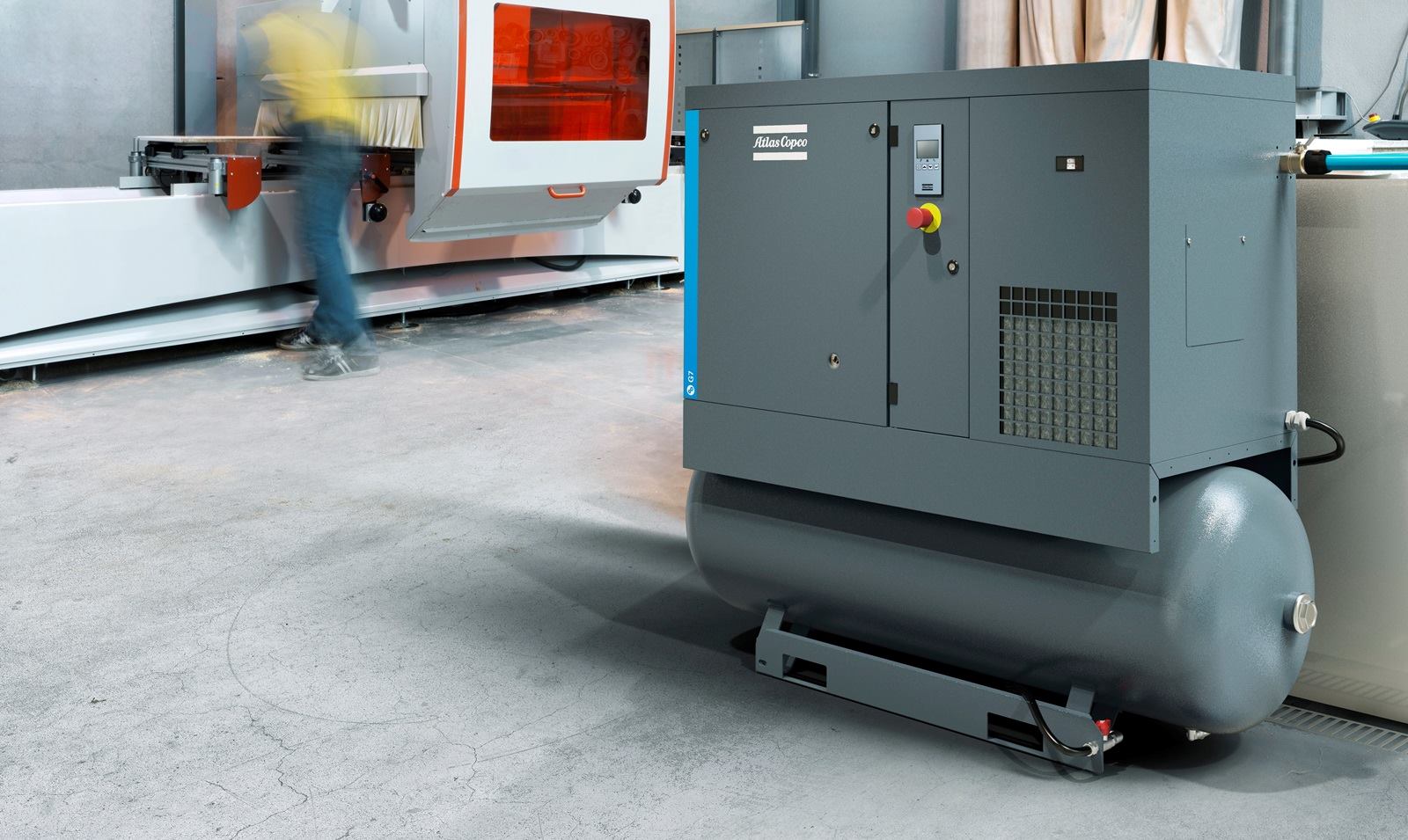
Excessive compressor noise from a conventional machine is a fact of life in most industrial and commercial applications. However, it’s not just an irritation; it is a quantifiable, regulated workplace hazard that directly impacts safety, employee health, and productivity. Low noise (quiet) compressors are specifically designed to run at 60–70–75 dB(A) and below, making them virtually noiseless and ideal for noise-sensitive industrial areas such as labs, clinics, and workshops etc.
Unwanted sound has a cost to all areas of business in Scotland, and this cost can be split into three areas: legislative responsibility, health and safety, and production efficiency. Reducing noise pollution isn’t just about comfort; it’s about compliance and profitability.
This guide will give you the technical information you need to make an informed choice about whether to invest in a quiet compressor. Learn what makes a compressor ‘quiet’, why it is important for your business, and how to choose the right model for your application.
UK Legal Requirements: The Control of Noise at Work Regulations 2005
Employers are legally required to adhere to the UK Control of Noise at Work Regulations 2005 to control noise at work. The laws regulating industrial noise set the point at which legal responsibilities are triggered. A given dB level will require a particular degree of protection for your workers.
The dB scale is a logarithmic scale. Don’t be deceived by small numbers; the difference between a compressor that is 85 dB and one that is 65 dB is not small. In fact, it is 100 times more powerful and your ear will hear it as 4 times louder. That’s the difference between a busy road and a conversation.
| Sound Source | Typical Decibel (dB) Level |
| Whisper | 30 dB |
| Atlas Copco Quiet Scroll Compressor | 52 dB |
| Normal Conversation | 60 dB |
| Conventional Reciprocating Compressor | 85 dB |
- Lower Exposure Action Value: 80 dB(A): The employer is required to formally assess the risk, provide information and training about the noise, and make hearing protection available.
- Upper Exposure Action Value: 85 dB(A): At this point in noise in the workplace, employers have a legal duty to take practical action to reduce the noise (i.e. with engineering controls). Hearing protection becomes mandatory if the noise cannot be reduced, and “hearing protection zones” are now required.
As the majority of “standard” loud air compressors operate at 85 dB(A) or more, they immediately create a legal burden and become an ongoing compliance issue for businesses.
The Hidden Costs: Health, Safety, and Productivity
It is no secret that industrial working environments can be noisy, and the noise produced by traditional air compressors can pose a significant workplace hazard.
- Health: Exposure to noise levels at or above 85 dB over extended periods is the main cause of the irreversible condition, Noise-Induced Hearing Loss (NIHL).
- Safety: Loud environments can make it challenging, or even impossible, for staff to hear important sounds such as fire alarms or verbal warnings. The inability to hear and respond to warnings significantly increases the risk of preventable workplace accidents.
- Productivity: Loud noise has a cognitive blocking effect, which interferes with concentration, increasing the likelihood of mistakes, reducing efficiency, and lowering the morale of employees.

How Are Quiet Compressors Engineered for Low Noise?
Modern, quiet air compressors achieve their low decibel readings through deliberate and targeted engineering designed to address each source of noise and then significantly dampen it. It’s not simply a standard compressor enclosed in a box. Their exceptionally quiet performance comes from an integrated system of advanced technologies designed precisely to deliver low noise levels.
Core Compression Technologies
The single most important factor in reducing the noise produced by quiet air compressors is the core compression technology used. Different air compressor types offer varying levels of silence:
- Scroll Compressors: This is the quietest air compressor technology available, with some models operating at as low as 52 dB. Scroll compressors use two spiral elements, one stationary and one orbiting. This design has fewer moving parts and, as a result, generates almost no vibration. Premier Distributors, Design Air (Scotland) Ltd, provide expert guidance on the full range of Atlas Copco oil-free silent air compressors, which are the ideal choice for ultra-quiet, oil-free performance in dental and laboratory environments. The Atlas Copco SF and SF+ series are the gold standard here.
- Rotary Screw Compressors: The workhorse of modern industry. This design uses two intermeshing screws which rotate smoothly, producing far less vibration and mechanical noise than piston models can. These oil-injected screw compressors are engineered for a 100% duty cycle and are perfect for continuous industrial applications. Models like the Atlas Copco G and GX series utilize acoustic canopies to dampen sound frequencies specifically generated by the screw element.
- Piston Compressors:Traditionally, the loudest type of compressor, modern quiet piston models (like the Atlas Copco LFx) have motors with low RPM, advanced balancing, and enclosures, which reduce noise enough for comfortable intermittent use in smaller workshops.
Key Design Features Achieving Noise Reduction
There are several critical features that contribute to quiet air compressor operation, which go beyond their core technology.
- Acoustic Enclosures: The housing for most quiet industrial compressors is a steel canopy which is lined with a fire-retardant, high-density acoustic foam which absorbs sound waves.
- Anti-Vibration Mounts: These rubber, or spring, mounts isolate the compressor from the floor, preventing the compressor’s vibrations from amplifying through the building’s structure, acting as a giant sound box.
- Variable Speed Drive (VSD) Impact: VSD air compressors don’t just cut energy costs; they also reduce noise. By precisely adjusting motor speed to match air demand, they often operate at a lower RPM for longer periods. When compared to fixed speed compressors, which constantly stop and start at full power, there is a substantial reduction in mechanical noise. The Atlas Copco GA VSD+ series, with its vertical iPM motor, is a prime example of an extremely quiet model that eliminates gear whine.
- Oil Lubrication vs. Oil-Free: Overall, oil-lubricated compressors are typically quieter than their oil-free counterparts in any technology, as the oil reduces friction and dampens sound. But in more sensitive industries like food and beverage, medical, and electronics, there are strict requirements for certified oil-free air compressors to guarantee 100% air purity and prevent contamination.

A Guide to Strategically Selecting a Silent Air Compressor
Choosing the best quiet compressor for your application is a multifaceted, strategic decision that must include consideration of your business’s particular operational needs. You must consider when selecting a silent model whether you need a dedicated compressor room or a point-of-use installation.
Step 1: Calculate Your Air Demand (PSI & CFM)
To calculate the air pressure (PSI) and air volume (CFM) your pneumatic tools require to operate, begin with your total CFM. Now add the requirements of all of the tools which could be expected to run simultaneously and then add a further 25-30% as a buffer to account for any potential future needs to ensure the compressor always runs efficiently. For higher air pressure needs, ensure the tank size allows you to store more air to prevent the motor from cycling too frequently.
Step 2: Define Your Workflow (Duty Cycle)
Consider how consistently you use compressed air in your business, as this is a key factor in deciding which air compression systems are appropriate.
- Intermittent Use: When tools are used in short bursts, they can be served comfortably by a piston compressor with a 50-75% duty cycle.
- Continuous Use: When your business uses manufacturing lines and other processes that need a constant clean air supply, these applications will necessitate a rotary screw or scroll compressor with a 100% duty cycle.
Step 3: Calculate the Total Cost of Ownership (TCO)
The initial purchase price is only one part of the equation when you look for compressors. With energy consumption accounting for up to 75% of the TCO, this is of chief concern when calculating TCO.
A variable speed drive air compressor from a premium brand like Atlas Copco may have a higher initial purchase price, but by reducing energy use by up to 60% will deliver a much lower total cost of ownership over its lifetime. This makes it a sound financial investment for any business with fluctuating air demand.
Maintenance for Quiet Operation
Running air compressor systems quietly cannot be achieved by simply buying a quietest compressor alone. Maintaining low-noise levels is achieved through professional installation and regular maintenance. Without regular maintenance, even the most expensive systems will become increasingly noisy over time due to the noise-failure correlation.
Follow these tips to keep your system running quietly:
- Check and tighten all fasteners to prevent rattling.
- Replace clogged intake filters to prevent motor strain, “gasping” sounds, and added noise.
- Inspect your anti-vibration mounts for wear.
- Monitor oil levels: In lubricated air compressors, oil acts as a sound barrier. Low oil leads to increased friction and mechanical clatter.
Finally, even the most modern systems can be retrofitted with remote monitoring technology like SMARTLINK, which notifies our team in advance of problems, like abnormal vibration, before these issues can develop into increased noise or a costly breakdown. Regular, proactive servicing is the only way to ensure you can rely on your air compressor to perform the way it should. Design Air (Scotland) Ltd’s tailor-made maintenance plans keep compressors as quiet and efficient as the day they were built for businesses all over Scotland, from Glasgow to Edinburgh and everywhere in between.
Investing in a quiet air compressor is an investment in the safety and compliance of your entire operation. By removing the need for a separate compressor room, you can place ultra-quiet compressors closer to the point of use, saving on pipework and installation costs.
The gentle hum of a modern air compressor is the sound of a safer, more profitable business, with a system that will pay dividends for years.
Frequently Asked Questions
What decibel level is considered a quiet air compressor?
Generally, a compressor operating between 60–70 dB(A) is considered quiet. Units below 60 dB(A), such as the Atlas Copco SF Scroll series, are considered ultra-quiet.
Are oil-free compressors quieter than oil-lubricated ones?
Typically, oil-lubricated compressors are quieter because the oil dampens mechanical sound. However, modern oil-free scroll compressors are an exception, offering completely silent operation for medical and dental use.
What UK laws regulate air compressor noise?
The Control of Noise at Work Regulations 2005 requires employers to assess risks if noise reaches 80 dB(A) and take immediate action to reduce noise at the source if it exceeds 85 dB(A).
Speak to Scotland’s Quiet Compressor Experts
If you have a short-term need or a temporary down unit, inquire about our hire equipment and keep your productivity high.
Consult with Design Air’s experienced team for a site survey and silent compressor recommendation to suit your space, noise targets, and air requirements.
Schedule your complimentary site survey today and experience the difference.