
Businesses all over the UK rely on the dependable delivery of clean compressed air to their tools and processes, and deciding whether that delivery system should be comprised of oil-lubricated or oil-free air compressors isn’t just a case of weighing the initial costs. The compressed air system you choose could determine not only the quality and purity of your products, but also your company’s legal compliance and long-term operating costs.
To make an informed decision on choosing the right air compressor, you need to understand the functional differences in engineering between the two types of air compressors. We hope this detailed resource will assist UK business owners, engineers, and plant managers with the technical decision-making needed to make a sound investment.
What Is the Difference Between Oil-Injected and Oil-Free Air Compressors?
The main difference between oil-free and oil-lubricated air compressors lies in how they handle heat and friction, as well as how they seal the air compression cycle from potential contaminants. Understanding these differences is vital when choosing between oil-free and oil-lubricated models.
Oil-Injected Air Compressors
An oil-injected, or oil-lubricated compressor, is the standard workhorse of general industry. Examples include the Atlas Copco GA, GX, and G-series rotary screw compressors. As its name implies, this design introduces a lubricant directly into the compression chamber. This oil is used to serve three vital functions:
- Lubrication: It forms a film on moving parts (the rotary screws) to minimise friction and wear.
- Sealing: It creates a hydraulic seal between the rotors and the housing to stop air leakage and maximise efficiency.
- Cooling: It absorbs the large amount of heat created during compression to allow the machine to be run continuously under heavy loads.
The robustness of this type of design generally equates to a longer working life under heavy-duty work, but an inevitable by-product of this system is that a small amount of oil (in aerosol and vapour form) will be carried over into the final compressed air. While oil-lubricated air compressors are often more energy-efficient initially, they require regular oil changes and filter replacements to manage this carryover.
Oil-Free Air Compressors
In an oil-free compressor, simply put, oil is not added to the compression chamber. Oil-free air compressors still use lubricant for gears and bearings, which are completely isolated from the air path by means of high-performance seals. The term ‘Oil-free’ here only refers to the air compression chamber, and not the compressor as a whole.
Oil-free compressors, such as the Atlas Copco ZR, ZT, and scroll series (SF), work by using technologies such as self-lubricating piston rings (e.g. those made from PTFE), precision-engineered rotors with special oil-free coatings, or contact-free scroll designs. The compression chamber’s isolation from the rest of the system ensures that compressed air is delivered without oil contaminants.
The maintenance focus is also different. In oil-lubricated systems, the biggest maintenance items are consumables like the oil filter and separator, which must be frequently replaced. In oil-free systems, the maintenance focus is on mechanical integrity and inspection of critical components to ensure the range of oil-free and oil-lubricated compressors operate at peak efficiency.
Air Quality, Compliance, and Risk
The reliable delivery of clean air is a necessity for most industries today, especially where air purity is critical. The International Organisation for Standardisation introduced the ISO 8573-1:2010 to standardise compressed air purity classes based on their concentration of solid particles, water, and total oil.
The Myth of “Technically Oil-Free”
ISO 8573 Class 0 is the highest standard and is the strictest. A Class 0 certification, which Atlas Copco is the first to have achieved, gives a validated assurance of 100% oil-free air. Only a compressor designed to be completely free of oil can provide this level of purity, and thereby eliminate the risk of oil contamination from the compressor contaminating the compressed air.
Some attempt to create “technically oil-free” air by fitting an oil-lubricated compressor with multiple downstream filters (coalescing and carbon towers). Although this method can reduce oil content, it is an unsatisfactory, short-term solution that significantly risks contaminating the air supply, and those risks only increase over time. Temperature spikes can cause oil vapour to bypass filters, leading to “breakthrough” contamination.
Filtration systems add ongoing maintenance and energy costs and can fail or degrade over time. Filtration is mitigation, not elimination, and therefore not a shrewd investment in the long-term operation of your business if you need guaranteed purity.
Application Suitability: Matching the Compressor to Your Industry
The right type of air compressor depends entirely on the requirements of the end-use process and your specific compliance needs.
Food & Beverage
To prevent product spoilage, altered taste, and to comply with standards like BRCGS (British Retail Consortium Global Standards). Poor air quality can be a critical control point failure. An oil-free air compressor is essential here. You can learn more about the specific needs for Air Compressors in the Food and Beverage Industry here.
Pharmaceuticals and Medical
To ensure end products are effective and patient safety is not compromised, in processes like fermentation, tablet coating, and the powering of sterile surgical tools. Specific regulations like HTM 02-01 (Medical Gas Pipeline Systems) strongly favour oil-free systems to avoid toxic decomposition risks.
Electronics
To avoid deposits on sensitive components that can cause connection failures and product defects in cleanroom environments. Oil-free compressors generally eliminate the static and insulation risks caused by oil trace.
Automotive Painting
To prevent surface imperfections like “fisheyes” that lead to costly rework. While some use filtered oil-lubricated air, the safest choice is oil-free.
General Industrial & Automotive Servicing
For powering pneumatic tools, operating machinery, and providing general “plant air” where trace amounts of oil are not detrimental, and durability is paramount. In these cases, oil-lubricated compressors are ideal for heavy-duty workloads.
Beyond the Purchase Price: A Total Cost of Ownership (TCO) Comparison
The initial purchase price of a compressor is only a fraction of its lifetime cost. A true TCO analysis typically breaks down as:
- Energy Costs: ~75%
- Maintenance Costs: ~15%
- Capital Investment: ~10%
An oil-lubricated compressor may have a lower upfront cost, but this is often offset by higher recurring expenses. For example, oil-lubricated systems can incur £2,000–£5,000 per year in extra consumable and filtration-related costs depending on usage. Regular oil changes and separator checks are mandatory.
Conversely, an oil-free compressor has a higher initial capital cost but significantly lower consumable and maintenance expenses. CAPEX, energy, maintenance and legal compliance costs over a 10-year period can lead to an oil-free system delivering a lower TCO in purity critical applications. At Design Air (Scotland) Ltd, we provide our customers with best-in-class monitoring tools, such as SMARTLINK – Atlas Copco’s remote monitoring platform, to ensure optimal uptime, predictive maintenance, and energy tracking.

A Quick Comparison: Oil-Lubricated and Oil-Free
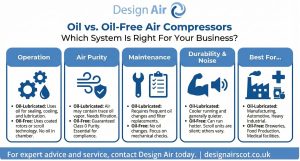
| Feature | Oil-Lubricated (e.g., GA Series) | Oil-Free (e.g., Z Series) |
| Air Purity | Requires extensive filtration; residual risk of oil contamination remains | Guaranteed and certified Class 0 air quality possible |
| Maintenance | Compressors require regular oil changes and filter replacements | Lower consumable costs; focus on mechanical integrity |
| Legal Compliance | Oily waste requires licensed, costly disposal (Hazardous Waste) | Clean condensate is simple and inexpensive to dispose of |
| Upfront Cost | Lower | Higher |
| Long-Term Cost | Higher operational expenditure (OPEX) | Often lower Total Cost of Ownership (TCO) |
| Ideal For | General industrial, workshops, construction | Pharmaceuticals, food & beverage, electronics |
UK Regulations and Standards for Compressed Air
Effective and regulation-compliant condensate management is crucial for any business operating in the UK. Under the Water Resources Act 1991 and the Hazardous Waste Regulations 2005, the condensate oil-lubricated air compressors produce (an emulsified mixture of oil and water) is classified as ‘hazardous waste’. Any breach of these regulations can result in fines of up to £20,000, or even the prosecution of company directors under UK environmental law.
In comparison to more traditional oil-lubricated methods, oil-free air compression systems are typically permitted to discharge their contaminant-free condensate directly into a foul sewer, thereby adhering to regulations and avoiding costly disposal practices.
Additionally, the UK government’s fiscal policy (such as “Full Expensing”) currently favours investment in efficient plant machinery, potentially subsidising the higher upfront cost of premium oil-free or VSD technology.
The final decision you reach on which air compressor technology is best for your business is most sensibly made through the objective analysis of your business’s air compression application. So, before choosing a compressor, we recommend assessing these six site-specific factors with a professional audit:
Air Purity Requirements
Does your process require a certified standard like Class 0? An ISO 8573-1 Air Quality Test can establish a baseline and ensure ongoing compliance where air purity is a top priority.
Usage Patterns
Is your air demand continuous or does it fluctuate? This will determine if a Variable Speed Drive (VSD) compressor is the most efficient choice to minimise your energy costs. Atlas Copco’s VSD+ models can reduce energy consumption by up to 50%.
Operating Environment
Do you plan to operate the compressor in a dry or humid environment? Will it be located in a sterile or dusty area? The quality of air at intake and the ambient temperature in the compressor’s environment will affect its performance and maintenance requirements.
Compliance Needs
Is your business governed by stringent regulatory standards, like those from the MHRA or BRC? This often dictates the need for Class 0 highest air quality as well as comprehensive air quality monitoring.
Space and Infrastructure
Oil-free scroll compressors, for example, operate significantly more quietly and have a smaller footprint than oil-lubricated alternatives and can provide additional comfort and efficiency benefits for your workforce.
Risk Tolerance
Can your business withstand an oil contamination event and remain profitable? What are the financial and reputational costs? This assessment is fundamental to choosing between risk mitigation (filtration) and risk elimination (oil-free) strategies. Effective pipework and system design are best made through a comprehensive analysis of your facilities.
How Does Atlas Copco Compare to Other Compressor Brands?
When comparing specific models, Atlas Copco leads with innovation. They were the first to achieve Class 0 oil-free certification. While brands like Kaeser and Ingersoll Rand offer competitive oil-free tech, Atlas Copco’s Z-series (ZR/ZT) often provides superior heat recovery options and integrated drying technology. Furthermore, the UK service network for Atlas Copco is extensive, ensuring that whether you use oil or oil-free compressors, support is readily available.
Summary: Making the Choice
When deciding whether oil-lubricated or oil-free compressors are the best investment for your business, consider your application’s requirements for air purity, your tolerance for potential air contamination events and their associated legal implications, and conduct a comprehensive analysis of the total cost of ownership.
When contamination is not an option, a certified oil-free system is the most secure investment in every case. For heavy-duty industrial work, on the other hand, a robust oil-injected machine is still an effective solution.
Frequently Asked Questions
What’s the difference between oil and oil-free air compressors?
The main difference is lubrication. Oil-lubricated compressors use oil in the compression chamber for cooling and sealing, while oil-free compressors rely on other cooling methods and tight mechanical tolerances to eliminate the need for oil in the air stream.
Do I need an oil-free compressor for food production?
Yes, it is highly recommended. Standards like BRCGS generally require air in contact with food to be free of contaminants. An oil-free compressor (Class 0) eliminates the risk of oil reaching your product.
How do I maintain an oil-lubricated air compressor?
Maintenance involves regular oil changes, replacing oil filters and separators, and checking scavenge lines to prevent oil carryover.
Do you need help deciding which compressor type is right for your business? Contact our specialists today for a free site evaluation and a quote tailored to your application.