

A Maintenance Manager at a Lanarkshire food packaging plant watches the Elektronikon® Nano™ Controller on their Atlas Copco GA 37 VSD flash a high-temperature shutdown at 14:47 on a Friday – 13 minutes before the weekend shift begins. Knowing how to prevent compressor breakdowns before this moment is the difference between a managed maintenance programme and a production crisis. Not always obvious.
At Design Air, as Atlas Copco Premier Distributors operating across Scotland and North East England, our engineers have seen every failure mode imaginable. This guide covers the true cost of downtime, the three root causes of failure, Scotland’s specific climate risks, a practical prevention plan, and what to do when a breakdown still happens.
What Is the True Cost of Compressor Downtime?
Compressor downtime costs far more than the repair invoice. Unplanned compressor downtime in UK manufacturing costs an average of £180 per minute in lost production. But the real financial damage comes from idle labour, missed delivery penalties, and premium freight charges to recover schedule costs that never appear on the maintenance budget.
A £2,000 repair can correspond to a £20,000+ total loss once production impacts are taken into account.
Beyond the Repair Bill: Calculating Your Downtime Cost
The formula is straightforward: Lost Revenue + Idle Labour Costs + Recovery Costs = True Downtime Cost. Most plant managers only see the first number.
Energy waste operates as a slow-motion breakdown. A single 6.4 mm air leak at 7 bar costs over £4,044 annually in wasted electricity at typical UK industrial rates. Our ultrasonic leak detection audits find these losses and frequently pay for themselves within weeks of the first survey.
The Hidden Cost: Compliance Exposure
Poorly maintained systems create regulatory exposure beyond energy waste. The Energy Savings Opportunity Scheme (ESOS) and ISO 50001 both need documented evidence of energy performance. ISO 11011 provides the methodology for compressed air energy audits.
The Pressure Systems Safety Regulations (PSSR) 2000 (hse.gov.uk) mandate a Written Scheme of Examination for pressure vessels – a structured process that also identifies potential failures before they occur.
The next section explains what actually causes those failures in the first place.
Why Do Compressors Really Break Down? The 3 Root Causes
Three failure modes account for the vast majority of compressor breakdowns: heat, lubrication failure, and mechanical wear. Understanding each one makes prevention straightforward.
Cause 1: Thermal Overload and Cooling Failure
Heat is the primary cause of failure in industrial compressors. Around 80-90% of the electrical energy consumed by a compressor motor converts directly into heat. This must be dissipated through oil coolers, aftercoolers, and thermostatic valves.
Here’s what most engineers miss: the cooling fan is not the brain of the cooling system – the thermostatic valve is. If this valve sticks closed, the cooler is bypassed entirely, and the compressor will trip on high temperature within minutes, even with a perfectly functioning fan. A £150 thermostatic valve service kit, missed at the 8,000-hour service, can cause a catastrophic air end seizure costing upwards of £15,000 to replace.
Rotor tip clearances in a rotary screw air end are typically 50-150 microns – thermal expansion from overheating closes that gap to zero.
Cause 2: Lubrication Breakdown
Oil performs four functions simultaneously: cooling, sealing, lubricating, and cleaning. Degraded oil forms varnish and sludge that coat internal surfaces, insulate components, and accelerate the very heat problem it was meant to solve.
Cause 3: Mechanical Wear on Belts and Bearings
Over-tensioning a V-belt by more than 10-15% above the manufacturer’s recommended static deflection force places excessive radial load on bearings, reducing L10 bearing life by up to 50%. Our factory-trained engineers identify these signs during routine servicing, replacing the thermostatic valve and belt assemblies before they cause a catastrophic failure.
Scotland’s climate adds a fourth threat that compounds all three.

How Scotland’s Climate Actively Tries to Break Your Compressor
Scotland’s high ambient humidity creates a condensate problem that accelerates every failure mode described above.
The Condensate Problem: Managing Moisture from Humid Air
A 55 kW compressor operating in typical 80% relative humidity – standard across Glasgow, Dundee, and Fife – can produce over 250 litres of water per day. This moisture washes away lubricant, corrodes air receivers, and overwhelms downstream equipment. ISO 8573-1 Class 4 water content needs a pressure dew point of +3°C – untreated ambient Scottish air fails this standard immediately.
Most operators assume compressor condensate can go straight to the drain. It can’t. This condensate is contaminated with oil and classified as hazardous waste.
Under the Water Environment (Controlled Activities) (Scotland) Regulations 2011 (CAR 2011), enforced by SEPA, discharging untreated condensate is a criminal offence. In the Scottish Sheriff Court, convictions can result in unlimited fines, plus remediation costs that routinely run to tens of thousands of pounds in contractor fees alone.
Winter Risks: Frozen Lines and Failed Drains
External pipework and automatic drains in unheated areas will freeze when temperatures drop, blocking control lines and bursting pipes. Our air quality testing service certifies systems to ISO 8573-1 standards, confirming that dryers and filtration are correctly specified for the moisture loads typical in Scottish facilities.
A structured prevention plan addresses all of these risks before they become failures.
Your Practical Prevention Plan: From Daily Checks to Predictive Tech
The 5-Minute Walk-Around: What Your Operators Must Check Daily
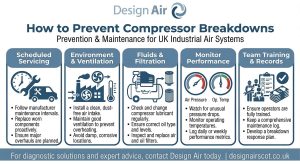
Before any physical check, operators must follow Lockout/Tagout (LOTO) procedures. The daily walk-around then covers four points: verify oil levels are within the sight glass range, manually test the condensate drain’s test button to confirm it’s discharging, listen for the hiss of air leaks, and check the Elektronikon® controller for any active warnings.
A fault code is the last line of defence – it means a parameter has already exceeded its limit. Predictive systems look for the rate of change, not the absolute value.
Beyond Prevention: How Predictive Monitoring Works
SMARTLINK – Atlas Copco’s remote monitoring platform – captures live data and can be configured to trigger an alert when oil temperature deviates more than 5°C above a rolling 30-day baseline, enabling intervention before the Elektronikon’s high-temperature shutdown activates at its 110°C limit. Our remote monitoring systems connect directly to your compressor and flag developing faults automatically.
Shock Pulse Monitoring (SPM) detects a 10% increase in bearing vibration trend over 30 days, allowing a planned replacement during scheduled downtime rather than an unplanned line stoppage. Optimiser 4.0 reduces mechanical stress across multiple machines by intelligently sequencing them.
Our compressor service plans cover the tiered schedule that underpins all of this: air filters and oil samples at 2,000 hours, full oil and separator element replacement at 4,000 hours, and unloader valve, Minimum Pressure Valve (MPV), and thermostatic valve overhaul at 8,000 hours.
What Happens When a Breakdown Is Unavoidable?
Even with a disciplined prevention programme, failures happen. When they do, the priority is not fixing the compressor – it’s restoring production.
A provider focused only on the repair might spend eight hours sourcing a rare part while the production line sits idle. Our compressor repair service operates on a different principle: a 4-hour response time for sites within 50 miles of our Airdrie depot, and a 24-hour guaranteed solution – meaning your machine is either repaired or a hire unit is installed and running in its place. For Atlas Copco GA VSD series machines, we carry critical parts on our service vehicles to avoid that sourcing delay entirely.
The goal is always the same: get your production back online as fast as possible. The broken compressor is secondary.
Before you call us, walk over to your compressor and check the service sticker. If the date is more than 12 months ago, your system is running on borrowed time. Design Air’s engineers cover Airdrie, Glasgow, Edinburgh, Dundee, Fife, Stirling, Perth, the Central Belt, and North East England. Book a no-obligation system health check with one of our engineers today.
Frequently Asked Questions
How to Prevent an Air Compressor from Exploding?
Modern compressors include multiple safety devices that make catastrophic failure rare. The real risk comes from neglected maintenance. The Pressure Systems Safety Regulations (PSSR) 2000 mandate a Written Scheme of Examination and periodic inspection by a Competent Person, covering safety valves and receiver tank integrity to keep systems safe.
What Causes a Compressor to Break?
The three primary causes are heat, contamination, and mechanical wear. Blocked coolers cause overheating – the most common failure mode. Degraded or contaminated oil loses its ability to lubricate and cool.
Worn belts, valves, and bearings will cause a failure if not replaced during routine servicing at the correct intervals.
How to Make an Air Compressor Last Longer?
Three things extend compressor life: supply clean, cool intake air. Follow the manufacturer’s service schedule using genuine parts. and monitor the machine continuously.
Daily operator checks combined with professional remote monitoring via SMARTLINK catch small issues before they become expensive failures, significantly extending running life.
What Is the Average Lifespan of a Compressor?
A well-maintained industrial rotary screw compressor, such as an Atlas Copco GA VSD series, can reach 60,000 to 80,000 operating hours – over 20 years in some applications. This figure depends entirely on service quality and frequency. A neglected unit that hasn’t had proper oil changes or filter replacements can fail within five years.
What Maintenance Schedule Does a Rotary Screw Compressor Need?
A standard schedule covers minor services – air filters and oil samples – every 2,000 hours, a full service including oil and separator element every 4,000 hours, and a major valve overhaul at 8,000 hours. Shock Pulse Monitoring (SPM) and Optimiser 4.0 can help tailor this schedule based on actual operating conditions and measured component wear.