
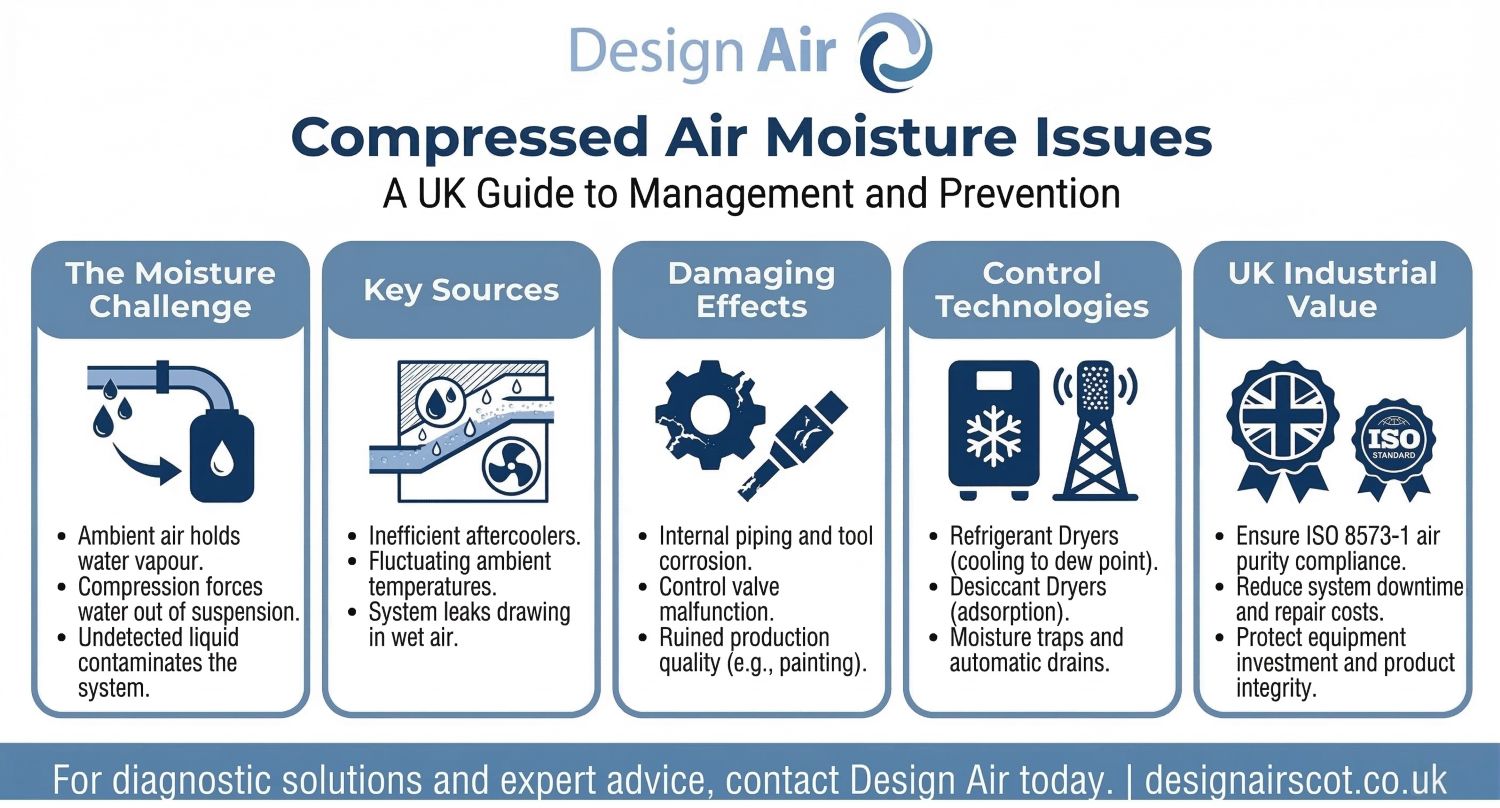
Receiver corrosion usually starts long before anyone sees water at the drain. Every compression cycle creates condensate, and that moisture has to be separated, drained, dried, and monitored before it attacks the vessel wall or reaches production.
Design Air, an Atlas Copco Premier Distributor in Scotland, writes this from the perspective of factory trained engineers working on Scottish industrial sites where humidity, compliance, and production continuity all meet in the compressor room. This guide explains the mechanism, the ISO specification route, the drainage architecture, and the monitoring technology that keeps tanks dry.
Why Moisture Forms Inside Industrial Systems
Moisture forms because compression heats atmospheric intake, increases its capacity to hold vapour, then releases liquid condensate as the charge cools inside receivers, pipework, and downstream treatment equipment. That process can’t be removed from physics, so the engineering task is controlled separation, drainage, drying, and verification.
In modern industrial settings, compressed air is recognised as the fourth utility, sitting beside electricity, water, and natural gas in manufacturing operations. The compression process raises the air temperature, temporarily increasing its ability to hold moisture in vapour form.
When that hot charge cools, the water drops out. For instance, an industrial 55kW rotary screw compressor operating at 24°C with 75% relative humidity can produce approximately 280 litres of liquid water in a single day.
The Condensate Route
The sudden expansion in volume and subsequent cooling causes 60% to 70% of the water vapour to condense into liquid droplets that fall to the bottom of the tank. Left untreated, this liquid causes internal corrosion, washes away pneumatic lubricants, damages tooling, and can make a pressure vessel fail inspection.
A typical moisture path looks like this:
- Ambient intake carries invisible vapour into the compressor.
- Compression raises temperature and vapour holding capacity.
- Cooling pushes the charge below its saturation point.
- Liquid condensate collects in receivers, filters, separators, and low points.
- Untreated carryover reaches the production process.
Where Symptoms First Appear
On one Central Belt food production site, we’d expect the first visible symptom to be water at a point-of-use filter or inconsistent actuator behaviour, not the internal wall thinning that’s already started. For a related diagnostic article, see compressed air moisture issues. We usually see that warning sign at the point of use long before anyone suspects hidden receiver corrosion.
Where the first symptom appears downstream, the root cause is usually upstream specification or drainage. That’s why the standard has to come before the component choice when preventing moisture damage in air tanks.
ISO 8573-1:2010 Sets the Dryness Target
ISO 8573-1:2010 gives engineers a way to specify purity by contamination class, so moisture control is no longer a vague maintenance task. The target becomes measurable: particles, water, and oil are classified separately, then matched to the production risk and the coldest point in the installation.
The benchmark used by manufacturers and trade bodies classifies contamination using a three-part code. Atlas Copco’s explanation of compressed air quality classes (atlascopco.com) sets out how those classes are applied in practical installations.
Purity Code Components
The three pillars below help engineers separate moisture damage and prevention decisions from general filtration choices. They also stop one component, such as a dryer, being treated as the whole answer when the system needs particle, water, and oil control together.
- A – Solid Particles: The maximum number of solid particles per cubic metre, categorised by particle size such as 0.1 to 0.5 µm, 0.5 to 1.0 µm, and 1.0 to 5.0 µm.
- B – Water: The maximum allowable water content, primarily measured by the pressure dew point.
- C – Total Oil: The concentration of total oil, including liquid, aerosol, and vapour, measured in mg/m³.
Water Classes in Practice
For Scottish facilities, we treat the water class as the deciding specification. A pharmaceutical packaging hall near Edinburgh and a general engineering workshop in Airdrie may both need clean supply, but their acceptable PDP will be different.
Class 1 <= -70°C suits ultra-critical environments where the driest possible compressed air is part of process control. In our experience, that matters most in food and drink plants across Glasgow, Fife, Dundee, and the wider Central Belt where hygiene, audit evidence, and downstream product protection all sit on the same compressed air system.
Once the purity target is fixed, the system has to be built around where liquid first appears. Receiver placement then becomes an engineering decision, not a space-saving afterthought.
Receiver Layout and Drains Do the First Heavy Lift
A wet receiver before the dryer slows velocity, stores the first condensate load, and gives liquid time to fall out before the drying stage. A dry receiver after treatment stabilises demand and protects the network, provided the drains, filters, and low-point collection are specified for the real condensate volume.
Achieving stringent moisture control requires a chain of wet and dry receivers, automated drains, separators, and correctly specified refrigerated or desiccant air dryers. Each part has to be sized for the actual duty cycle, humidity, and production risk.
A receiver without a drain becomes a corrosion chamber, and a dryer without upstream separation carries a condensate burden it wasn’t selected to handle. That is why preventing moisture damage in air tanks starts with layout before it becomes a product choice.
Wet Receiver, Dry Receiver, or Both
The wet receiver sits immediately after the compressor and aftercooler. Its job is to accept hot, moisture-loaded discharge and allow initial separation before treatment.
The dry receiver sits after drying and filtration. Its job is to store treated supply and buffer demand without reintroducing liquid into the network.
Drain Selection and Daily Risk
Manual draining may be acceptable on small, low-duty installations, but most industrial sites benefit from timed or zero-loss automatic devices. If a compressor runs through night shift in Aberdeen or Perth, waiting for a morning manual check leaves too much time for condensate to sit against vessel walls.
Good drainage reduces corrosion risk before the air reaches the dryer. But drainage can’t change vapour content, so the dryer selection still has to match the required water class.
Refrigerated and Desiccant Dryer Selection
The dryer is selected by the required PDP, the lowest ambient exposure, and the process consequence of carryover. Refrigerated units suit Class 4 general industrial service around +3°C, while adsorption units are required when the application needs -20°C, -40°C, or -70°C performance.
Refrigerated units cool the compressed stream to around +3°C so liquid forms and can be separated. They’re energy-efficient for general manufacturing, but they can’t physically achieve sub-zero PDP because internal condensate would freeze and block the heat exchanger.
Desiccant dryers are different. As moist air flows through one tower, the desiccant beads chemically adsorb the water vapour onto their surface, producing bone-dry air with a PDP as low as -40°C to -70°C.
Selection Matrix for Scottish Sites
Where pipework passes through an unheated plant room, external yard, or fish processing site on the east coast, Class 4 may be too close to the freezing point. A dryer that looks correct in a catalogue can fail when winter ambient temperature drops below +3°C.
For Scottish sites, we usually move from dryer selection straight into compliance planning because condensate risk becomes a legal control as soon as receiver condition and safe operating limits are in question.
Compliance Turns Corrosion Into A Legal Issue
Pressure vessel corrosion isn’t only a maintenance defect. Under the Pressure Systems Safety Regulations 2000, owners and users must control stored-energy risk through defined safe operating limits, formal examination, and documentary evidence that the vessel remains fit for use.
The Health and Safety Executive explains the purpose of pressure systems regulations (hse.gov.uk): preventing serious injury or fatality from the sudden release of stored energy. That applies directly to compressed air receivers operating above the relevant threshold.
The HSE’s Approved Code of Practice L122, Safety of pressure systems, outlines the duty to maintain safe operation. The Written Scheme of Examination is the formal legal document that states which parts need examination, what the examination covers, and how often it happens.
Inspection Evidence and Receiver Condition
A receiver that has been wet internally for years may look acceptable externally. The problem is wall loss, pitting, and unknown remaining tolerance.
The key compliance controls are:
- Written Scheme of Examination: The document defines the parts of the installation requiring inspection and the examination frequency.
- Competent Person Examination: The system must be inspected strictly in accordance with the WSE by an impartial Competent Person.
- Condition Evidence: If moisture-induced corrosion has thinned the tank walls beyond the manufacturer’s safety tolerances, the tank will fail inspection and must be legally decommissioned or immediately repaired.
- Service Records: Drain function, separator service, filter changes, and dryer performance records support the inspection trail.
Records That Support Compliance
Independent third-party entities, or highly trained specialist distributors holding qualifications like the dipCAM, frequently act in this advisory or examination capacity. The same compliance frame should guide receiver advice, treatment selection, and statutory preparation.
A legally examined vessel still needs daily operating evidence. That’s where monitoring has changed the maintenance model and strengthened moisture damage and prevention planning.
Smart Monitoring and Energy Control Are Changing Prevention
In 2024 and 2025, the integration of the Internet of Things and Artificial Intelligence has become the defining trend in preventing moisture damage and optimising system efficiency. The practical gain is earlier detection of humidity drift, drain failure, pressure instability, and inefficient compressor loading.
Early Warning Signals
Today, platforms like SMARTLINK and advanced systems like MANAGAIR use IoT-enabled sensors placed throughout the compressed air network to monitor real-time parameters such as pressure, temperature, flow rates, humidity, and dew point.
Another major development is the fusion of Variable Frequency Drives with smart controllers that dynamically balance the load across multiple compressors. If the system can see demand, dryness, pressure, and runtime together, it can detect conditions that a weekly manual inspection will miss.
Predictive maintenance is the important trend behind this shift. Instead of waiting for water at a filter bowl or a failed inspection, the system can flag drift early enough for a service engineer to act.
What Modern Monitoring Should Track
A good monitoring system doesn’t replace engineering judgement. It tells the engineer where to look before the fault becomes visible at production level.
Key parameters include:
- Receiver pressure trends during loaded and unloaded compressor states.
- Dryer inlet and outlet temperature.
- PDP drift against the water class target.
- Automatic drain cycle frequency and abnormal non-discharge.
- Compressor loading balance across fixed-speed and VFD machines.
- Filter differential pressure, which can increase power demand.
Turning Data Into Action
By using efficient VFD compressors, reliable dryers, point-of-use measurement, and connected service data, Scottish businesses can reduce energy waste while protecting receivers from moisture-induced degradation. The value comes from combining system design with evidence, not from installing sensors without a maintenance response.
The Airdrie team was appointed an Atlas Copco Premier Distributor (atlascopco.com), which matters when a Scottish manufacturer needs specification, service, and monitoring to sit under one accountable engineering route. With that support, industrial sites can keep their compressed air systems safe, compliant, dry, and efficient.
FAQ
The questions below cover the practical checks our engineers are most often asked during moisture, receiver, and inspection discussions.
- Each answer assumes an industrial installation, not a hobby compressor.
- Site-specific advice should be checked against the installed dryer, receiver, drain arrangement, and WSE.
- FAQPage schema should be applied when publishing.
How to Get Moisture Out of Air Tanks?
Moisture is removed by depressurising safely, opening the drain valve, and letting collected condensate discharge until the tank clears. On industrial systems, that manual step should be supported by aftercoolers, separators, automatic drains, and correctly specified drying equipment so liquid is removed before it reaches production.
Should Air Tanks Be Drained of Moisture?
Yes, tanks should be drained because standing condensate corrodes internal vessel walls, contaminates downstream equipment, and creates inspection risk. Drainage is part of the control chain, not a substitute for treatment. If liquid collects daily, the upstream cooler, separator, and dryer specification should be checked.
How Often Should You Drain Moisture From the Air Tank?
Drain frequency depends on compressor duty, humidity, receiver size, and installed drainage equipment. A manually drained industrial receiver is commonly checked daily, while automatic drains should be inspected for correct discharge during service. In high-humidity Scottish plants, skipping checks quickly turns condensate into a corrosion issue.
What Draws Moisture Out of Air?
Cooling draws liquid condensate out when the stream falls below its saturation point, while adsorption removes vapour at lower PDP targets. Refrigerated dryers cool the charge to around +3°C. Desiccant systems use bead surfaces to adsorb vapour, enabling -40°C or -70°C performance where the process needs it.
What ISO 8573-1 Class Prevents Hygiene Risk?
Class selection depends on product contact and audit requirements, but Class 3 at -20°C PDP is often used where very dry supply is required to inhibit microbial growth. Direct food, medical, or validated processes may need Class 2 or Class 1. The risk assessment sets the target.
What Happens If Corrosion is Found During Inspection?
If corrosion has reduced receiver wall thickness beyond the manufacturer’s tolerance, the vessel can fail examination and may need repair or decommissioning. That outcome affects production, insurance, and legal operation. Good drainage records, treatment performance data, and WSE compliance reduce the chance of surprise failure.
If your Scottish site is seeing condensate at filters, unstable dryer performance, or receiver inspection concerns, our Airdrie team can assess the system, specify the correct PDP target, and advise on drainage, monitoring, and inspection preparation across the Central Belt and wider Scotland.