
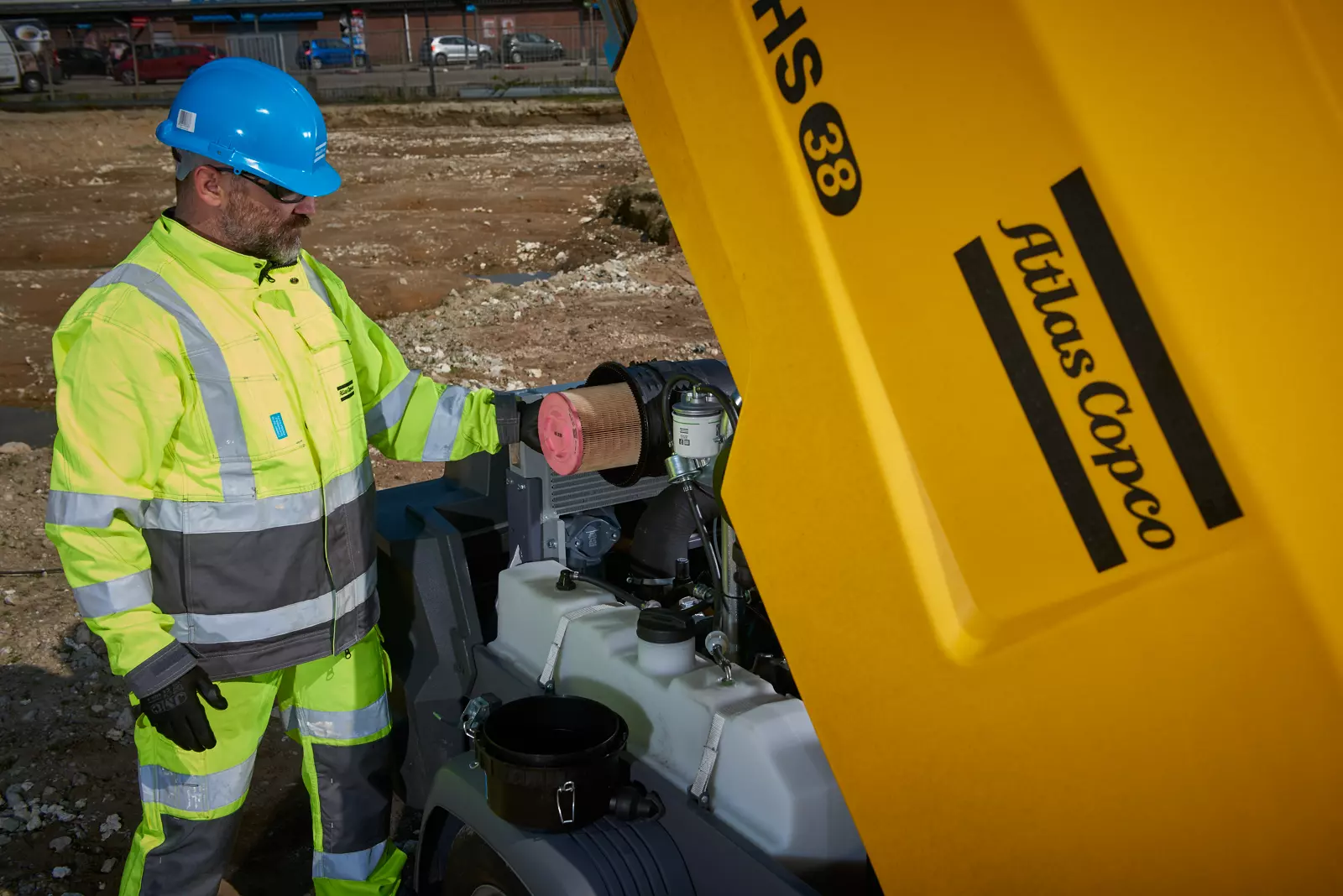
A compressor room is not thermally neutral. When intake air gets hotter, colder or wetter, the system produces different mass flow, carries a different moisture load and leaves less margin for dryers, lubricant and heat recovery.
Design Air, an Premier compressed air distributor in Scotland, works from Airdrie with factory trained engineers covering Glasgow, Edinburgh, Stirling, and the wider Central Belt. This guide explains the operating limits, physics, and design checks that matter before heat, cold, or moisture start affecting production.
The Temperature Mechanism Behind Compressor Performance
From the thermodynamic realities of Charles’s law, Boyle’s law, Gay-Lussac’s law, and the Rule of 20 governing moisture condensation, temperature affects every molecule of air and drop of oil within the system.
A rotary screw machine draws a fixed volume per revolution, but industrial work depends on mass flow, usually measured as SCFM. If intake conditions rise from 20°C to 35°C, the inlet charge contains less mass per stroke. The compressor then runs longer, or a VSD machine increases RPM, to deliver the same useful output.
Charles’s law explains why air volume expands as temperature rises, while Boyle’s law explains the pressure-volume relationship that makes compression useful in the first place. Site heat matters because catalogue capacity assumes standard reference conditions, not a hot plant room beside process equipment.
What Changes as Conditions Rise
A compressor room is not just a housing space. It is part of the machine’s thermal design, and poor room design moves the fault downstream into receivers, drains, filters, and production equipment. That’s why thermal conditions need to be checked at the intake, the cooler, the dryer inlet, and the lowest exposed pipework.
In our surveys, we treat that room as part of the compressed air system rather than as separate building fabric.
Why the 5°C to 30°C Window is the Baseline
Standard industrial compressors are commonly designed to operate well inside a surrounding air window of 5°C to 30°C, or 41°F to 86°F. Below that range, condensate freezing and lubricant viscosity become the concern. Above it, intake density, cooling load, and dryer sizing start to move away from catalogue assumptions.
A Scottish plant room can face both edges of that range. A bottling hall near Edinburgh may need summer ventilation margin, while an unheated east coast processing area may need winter freeze protection.
Practical Design Checks
- Keep the compressor room no more than 5°C to 8°C above outdoor conditions where ventilation design allows.
- Route hot exhaust away from inlet louvres so the unit does not breathe its own waste heat.
- Check that intake paths, air filters, and ducting are sized for peak summer load, not average annual load.
- Use an Air Receiver Tank sized and installed with inspection access, isolation, and condensate management in mind.
These checks are basic, but they prevent expensive misdiagnosis. If the room is too hot, a site may blame the compressor, dryer, or filters when the first fault is air movement. We’ve seen that pattern often enough to treat ventilation as part of the compressed air system, not as building fabric.
Moisture Load Follows the Rule of 20
The industry operates on the Rule of 20: for every 20°F, approximately 11°C, increase in surrounding conditions, the air’s capacity to hold water vapour roughly doubles.
This is why a dryer that copes in March can pass liquid water in July without any change in production demand. As air is compressed, its volume decreases, but the total amount of water vapour remains in the flow, pushing the air towards saturation. When that saturated flow cools in the aftercooler and pipework, liquid water drops out.
Thermal problems are often first noticed as water, not as temperature. The compressor may still hold pressure, but the treatment train has lost its margin.
Where Water Causes Damage
- Overloaded dryers allow higher pressure dew point into the distribution line.
- Drain valves can block or freeze, leaving condensate inside filters and receivers.
- Corrosion starts on internal pipe and receiver surfaces where liquid sits.
- Pneumatic valves lose repeatability when water washes away lubricants.
- Product quality can be affected in food, drink, packaging, and finishing processes.
For a deeper fault path, we have covered dryer overload and condensate carryover in our guide to compressed air moisture issues. Moisture is rarely isolated. Once it passes treatment equipment, it becomes a production reliability problem.
High Heat Conditions Hit Oil, Electronics, and Treatment Equipment
High-temperature operation changes the heat balance inside the compressor and aftercooler. The injected oil acts as a heat sink, absorbing much of the heat of compression, but it still has to reject that heat through the cooler.
Most operators notice the result as higher discharge temperature, nuisance trips, rising pressure dew point, or shorter service intervals. The mechanism is chemical as well as mechanical: Arrhenius behaviour means lubricant degradation accelerates as temperature rises.
Failure Modes to Check First
“Keep the room cool” isn’t enough for a Scottish facility with shift changes, seasonal humidity, and production equipment dumping heat into the same room. We check each component against the actual thermal load it sees during production, not the average room temperature during a service visit.
Cold Weather Creates A Different Fault Pattern
Cold conditions do not just reduce comfort in the compressor room. If the temperature around pipework and drains drops below about 4°C, condensate can freeze, expand, block control lines, and crack housings.
Facilities face cold winters that threaten condensate freezing and oil viscosity issues, alongside increasingly warm summer peaks that challenge cooling capacities. The correct specification depends on the lowest point in the system, not the reading beside the compressor controller.
Winter Controls Worth Specifying
- Fit trace heating where drains, pipework, or separators are exposed to freezing conditions.
- Use desiccant drying where any downstream pipework can fall below +3°C.
- Check lubricant grade and warm-up behaviour before restarting after shutdowns.
- Keep condensate drains maintained before holiday stoppages and winter production breaks.
Where oil aerosol, heat, and water combine, the next failure is often contamination rather than temperature alone. We cover that mechanism in our guide to compressed air oil carryover. It’s useful to review cold-weather controls before a shutdown, because frozen condensate faults usually appear when production restarts.
Energy Use Makes Temperature Control A Financial Issue
Energy consumption is the commercial reason these temperature effects can’t be treated as a minor maintenance issue.
In Europe, 10% of all industrial electricity consumption is dedicated to producing compressed air, amounting to 80 terawatt-hours per year. In some heavily mechanised facilities, compressed air accounts for up to 40% of the total electricity bill.
Why Heat Becomes A Cost
System losses are severe because approximately 90% to 91% of electrical energy input is lost, primarily as heat, with only 9% to 10% translating into actual mechanical work.
That heat is not always useless, but it has to be controlled and recovered deliberately. Guidance commonly aligns with the rule of thumb that every 2 psi reduction in compressor discharge pressure reduces energy use by about 1%. Poor temperature control so affects both runtime and the pressure target a site thinks it needs.
Market and Energy Figures
For large undertakings, the Energy Savings Opportunity Scheme treats these losses as audit targets through ESOS guidance (gov.uk). If inlet conditions are raising runtime or pressure setpoints, that is not a maintenance detail. It is an energy reporting issue that should be visible in compressor control data, electricity consumption, and heat recovery calculations.
Heat Recovery Turns Waste Heat Into A Measured Asset
In typical industrial applications, most of the electrical energy consumed by an air compressor is converted into heat. For rotary screw machines, that waste heat can often be captured from oil and air cooling circuits when the design allows.
By using advanced energy recovery systems, Scottish industries can reduce heating demand, lower carbon output, and turn a thermal liability into a measurable financial asset. Atlas Copco’s heat recovery guide (atlascopco.com) gives a clear manufacturer-level explanation of that opportunity.
Two Evidence Points Buyers Remember
- One industrial facility achieved zero extra energy purchases for process heating, reduced CO2 emissions by 260,000 tonnes annually, and realised direct financial savings of £37,000 per year.
- One education site offset a £40,000 annual heating bill and reduced its carbon footprint by 200 metric tons.
A 75 kW machine running 4,000 hours a year at £0.15 per kWh costs £45,000 in electrical input. If a usable share of that input can be recovered as heat, the useful value depends on whether there is a real heat demand at the same time the compressor is running.
Compliance Links Temperature to Inspection Risk
The Pressure Systems Safety Regulations 2000 require pressure equipment to operate within defined safe limits and, where applicable, under a Written Scheme of Examination. Internal corrosion from uncontrolled condensate is one reason receivers and pipework fail inspection.
The Pressure Systems Safety Regulations guidance (hse.gov.uk) is not written as a ventilation design manual, but the link is practical. If room conditions overload dryers and leave water in receivers, compliance exposure follows.
Standards and Schemes to Map
ISO 1217 matters because performance figures need a defined test basis. If a buyer compares compressor capacity without correcting for intake temperature, pressure, humidity, and site conditions, they may think two machines are equivalent when they are not. That gap becomes visible once room heat raises runtime or reduces delivered mass flow.
Manufacturer-Backed Specification
Design Air (Scotland) Ltd, established in 2003 and headquartered in Airdrie, operates as an Atlas Copco Premier Distributor. Atlas Copco’s distributor appointment notice (atlascopco.com) confirms that status, and it matters when a specification needs manufacturer-backed engineering rather than catalogue substitution. For regulated sites, our manufacturer-backed support helps connect performance data, service history, and inspection risk.
How We Specify for Scottish Sites
Serving key industrial hubs across Glasgow, Edinburgh, Stirling, and the broader Central Belt, we specify, install, and maintain compressed air systems, nitrogen generators, and vacuum pumps. A site survey starts with load, location, and worst-case condition, not just compressor kW.
Where a food manufacturer in Fife has exposed pipework, we let the coldest section of the network drive dryer choice. Where a pharmaceutical site near Edinburgh has cleanroom risk, we let ISO 8573-1 class requirements drive filtration and dew point.
A Practical Survey Sequence
- Measure room intake and discharge conditions under real production load.
- Check cooler cleanliness, exhaust routing, and inlet separation.
- Confirm dryer corrected capacity against peak summer inlet conditions.
- Inspect drains, receivers, and exposed pipework for condensate risk.
- Calculate recoverable heat before specifying new heating or ventilation work.
That sequence catches the gaps that generic advice misses. It also gives procurement a technical basis for comparing options beyond purchase price. When temperature effects are quantified, the conversation moves from opinion to operating evidence.
FAQ
We use these answers as a quick diagnostic route before booking a survey:
- Check whether the problem appears in hot weather, cold weather, or both.
- Note whether the symptom is pressure loss, water carryover, nuisance tripping, or product contamination.
- Record compressor room temperature near the intake, not just the outdoor temperature.
How Does Temperature Affect Compressed Air?
Temperature affects compressed air by changing density, moisture capacity, and cooling margin. Hot intake air contains less mass per compressor revolution, while warmer saturated air carries more water vapour into the treatment train. The result is longer runtime, higher dryer load, and greater risk of liquid water downstream.
How Do Temperature Changes Affect a Pneumatic System?
Temperature changes affect pneumatic system performance through pressure stability, lubrication, seal behaviour, and moisture control. Hot conditions increase condensate load after cooling, while cold conditions can freeze water inside drains and small control passages. Both conditions change how reliably cylinders, valves, and instruments repeat their movement.
How Does Ambient Temperature Affect?
Ambient temperature affects the compressor at the inlet, cooler, dryer, and receiver. Higher inlet temperature reduces air density and raises the moisture burden. Lower surrounding temperature can thicken lubricants and freeze condensate, so the same installation needs summer ventilation checks and winter drainage checks before the season changes.
What is the Temperature Around an Air Compressor?
The temperature around an air compressor is the condition of the air surrounding and entering the machine. For many standard industrial compressors, the usual operating window is 5°C to 30°C. Measurements should be taken near the intake path under load, not at a distant wall thermometer.
How Cold is Too Cold for an Air Compressor?
Below about 4°C, condensate in drains, filters, and exposed pipework can freeze. Below the manufacturer’s stated operating range, lubricant viscosity and warm-up behaviour also become concerns. For unheated Scottish plant rooms, we normally assess drainage, dryer type, oil grade, and pipe exposure before winter operation.
Is 40C Ambient Temperature?
Yes, 40°C can describe the surrounding intake environment. It is above the normal 5°C to 30°C window for many standard industrial installations. At 40°C, capacity correction, ventilation design, and dryer sizing need engineering review, because the treatment equipment may no longer have enough margin.
What is the Desired Temperature for a Pneumatic System?
A pneumatic system is usually best supported by a compressor room held within the manufacturer’s specified range, commonly 5°C to 30°C for standard industrial equipment. The treatment equipment must also be sized for the hottest inlet condition and the coldest downstream pipework. Stable conditions matter more than averages, so don’t rely on a single spot reading.
For a Scottish site where heat, moisture, or winter exposure is affecting compressed air reliability, Design Air in Airdrie can carry out a compressor room survey, dryer sizing check, and heat recovery assessment across the Central Belt and wider Scotland.