
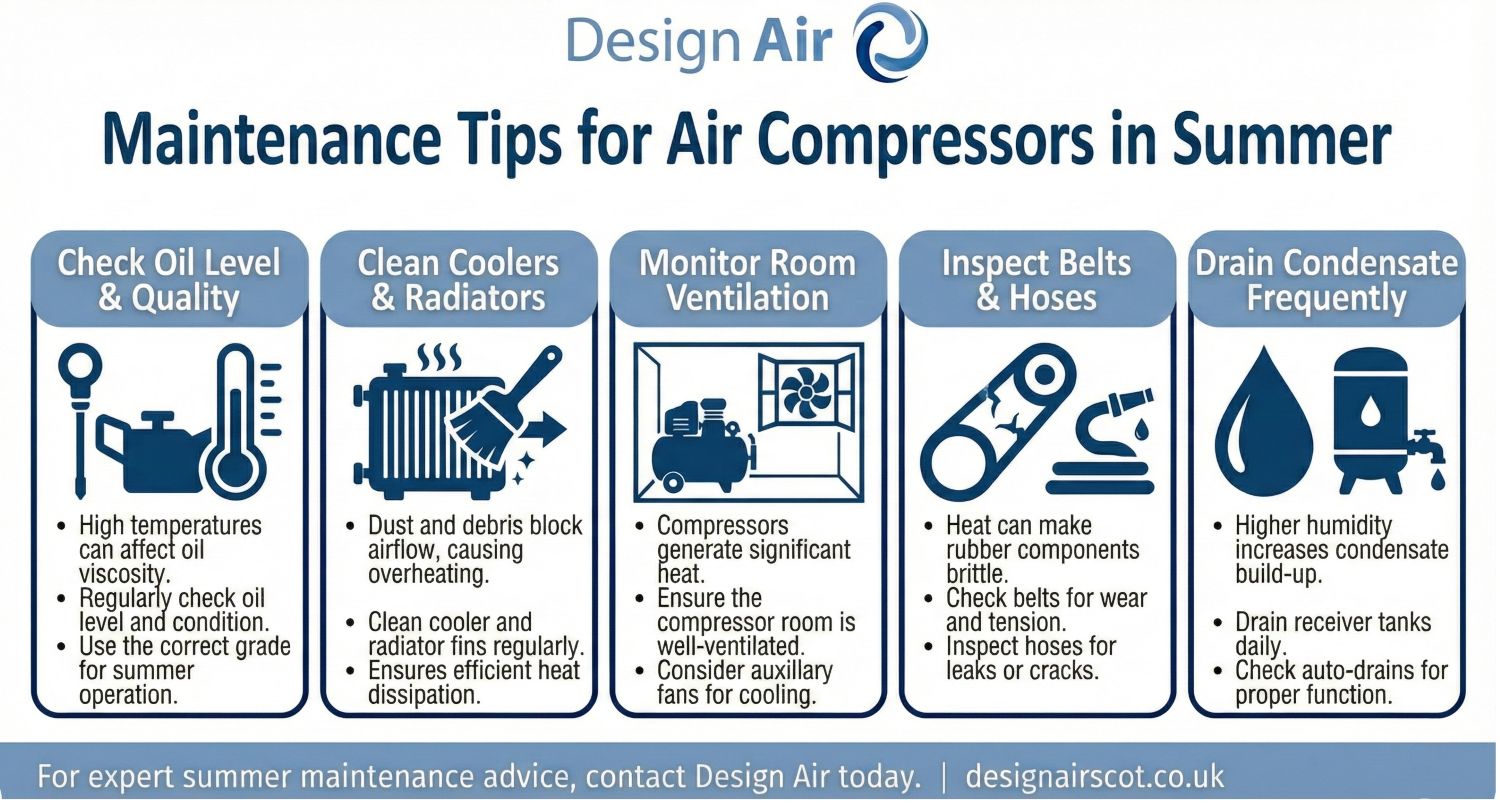
A drive belt looks like a consumable, but in a belt-driven compressor it behaves like a calibrated transmission component. Once tension, alignment or heat control drifts, motor power turns into slip, dust, vibration and lost free air delivery.
Design Air, an Atlas Copco Premier Distributor in Scotland, writes this from the point of view of factory trained engineers supporting industrial sites from Airdrie across Glasgow, Edinburgh, Fife, Dundee, Perth, and Aberdeen. This guide explains inspection, tension, compliance, air purity risk, and when to replace belt-driven equipment with direct-drive or VSD technology.
Why Drive Belts Matter to Compressor Efficiency
A compressor drive belt transfers motor torque into airend rotation, so any slip, misalignment, or heat damage reduces free air delivery before the operator sees a pressure fault. Poor belt condition turns electrical input into heat, dust, vibration, and avoidable service cost.
Fact.MR projects demand for industrial air compressors in the UK (factmr.com) to grow from USD 0.79 billion in 2025 to about USD 1.13 billion by 2035, with a 3.6% CAGR. That growth matters because every new compressor installation still needs the same basic protection: dry air, clean receivers and predictable drainage.
Fact.MR reports that UK industrial compressor sales (factmr.com) are expected to rise from USD 0.79 billion in 2025 to USD 1.13 billion by 2035. The stationary compressor segment remains the largest revenue-generating category because continuous manufacturing sites rely on fixed compressed air plant.
What Slip Costs Before Anyone Hears IT
A slipping drive can waste 5% to 10% of input energy before audible squealing appears. Gross belt slippage generates intense heat that glazes the rubber and destroys friction, so it is often an energy fault before it becomes a breakdown.
If a 55 kW unit is already running close to capacity on a Central Belt production line, wasted input does not stay theoretical. It appears as longer load cycles, poorer pressure recovery, and a service call that should have been a scheduled inspection.
Five Steps to Maintain Air Compressor Belt Condition
The five steps are isolation, visual inspection, pulley alignment, measured belt tension, and post-run verification. Skipping any one of them means the maintenance record may look complete while the machine still carries a known mechanical fault.
Before using qualifying pressure equipment, a Written Scheme of Examination must be drawn up or certified by a “Competent Person”. Under PSSR 2000, this is especially important where compressed air systems store energy above ordinary workplace pressures.
Our manufacturer-trained service engineers hold “Competent Person” status under that framework. That allows us to certify Written Schemes of Examination, carry out statutory inspections, and respond to complex 24/7 compressor repairs.
The Practical Inspection Sequence
Follow this order before checking belt condition on an Atlas Copco GX, GA, or similar belt-driven unit:
- Isolate the main electrical supply, lock the isolator, and wait for rotating parts to stop.
- Remove guards only with tools, then check for dust, oil, cracking, fraying, glazing, and missing ribs.
- Inspect pulley grooves for polishing, scoring, uneven wear, and debris.
- Measure alignment with a straight edge or laser tool across pulley faces.
- Set belt tension with the manufacturer method, then re-check after the run-in period.
New synthetic rubber belts stretch during their first operating hours, so a 50-hour re-tension check matters. After that, a sensible preventive maintenance trend is 500-hour visual checks and replacement between 4,000 and 8,000 hours, depending on duty cycle, heat, contamination, and start frequency.
What a Good Belt Inspection Catches
Glazing means shiny, hardened sidewalls caused by heat and slippage. Belt dust means fine black rubber inside the cabinet or below the guard, usually from abrasion, misalignment, or a contaminated pulley.
At a food packaging hall near Glasgow, engineers should treat dust plus repeated pressure dips as a drive-train symptom before changing pressure settings. If the symptom persists, the supply-side check should follow the same logic as our air compressor pressure problems diagnostic approach: isolate the compressor from the distribution network before blaming the machine.
Tension, Alignment, and Clean Running
Correct belt tension is a measured value, not a thumb-pressure judgement. Too loose and the belt slips. Too tight and motor bearings, airend bearings, and shaft loads rise beyond their intended operating range.
The belt sidewall has to wedge into the pulley groove and transmit torque through friction. Oil mist, heat ageing, or incorrect groove geometry reduces that friction before the belt looks badly damaged.
Clean Contact Surfaces Matter
Use the following checks when recording maintenance procedures:
- Measure the belt span at the correct point, with deflection or sonic tension frequency recorded against the service data.
- Keep pulley faces in the same plane, because angular error forces the belt to climb one side of the groove.
- Keep the compressor cabinet clean and ventilated, because trapped dust and high operating temperature accelerate rubber hardening.
- Repair oil leaks before fitting a new set, because oil contamination changes the friction surface.
Traditional fan belts tend to slip and lengthen as they wear. Cogged V-belts can save around 2% of transmission energy by reducing bending resistance as the belt wraps around the sheaves, but only when the pulley profile, matched set, and tension method suit the compressor.
When Belt Faults Reveal System Issues
If a site needs 750 cfm during a third shift and the machine is already close to its maximum free air delivery, a marginal belt fault may expose an undersized system. That is why belt inspection should sit beside leak testing, pressure logging, and demand review, rather than replace them.
For Scottish sites comparing service coverage, our Air Compressors Glasgow page sets out support for compressor rooms across the west of Scotland.
Compliance for Belt-Driven Compressor Maintenance
Regulatory compliance is not separate from belt maintenance. UK businesses operating compressed air systems need safe inspection regimes, guarded transmission parts, and maintenance records that prove the work was controlled.
Under Part II of the pressure systems guidance (hse.gov.uk), any pressure system containing a relevant fluid, such as compressed air above 0.5 bar, must meet defined inspection duties. The stored energy is the hazard, not the size of the plant room.
Guarding and Isolation Requirements
Under PUWER, the Provision and Use of Work Equipment Regulations 1998, transmission machinery such as V-belts, pulleys, and rotating shafts must be securely guarded to prevent entanglement or accidental contact. Guards should fully enclose moving parts, allow suitable ventilation, require tools for removal, and be maintained to prevent the buildup of flammable debris.
The compressed air safety booklet (hse.gov.uk) covers safe compressed air use. It stresses isolation, lockout, disconnection of power, and waiting for moving components to reach a neutral position before belt work begins.
Air Quality Risks From Belt Condition
While ISO 8573-1 classifies air purity by solid particulates, water, and oil aerosols, it is indirectly linked to drive condition because unstable transmission increases heat, vibration, and lubricant stress inside the compressor package.
Excessive heat degrades lubricating oil, leading to vapour and possible oil carryover into the compressed air stream. If an operation requires Class 0 or Class 1 air purity, such as food processing or pharmaceuticals, stable and vibration-free transmission helps protect the wider quality system.
Maintenance Evidence for ISO-Led Sites
ISO 14001, ISO 9001, and ISO 45001 support a stronger maintenance record. ISO 14001 supports reducing energy waste, ISO 9001 supports repeatable records such as quarterly bearing inspections and oil analysis, and ISO 45001 supports formal risk assessment for maintenance activities.
For air purity, ISO 8573-1: Compressed Air Quality (airbestpractices.com) is useful because it separates particulates, water, and oil into measurable classes. Site assessments, breathing air testing, ISO 5388 compressor performance references, and ultrasound leak detection can all help connect mechanical condition to operating efficiency.
Audit Evidence for Sensitive Sites
Food and drink sites in the Central Belt should treat oil carryover as a product risk, not just an engineering nuisance. Pharmaceutical sites near Glasgow and Edinburgh should record air purity against the required class, while Aberdeen and Fife coastal facilities should check ventilation and corrosion effects around cabinets and guards.
A belt problem can start as a mechanical issue and end as a product quality issue. That is why the inspection record should connect the compressor room to the audit file, especially where insurers, customers, or internal quality teams ask for evidence.
Drive Belts Versus Direct Drive and VSD Systems
Belt-driven compressors remain useful on smaller and legacy packages because they are serviceable and can act as a mechanical fuse. Direct-drive and gear-driven systems remove transmission losses at the cost of higher capital spend and more specialist vibration analysis.
Atlas Copco’s manufacturer belt guidance (atlascopco.com) keeps the maintenance message practical: inspect, clean, align, tension, and replace before failure. As an official Atlas Copco Premier Distributor (atlascopco.com), the Airdrie engineering team has access to genuine OEM spare parts, diagnostic software, and manufacturer-backed service data.
When to Change the Specification
Fact.MR’s UK industrial compressor forecast (factmr.com) points to continued demand for energy-efficient compressed air equipment. For belt-driven machines, that growth does not remove the old maintenance risk: belt tension, pulley alignment and heat still decide whether the drive transmits power cleanly.
By following 500-hour and 4,000-hour inspection and replacement schedules, using sonic tensioning where specified, and integrating modern VSD solutions where demand varies, facility managers can remove much of the unpredictable downtime associated with drive belt failures. The best specification is the one that matches duty cycle, audit burden, energy cost, and site response risk.
FAQ
The following answers cover the questions facilities managers and engineers ask most often when belts begin to slip, shed dust, or fail early. Each answer assumes an industrial belt-driven rotary screw or reciprocating compressor, with final limits checked against the manufacturer’s service data.
Before replacing parts, check these three records:
- Check the latest tension and alignment readings.
- Confirm the run hours since the last belt change.
- Record any evidence of oil, heat, dust, or vibration around the guard.
How Long Should an Air Compressor Belt Last?
An industrial drive belt commonly lasts between 4,000 and 8,000 operating hours when tension, alignment, ventilation, and pulley condition are controlled. Some sites see shorter life where starts are frequent, cabinets run hot, or oil contamination reaches the belt surface. The 500-hour inspection record is the early warning system.
How Do You Keep a Belt in Good Condition and Make IT Last Longer?
Keep the belt clean, correctly tensioned, aligned across the pulley faces, and protected by properly secured guarding. Record tension after installation and again after the 50-hour run-in period, because new synthetic rubber stretches early. Use matched OEM belt sets, inspect pulley grooves before replacement, and fix oil leaks or ventilation faults before fitting new parts.
Why Does My Drive Belt Keep Breaking?
Repeated breaking usually points to one of five causes: excessive tension, low tension with slip, pulley misalignment, damaged pulley grooves, or contamination. Heat glazing and black dust are useful evidence because they show friction failure before the final break. Vibration from worn bearings can create the same symptom.
Do Compressor Belts Affect Air Quality?
Yes, indirectly. A slipping or vibrating belt can increase heat inside the compressor package, and excessive heat degrades lubricating oil. That can increase oil vapour and carryover risk in the compressed air stream, which matters for Class 0 or Class 1 applications in food, drink, and pharmaceutical production.
Design Air in Airdrie provides belt inspection, statutory inspection support, air quality testing, and 24/7 compressor repair across Scotland. To arrange a site assessment for a belt-driven compressor room in Glasgow, Edinburgh, Dundee, Fife, Perth, Aberdeen, or the wider Central Belt, contact our engineering team.