
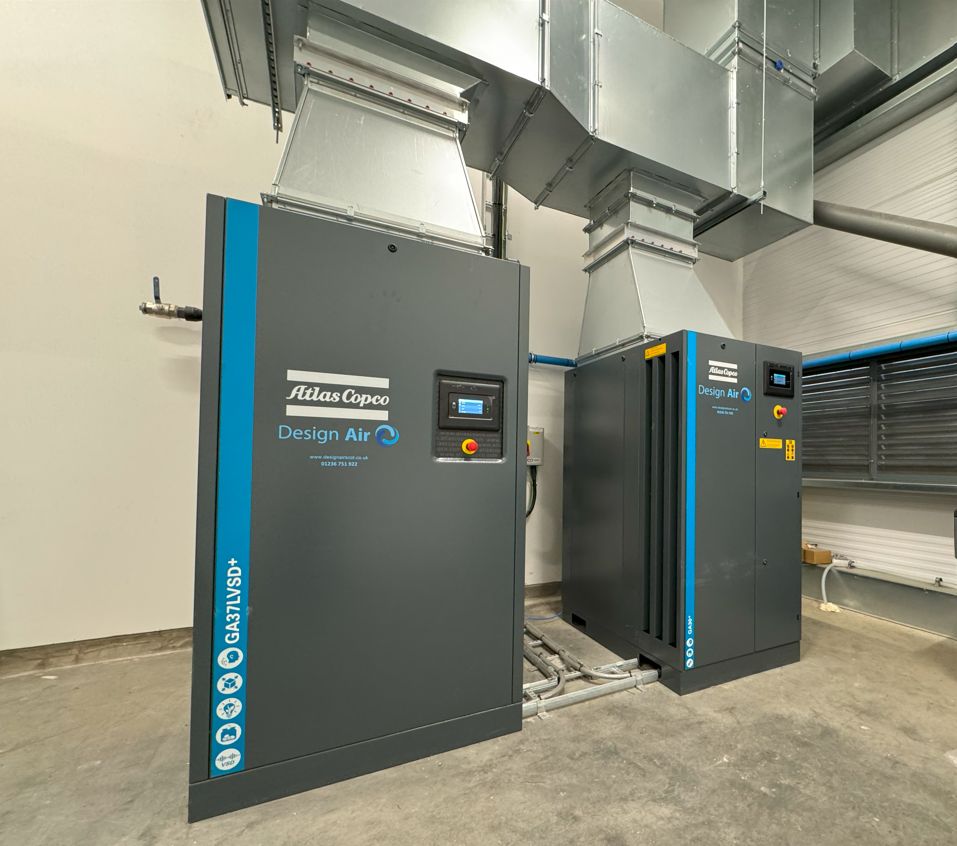
At shift handover, the incoming team starts its line while the outgoing team still has machines running. That overlap can create a compressed air peak which neither shift produces alone. For a factory adding a second production shift, the capacity checklist needs to capture that operating pattern before an equipment order is placed.
A pressure shortfall during handover can interrupt production even when the compressor copes comfortably with each shift separately. Elsewhere, the existing equipment may have sufficient output but need a revised maintenance schedule, dryer assessment or condensate arrangement to support longer operation.
At Design Air, Atlas Copco Premier Distributor in Scotland, we assess those changes as a system decision. The starting question is whether the factory needs more air at the same time, followed by whether the installation can sustain the extended duty safely and reliably.
Does the Second Shift Increase Peak Demand?
Longer operating hours alone do not establish a need for additional compressed air capacity.
If the same machinery runs sequentially on two shifts, the daily volume of air consumed increases without necessarily changing the maximum flow required. The compressor produces air for longer, while the highest simultaneous demand may remain unchanged.
The distinction matters for Central Belt manufacturers extending production without adding another line. A packaging plant in Falkirk might repeat its daytime production pattern into the evening. A factory in Livingston might introduce different equipment, cleaning operations or nitrogen generation during the additional hours. Those changes create different capacity questions.
Use the proposed production schedule to identify what changes:
| Proposed Change | Capacity Question | Other Assessment Needed |
|---|---|---|
| The same machines run for longer | Can the existing installation sustain the required duty? | Maintenance, cooling and operating costs |
| Both shifts briefly operate together | Can the system support the overlap without unacceptable pressure loss? | Start-up sequencing and storage |
| Additional machines run simultaneously | Does combined demand exceed deliverable capacity? | Distribution, drying and electrical provision |
| The second shift uses a different process | Are its flow, pressure and air-quality requirements compatible? | Treatment and point-of-use requirements |
| Production continues during servicing | Can the remaining equipment support the agreed production load? | Standby arrangements and maintenance access |
Keep the assessment tied to the change of shift. General compressor sizing establishes the required flow and pressure for an installation. This decision adds a different question: which parts of the existing system become limiting when the production timetable changes?
Establish the Current Operating Baseline
A compressor nameplate describes equipment performance under stated conditions. It does not show how the factory uses air during production, where pressure is lost or how much electricity the compressor house consumes between productive cycles.
Atlas Copco’s compressor selection guidance (atlascopco.com) recommends assessing actual usage over time to identify demand peaks and troughs. That evidence is more useful than an assumption that twice the production hours require twice the installed compressor power.
Match Operating Records to Production Events
Gather representative operating records and the production schedule together. Include normal production, demanding product runs, start-up, breaks, cleaning and shutdown. A quiet day provides a poor basis for approving a busier shift pattern.
For each significant event, establish which machines were operating and whether the pressure available to the process remained acceptable. Record compressor loading behaviour, electricity consumption and relevant alarms alongside the production activity.
A pressure dip becomes much easier to interpret when it can be associated with a specific event. Simultaneous machine starts suggest a different investigation from a gradual deterioration over an entire shift.
If the second shift has not started, the current records cannot prove its performance. Use them as the baseline, then identify the additional loads and planned overlap explicitly. Treat a forecast as a forecast until representative operation has been checked.
Define the Requirement at the Process
Obtain the equipment supplier’s air requirements for any new machinery. Confirm the operating pressure, consumption pattern and air quality needed at the connection.
A quoted average consumption may conceal a much higher demand during one part of the machine cycle. Conversely, adding together every machine’s maximum consumption can overstate the requirement if those events cannot occur simultaneously.
We would also check whether supporting equipment has been included. An on-site nitrogen generator, for example, introduces a compressed air requirement which needs to be considered alongside the production machinery it serves.
Document the permitted combinations of equipment. If the capacity assessment assumes that cleaning and production never occur together, that restriction needs to appear in the operating schedule. Otherwise, the assumption can disappear at the first busy handover.
Resolve Uncertainty Before Specifying Equipment
Where operating records cannot distinguish production demand from leakage, poor control or distribution losses, an equipment quotation will carry the same uncertainty.
Our energy audit provides a route to measured assessment, supported by ultrasonic leak detection and pressure optimisation. The purpose is to establish what the existing installation is doing and which changes are justified.
For the second-shift decision, the useful output is an agreed operating baseline: the loads that must run together, the pressure they require and the current system’s performance against them. That gives procurement a defensible basis for comparing corrective work with additional capacity.
Separate Brief Peaks From Sustained Shortfalls
A short pressure disturbance and a continuous shortage of air can look similar to an operator. Both may slow pneumatic equipment, but their causes and remedies differ.
Check Whether Storage Can Support the Event
An air receiver stores compressed air which can support a temporary demand peak. Its usefulness depends on the available storage, the permitted pressure range and whether the compressors can replenish it before the next event.
Atlas Copco’s sizing guidance (atlascopco.com) explains that suitable storage can support a brief high-demand event when sufficient recovery time follows.
For shift handover, that makes event duration important. A short overlap may be manageable through an assessed combination of storage and start-up sequencing. A prolonged period of simultaneous production requires a different calculation.
A larger receiver cannot correct a sustained imbalance indefinitely. If consumption continues to exceed generation, the stored air is depleted and pressure falls. Before specifying storage, establish how the system will recover.
Locate the Pressure Loss
Pressure available in the compressor house is only part of the evidence. The production equipment needs sufficient pressure after air has passed through treatment equipment, distribution pipework and its local connection.
If compressor-house pressure remains satisfactory while one production area loses pressure, investigate the route to that area. Restrictions, filtration condition or an unsuitable branch connection may be limiting delivery.
If pressure declines throughout the system while available compressors remain fully loaded, a generation shortfall becomes more plausible. Confirm the demand and equipment condition before drawing that conclusion.
Avoid increasing the system pressure as the default response. It may conceal a distribution problem while leaving the underlying restriction unresolved. Any proposed pressure change also needs to remain within equipment ratings and established safe operating limits.
Test Capacity With the Largest Compressor Unavailable
A system which supports both shifts with every compressor running may still be unable to maintain production during planned service or a breakdown.
The capacity decision should compare logged peak demand, including overlap and new simultaneous loads, with the air the installation can deliver at the required pressure and quality. Then repeat the assessment with the largest compressor unavailable.
Define What Production Must Continue
The largest-compressor-out assessment is a resilience test, rather than a universal requirement to purchase identical spare equipment.
Agree what the factory needs to maintain during an outage. Full output may be essential at one site. Another may be able to stop a secondary process while protecting its critical line.
That decision belongs with production management. Engineers can establish the available supply and the consequences of losing equipment, but they need an agreed continuity requirement against which to assess it.
Record any reduced-production arrangement in practical terms. “Operate essential loads only” is insufficient if the shift supervisor has no list of those loads or no authority to stop the others.
Include the Whole Supply Route
A standby compressor is useful only if its air can reach production through suitable treatment and pipework. A common dryer or another shared component can remain a limiting point even when generation is duplicated.
Check the proposed service configuration as carefully as normal operation. Confirm which equipment can be isolated and which parts of the installation remain available.
Additional compressor capacity is justified when demonstrated demand exceeds the usable supply under the operating conditions the factory has agreed to support, after practical corrective measures have been assessed. That includes the largest-unit-out condition where production continuity requires it.
If future product mix remains undecided, the answer may stay provisional. A system adequate for the proposed shift can become inadequate for a later process with different simultaneous demand. Keep that uncertainty visible in the investment decision.
Reassess Dryer Duty and Air Quality
Extending production hours does not automatically require a larger dryer. It does require confirmation that the existing dryer can maintain the specified air quality throughout the proposed operating conditions.
Assess Capacity Under Actual Conditions
Dryer capacity is stated against defined conditions. Check the actual airflow, inlet temperature, operating pressure and ambient temperature against the manufacturer’s data.
Atlas Copco’s dryer selection guidance (atlascopco.com) identifies these conditions as inputs to dryer selection and describes applying the manufacturer’s correction factors.
This matters when an additional compressor is connected to an existing treatment train. Increasing generation can increase the flow presented to the dryer beyond its assessed capacity.
The same maximum flow over longer hours raises a different question: can the dryer sustain its duty, and can it be maintained within the revised schedule? Include dryer alarms, drains and filtration condition in the review.
Preserve the Requirement at the Coldest Point
An evening shift may keep air flowing through areas which previously cooled down after production stopped. Unheated stores, external pipework and remote equipment deserve attention where they form part of the supply route.
Pressure dew point describes the temperature at which water vapour begins to condense at the stated pressure. The required specification should suit the conditions the air will encounter, rather than the temperature beside the dryer alone.
Our guide to compressed air moisture issues explains the relationship between moisture removal, drying and downstream contamination.
For a second-shift trial, verify the air-quality requirement at the relevant process. A stable pressure reading does not demonstrate acceptable moisture or oil content.
Check Cooling Through the Extended Run
A compressor room which performs satisfactorily during one shift has not necessarily been assessed for a longer uninterrupted operating period.
Confirm that cooling arrangements remain effective throughout the proposed schedule. Check ventilation operation, cooler condition, intake restrictions and any route by which discharged hot air could return to the compressor inlet.
The practical concern is sustained operation within the equipment manufacturer’s limits. A room temperature taken soon after start-up does not establish what happens near the end of the additional shift.
Our article on ambient temperature effects on compressed air systems covers the connection between operating conditions and system performance.
Include building controls in this check. If ventilation is switched by a timer, occupancy system or separate facilities schedule, verify that it continues to operate whenever the compressor installation needs it. The production timetable and the plant-room timetable need to agree.
Replan Maintenance Around Running Hours
The second shift increases the time for which production depends on compressed air. It also removes some of the periods previously available for service.
Doubling operating hours does not prove that failure probability doubles. It does increase exposure to an interruption during production and can bring running-hour maintenance tasks forward.
Recalculate Due Dates for Each Machine
For an illustrative schedule of eight hours a day, five days a week and 48 weeks a year, production covers 1,920 hours annually. Extending the schedule to 16 hours a day gives 3,840 hours.
Those are scheduled production hours, not automatically the running hours of every compressor. Lead-and-standby control, unloading and equipment rotation affect the hours accumulated by individual machines.
Use actual hour readings and the manufacturer’s service schedule to project due dates. Where a task has both an hour limit and a calendar limit, apply the specified requirement. Doubling annual hours will bring some tasks forward, while a calendar limit may continue to govern others.
Include dryers, drains and treatment equipment in the revised maintenance plan. Their condition affects the usable air supply even when the compressors themselves are available.
Protect a Service Window
Identify when equipment can be safely isolated and serviced. If production occupies the former evening shutdown, service may need to move to a remaining gap or a planned weekend outage.
Before accepting that arrangement, confirm whether the available supply supports the required production while equipment is isolated. Servicing during production depends on that assessment.
Our factory-trained service engineers work with the equipment schedule and the site’s operating requirements. For procurement, the relevant comparison is the maintenance provision required by the new duty, rather than the previous annual service cost carried forward unchanged.
Give the Additional Shift Clear Responsibilities
The incoming team needs access to the same operational information as the daytime team.
Set out who checks alarms, how faults are escalated and which conditions require production to stop. Confirm that the shift can identify a compressor fault, a dryer fault and a process pressure problem without assuming that each symptom has the same cause.
Keep operating checks distinct from maintenance work. A shift inspection does not replace a scheduled service or a statutory examination.
Build the Electricity Budget From Measured Input Power
Motor rating is not the same as average compressor-house electricity consumption. The useful budget input is the measured mean power associated with the proposed operating pattern.
Consider an illustrative second shift running for 1,920 hours annually at a mean compressor-house input power of 41 kW:
41 kW × 1,920 hours = 78,720 kWh per year.
Multiply that energy requirement by the applicable electricity unit rate in the factory’s contract. Account for relevant levy treatment and other tariff terms separately, rather than applying a manufacturing average as though it were the site’s price.
Keep the Measurement Boundary Clear
Confirm what the power measurement includes. If it covers compressors only, separately powered dryers or cooling equipment may sit outside the calculation. If it already includes them, avoid adding their consumption again.
Also establish whether the plant currently switches compressed air off after the first shift. Extending the period of pressurisation can extend the time for which leaks consume air, even during production pauses.
For the business case, distinguish additional operating cost from potential savings identified through corrective work. A saving should be supported by the assessed change and its operating hours, rather than assumed because new equipment is being purchased.
Review Pressure-System and Environmental Arrangements
Changing the timetable can alter how equipment is used without changing its pressure rating. Adding receivers, compressors or pipework can also change the installation itself. Review both aspects before the additional shift starts.
Confirm the Written Scheme of Examination
The Health and Safety Executive’s PSSR guidance (hse.gov.uk) defines compressed air above 0.5 bar above atmospheric pressure as a relevant fluid under the Pressure Systems Safety Regulations 2000. The application of particular duties depends on the system and applicable exceptions.
HSE states that qualifying pressure equipment requires a Written Scheme of Examination and an examination before use. The 0.5 bar definition should not be treated as a complete test of whether every installation requires a written scheme.
Retrieve the current scheme and examination records. Ask the competent person to assess whether proposed modifications or changed operating conditions affect the scheme, examination arrangements or safe operating limits.
Maintenance and statutory examination serve different purposes. A recent compressor service does not, by itself, establish that examination requirements have been met.
Design Air’s compliance service covers Written Schemes of Examination and statutory examinations under PSSR 2000. For an expansion, that work needs to reflect the actual installation and proposed use.
Assess Condensate Collection and Disposal
When atmospheric air is compressed and subsequently cooled, water vapour can condense. Longer production can increase the total volume of air processed and the condensate requiring collection.
Atlas Copco’s condensate guidance (atlascopco.com) explains that condensate from oil-injected compressors can contain oil and other contaminants.
Inspect drain operation, collection arrangements and treatment capacity against the extended duty. A system which was attended throughout its previous operating period may now run for several additional hours between checks.
Confirm the site’s authorised disposal route and any relevant discharge conditions. A functioning oil-water separator does not, on its own, establish permission to discharge to a particular drain.
Review Evening Noise and Operating Restrictions
Inspect the site’s existing planning conditions, operating permissions and environmental requirements before extending production into the evening.
For an Airdrie or West Lothian factory near residential property, compressor operation, cooling outlets and other plant-room noise may warrant assessment under the proposed timetable. A manufacturer’s sound figure alone does not establish the effect at a neighbouring property.
Where an acoustic assessment is needed, define the actual operating arrangement and proposed hours. Avoid assuming that daytime operation establishes acceptability after dark.
Any proposed noise-control measure also needs an engineering check. Restricting ventilation to reduce sound can create a cooling problem, so assess both requirements together.
Plan Any Upgrade Around the Available Shutdown
If the assessment establishes a need for additional capacity, define the installation sequence before agreeing the production start date.
Space for another compressor is only one consideration. Confirm electrical provision, treatment capacity, pipework connections, isolation arrangements and maintenance access. Identify which existing services must stop during the work and when the revised installation can be tested.
Use the Shutdown as a Commissioning Window
The shutdown plan should include installation, inspection, commissioning and the checks needed before production restarts. Leave time to investigate a failed acceptance check.
Our case study on doubling nitrogen capacity and maximising efficiency over a single weekend describes a manufacturing expansion involving additional nitrogen generators and a compressed air plant-room overhaul.
We completed removal, installation and commissioning during the planned weekend outage, restoring the utilities for Monday production. The project demonstrates the value of coordinating generation, drying, storage and controls within an agreed production window.
That programme is project-specific. A second-shift upgrade may require a different outage or temporary supply arrangement, depending on the existing installation and the work involved.
Give Procurement a Defined Operating Requirement
A useful specification should state what the installation must support:
- Identify the processes permitted to operate simultaneously, including shift overlap.
- State the required pressure and air quality at the relevant production connections.
- Define the production load to be maintained during compressor service or an outage.
- Describe the proposed operating hours and available maintenance windows.
- Record the site conditions and constraints affecting installation and operation.
- Set out the evidence required for acceptance before the additional shift begins.
This allows quotations to be compared against the same requirement. Equipment prices are difficult to compare fairly when each proposal assumes a different production load or continuity standard.
Validate the New Shift Before Routine Operation
A representative trial provides the final check between the assessment and the operating timetable. Agree the acceptance criteria with production and engineering before the trial begins.
Include demanding production cycles, handover overlap and the supporting processes expected during the additional shift. Where feasible and safely planned, assess the agreed service or outage configuration as well.
Record whether process pressure remains acceptable, treatment performs as required and temperatures remain within the equipment’s specified limits. Check alarms and escalation arrangements with the people who will operate the additional shift.
If the trial exposes a problem, keep the diagnosis specific. A local pressure restriction, insufficient generation, dryer limitation and cooling fault each require different corrective work. Increasing compressor output without identifying the limiting component can leave the production problem in place.
Before the start date, assemble the demand assessment, equipment information, maintenance schedule and applicable examination records in one operating file. Give the shift supervisor the permitted equipment combinations, checks and escalation contacts. Those are the instructions the incoming team will need when the handover starts.