



Key accessories for compressed air systems decide whether plant air stays dry, clean, legal, and energy-efficient after it leaves the machine. Often referred to as the “fourth utility” after electricity, water, and gas, compressed air is fundamental to manufacturing, packaging, and processing operations.
Design Air, Atlas Copco authorised distributor in Scotland, writes from the position of dipCAM-qualified engineers working on systems across Airdrie, Glasgow, Edinburgh, Fife, Dundee, Perth, and Aberdeen. This guide sets out which accessories matter, how to specify them, and where poor choices show up in energy bills, contamination risk, and pressure-system compliance.
Why Accessories Decide System Performance
Accessory Groups by Operating Duty
Compressed air accessories are not secondary items. They control stored volume, pressure stability, water removal, oil control, particulate filtration, condensate disposal, and statutory safety.
A well-sized machine with weak downstream equipment still delivers unstable, contaminated, expensive air at the point of use. That is why key accessories for compressed air systems should be specified as part of the process design, not added after the compressor has been selected. We see that mismatch when production teams buy a capable compressor but leave storage, drainage, and filtration to later procurement decisions.
Most catalogue pages treat accessories as a shopping list: hoses, couplings, spray guns, filters, gauges, and service kits. That misses the operational point. In a Scottish food plant, pharmaceutical line, or offshore support workshop, the accessory package is what turns generated air into usable process air.
Market Growth and Procurement Pressure
The UK industrial air compressor market is forecast to grow from USD 0.79 billion in 2025 to USD 1.13 billion by 2035, according to UK industrial air compressor market data (factmr.com). That growth is being shaped by energy cost, automation, air quality audits, and regulation, not by basic tool attachments.
Process Context Matters More Than the Catalogue
A good accessory specification starts with the process, not the catalogue. A distillery bottling line, a packaging hall near Edinburgh, and an Aberdeen fabrication site can all run at 7 bar, but their air quality and pipework requirements won’t be the same.
If storage and distribution are wrong, every downstream filter and dryer has to compensate for unstable flow.
Storage, Distribution and Pressure Control
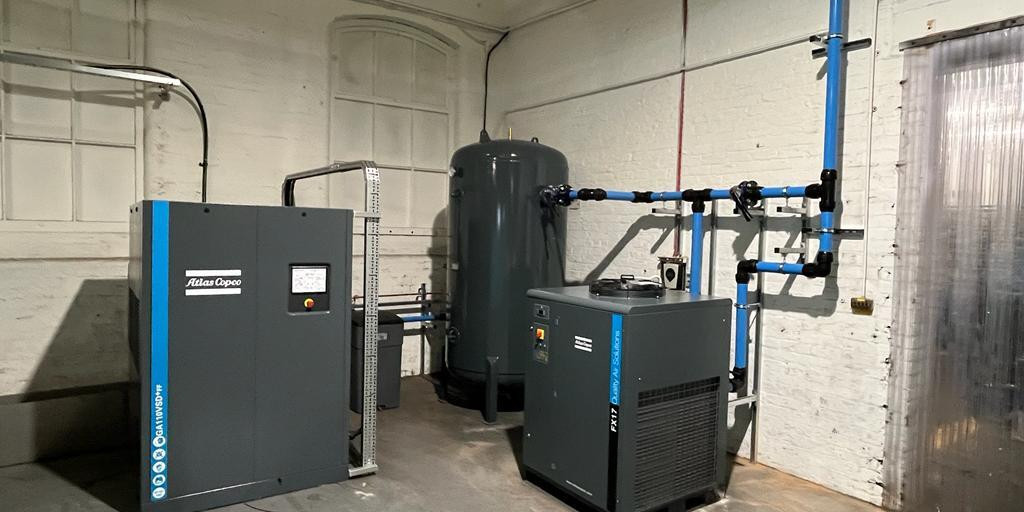
A receiver is the buffer between generation and demand. It stores compressed air, smooths short demand peaks, and gives the control system enough volume to avoid rapid load and unload cycling.
For buyers reviewing a new installation, the Air Receiver Tank should be treated as a pressure system component, not a passive vessel. UK pressure-system rules apply when relevant fluids, including compressed air, are above 0.5 bar gauge, and qualifying systems need a Written Scheme of Examination before operation.
Receiver Compliance and Legal Duty
The rules set out specific legal duties for those who design, install, operate, or maintain pressure systems to prevent serious injury. The Health and Safety Executive PSSR guidance (hse.gov.uk) explains that the purpose is to prevent harm from stored energy after pressure equipment failure.
The Health and Safety at Work etc. Act 1974 sits behind that duty. Regulation 8 requires a scheme drawn up or certified by a competent person, and the common threshold is a vessel where pressure multiplied by internal volume exceeds 250 bar litres. PSSR 2000 is the regulatory framework many Scottish sites need to consider when receivers and protective devices are part of the installation.
Operational Checks Before Commissioning
Receiver and regulator checks should be practical, documented, and tied to the installation. Confirm whether the vessel falls above the 250 bar litre threshold before commissioning, check safe operating limits against the process pressure, and record Regulation 9 periodic examinations separately from routine maintenance visits.
Sizing and Point-of-Use Control
Fit the compressed air regulator close enough to the point of use to prevent artificial demand, then review receiver sizing when new high-flow users are added to the line. A regulator isn’t a cure for poor generation pressure, but it can trim pressure for a pneumatic actuator or packaging valve bank while the main system runs at the lowest pressure that still supports production.
A practical review should cover these checks:
- Confirm receiver volume against peak demand and compressor control type.
- Check regulator locations against actual point-of-use pressure requirements.
- Record safe operating limits, isolation points, and examination status.
Pipework and Fittings
Pipework material affects pressure drop, leakage, contamination, and installation time. Aluminium modular systems often use push-to-connect or modular fittings that reduce thread leak points, while stainless steel piping and hoses suit breweries, pharmaceutical cleanrooms, and washdown areas where chemical resistance matters.
Where coastal air is present, as it is around Fife, Aberdeen, and east coast processing sites, corrosion risk changes the decision. Galvanised steel can shed internal corrosion products into the air stream, which makes filtration work harder before the air reaches final use.
Storage and distribution set the baseline pressure profile, but water control decides whether that pressure carries usable air or contaminated vapour.
Air Dryer and Filtration Specification
The most useful retellable fact is this: refrigerated dryers typically achieve ISO Class 4 for water. That means they suit general plant air, but they are not the right specification for pipework exposed to Scottish winter temperatures below the dryer pressure dew point.
ISO 8573-1:2010 defines air purity by three contaminants: solid particles, water, and oil. The British Compressed Air Society ISO 8573 guide (bcas.org.uk) sets out the three-part classification used across food, medical, pharmaceutical, and industrial applications.
For water, the second digit defines pressure dew point. Refrigerated units cool air to condense vapour and usually deliver around +3°C PDP, which maps to ISO Class 4 for water. For more on how condensate forms inside a compressed air system, see our detailed guide.
Dryer Selection Table
Desiccant and Membrane Options
These systems routinely achieve a Pressure Dew Point of -40°C, and can reach -70°C, effectively stopping any microbial growth. Desiccant dryers use porous material such as activated alumina or silica gel to adsorb moisture rather than cooling the air, so purge strategy and inlet filtration have to be specified together.
The first ISO digit covers solid particulates, including particle size and count. Class 1 dictates maximum particle size of 0.1 microns or smaller and an extremely low particle count, such as a maximum of 20,000 particles of 0.1-0.5 microns per cubic metre. The second digit covers water, and the third digit covers total oil content in mg/m3.
Filtration and ISO Digits
Coalescing filters are designed to remove water and oil aerosols down to 0.01 microns with up to 99.999% efficiency. For direct food contact, a Class 2:2:1 target is often used, which demands -40°C PDP and oil content no higher than 0.01 mg/m3.
BCAS BPG 102 is useful when teams need a practical reference point for safe compressed air treatment and system housekeeping. It doesn’t replace a site-specific specification, but it helps buyers connect dryer choice, filtration duty, drain design, and maintenance evidence.
Where the specification calls for clean air, the dryer and filter cannot be chosen separately. A filter loaded with liquid water loses efficiency, and a dryer fed with oil aerosol can lose adsorption performance.
Treatment Chain Planning
Key accessories for compressed air systems should be matched as a treatment chain. Clean dry air still leaves one by-product behind, and that condensate has to be treated before discharge. That is why drains, separators, and discharge routes need to be considered at the same time as dryers and filters on oil-injected systems.
Condensate, Oil Control and Contamination Risk
Oil-water separators use settling chambers and oleophilic, oil-attracting filters to separate the lubricant from the water, ensuring the discharged water meets legal environmental standards. That process matters because condensate from oil-injected systems is not just water.
At one Central Belt manufacturing site, we found timer drains venting clean air every cycle while condensate still pooled in a low point near the ring main. The compressor room looked orderly, but the loss was hidden in the drain strategy.
Condensate Management and Oil Carryover
Zero-loss drains remove condensate without dumping useful compressed air, while timer drains should be reviewed where flow changes by shift or season. Oil-water separators need service media changes before saturation, drain lines should be protected from freezing where they leave heated plant rooms, and discharge routes must be documented for environmental compliance.
Industries are increasingly specifying 100% oil-free compressors to bypass the risk of hydrocarbon contamination and reduce the need for downstream oil-water separators. That doesn’t remove the need for moisture control or particulate filtration, but it changes the contamination risk at source.
Oil carryover reaches downstream equipment as liquid, aerosol, or vapour. It can foul valves, coat desiccant media, affect painted finishes, and create audit risk in food or pharmaceutical lines. We explain those oil carryover mechanisms in more detail in a separate technical article.
Final Filtration and Site Checks
For process air, filtration accessories are shifting from bulk oil removal toward microbiological and ultra-fine particulate control. That shift matches the rise in Class 0 oil-free compression in food, beverage, life sciences, and clean packaging environments. Where food, paint, or instrument air is involved, the final stage should be selected against the actual contamination risk at the point of use.
Review Priorities
A site review should identify whether condensate contains lubricant, process contamination, or both, confirm that drains remove liquid without wasting compressed air, and match final filtration to the product, audit standard, and point-of-use risk. Our surveys document those three checks before any drain or separator changes are signed off.
Once contamination is controlled, the next loss usually appears in the electricity bill.
Energy, Leak and Heat Recovery Accessories
Energy accessories pay back because compressed air is an expensive utility to waste. Leak detection, smart drains, pressure control, VSD integration, and heat recovery all reduce the gap between generated air and useful work at the point of use.
The Carbon Trust highlights the mathematical relationship between pressure and energy: reducing generation pressure by 10% can lead to a 5% saving in energy. That figure is set out in its compressed air guidance on saving money from thin air at the Carbon Trust (carbontrust.com).
A Scottish plant running at 7.5 bar should not accept that pressure as fixed. If the highest user can run at 6.8 bar after local regulation and pipework corrections, generation pressure can be lowered without starving production.
Leak Cost Evidence
The Carbon Trust and the US Department of Energy compressed air resources (energy.gov) estimate that unmaintained facilities can waste between 20% and 30% of their total compressed air production capacity through leaks alone. Even small leaks at normal industrial pressures can become a persistent electricity cost if they are left unresolved.
Such leaks can also add unnecessary carbon emissions because the compressor has to generate air that never reaches useful work. Across industrial air systems, avoidable leakage translates into wasted electricity, higher service load, and more wear on compressors, dryers, drains, and filters.
Monitoring and Heat Recovery
IIoT monitoring is becoming a normal part of key accessories for compressed air systems, especially where maintenance teams need trend data rather than occasional spot checks. Connected sensors can track pressure bands, dew point, drain activity, leakage indicators, and compressor loading, then turn those readings into service priorities. That shift moves sites from reactive maintenance toward predictive maintenance based on actual system behaviour.
Heat Recovery and Load Response
Variable speed drive compressors can offer energy savings of up to 50% compared with traditional fixed-speed models, because the motor output tracks real demand instead of repeatedly loading and unloading. Accessory design now has to handle variable flow without losing dew point stability in dryers or coalescing efficiency in filters.
Up to 90% of the electrical energy used by a compressor is converted into heat. Modern heat exchangers capture this waste heat to pre-heat boiler water or provide space heating for the factory, lowering gas or heating oil bills. Atlas Copco 2025 trend reporting (atlascopco.com) places heat recovery and connected systems among the current engineering priorities.
Energy loss isn’t solved by buying one accessory. It is solved by matching drains, controls, dryers, monitoring, and maintenance to the way the site loads the system.
Compressor Parts, Monitoring and Maintenance Discipline
A service kit is only useful when it protects the air quality target and the operating profile. Filters, belts, valves, drains, oil, separators, sensors, and gaskets should be changed against duty, hours, contamination load, and process risk, not against a generic calendar alone.
Advanced models offer digital monitoring and alarms for blockages. Platforms such as SMARTLINK connect equipment data to maintenance decisions, which helps engineers see rising load hours, unstable pressure, dryer alarms, and leak trend changes before a stoppage is reported by production.
Maintenance Decision Points
If a plant runs a 184.29 kW air system and a survey identifies 65.75 kW of avoidable loss, the accessory decision is no longer minor procurement. Even a 5 kW preventable loss across long operating hours becomes a visible annual cost.
Maintenance also sits inside a wider statutory context. HSE publication L122 is the Approved Code of Practice and guidance for pressure systems, so it should be read alongside legal duties when receivers, written schemes, examinations, and safe operating limits are being reviewed.
Buying Discipline for Scottish Sites
Where risk is higher, specify from the process backwards. A food line in Glasgow needs the ISO class, dew point, and oil target documented before the dryer or filter is selected. An Aberdeen coastal facility should review pipework corrosion and fittings before assuming the existing distribution network is fit for another decade.
Our engineers usually start with the failure mode: water, oil, particulate, pressure drop, leakage, heat, or compliance. That approach keeps compressor parts and spares tied to a measurable operating duty.
When the spare is chosen for the duty rather than the shelf, maintenance becomes a control measure rather than a reaction to failure.
FAQ
What Accessories Do You Need For an Air Compressor?
An industrial installation normally needs a receiver, isolation valves, filters, dryer, drains, oil-water separator, pressure regulator, gauges, pipework, hoses, fittings, and safety devices.
The exact list depends on air quality, operating pressure, flow variation, condensate volume, and whether the process is general plant air or direct product contact. For Scottish sites, winter exposure, coastal corrosion, audit requirements, and receiver examination duties can change the accessory package.
What Are Compressor Accessories?
Compressor accessories are downstream and support components that make the generated air usable, safe, and controlled. They include dryers, filters, receivers, separators, drains, regulators, monitoring equipment, hoses, fittings, and maintenance spares.
In industry, these items affect pressure stability, ISO air quality, energy loss, and compliance. They should be specified against the duty of the process, not treated as generic add-ons.
What Are the Key Components Of an Air Compressor?
The main machine components are the air end or pump, motor, drive system, intake filter, cooling system, oil system where fitted, separator, control panel, safety valve, and discharge connection. Rotary screw packages may include integrated dryers or variable speed drives, but those should still be checked against site demand.
Those package components generate and control the compressed air. The wider accessory system then stores, treats, distributes, monitors, and protects that air before it reaches the tool, instrument, or production process.
What Are the Components Of a Compressed Air System?
A full system includes the compressor package, air receiver, dryer, filtration train, condensate drains, oil-water separator, distribution pipework, regulators, point-of-use connections, monitoring, safety valves, and compliance documentation. The system boundary ends at the tool, actuator, instrument, or process using the air.
That boundary matters because failures often sit outside the compressor itself. Leaking couplings, saturated filters, timer drains, undersized pipework, and poorly placed regulators can waste energy even when the machine is in good condition.
Which Air Purity Standard Should Scottish Manufacturers Use?
ISO 8573-1 is the normal framework for specifying compressed air purity by particles, water, and oil. A whisky bottling line, pharmaceutical packaging hall, and general engineering workshop may all need different classes.
The specification should be written before equipment is priced, because the required dew point and oil limit drive accessory selection. This is one reason key accessories for compressed air systems need to be chosen from the process backwards.
When Do Pressure-System Regulations Apply To Compressed Air Equipment?
UK pressure-system regulations apply when compressed air is a relevant fluid above 0.5 bar gauge, with extra duties for qualifying systems such as vessels above 250 bar litres. Standard servicing does not replace statutory examination.
A competent person must draw up or certify the Written Scheme of Examination, and inspections must follow that scheme. The practical question is not only whether the compressor runs safely today, but whether the receiver and associated protective devices have the right documented control.
For a Scottish site survey covering dryers, filtration, condensate management, pressure control, and receiver requirements, contact Design Air in Airdrie. Our engineering team can review the accessory specification against your process, operating pressure, air quality target, and energy loss evidence.
Related Posts

Air Compressor Storage for Scottish Industrial Sites
Air compressor storage means two linked…
Reading and Using Air Compressor Dials: How to Read Air Compressor Gauges Safely
Reading and using air compressor dials…