
Industries · Renewables & Wind Power
Air Compressors for Renewables and Wind Power
Wind projects do not have one standard compressor specification. A construction contractor, a component manufacturer and an operations team can all use compressed air, yet the pressure, flow, air quality, duty cycle and service access they need are different. The wrong choice produces avoidable running hours, water in the distribution network and a system that is difficult to maintain when the site is busy.
Air Compressors for Renewables and Wind Power should be specified from the work being done, not from a catalogue headline. Start with the tool or process, measure the demand profile, define the quality required at the point of use, then select the compressor, dryer, receiver, filters and pipework as one system.

Design Air, Atlas Copco Premier Distributor in Scotland, supplies, designs, installs and maintains industrial compressed air, nitrogen and vacuum systems across Scotland. For a renewables project, our engineering team should first establish the operating conditions and the boundaries of the requirement. That is more useful than assuming that every wind-related application needs the same technology.
Air Compressors for Renewables and Wind Power: Where They Fit
Compressed air is usually a supporting utility around a wind asset rather than a permanent turbine subsystem. It can power tools, support surface preparation, supply controlled air to a manufacturing process or serve temporary construction work. Each use has a different failure mode, so the selection should start with the consequence of a pressure drop, moisture carry-over or unavailable equipment.
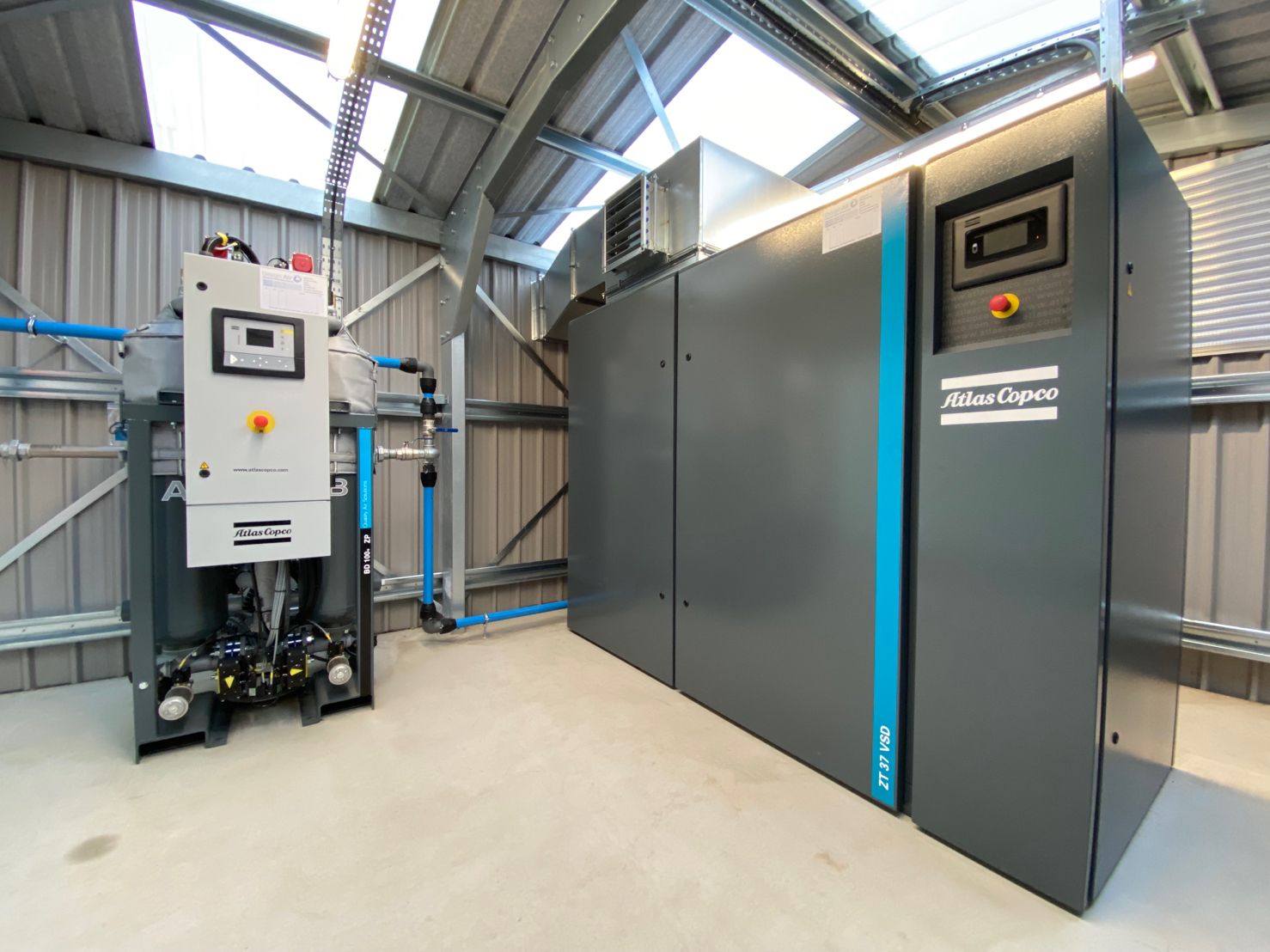
Manufacturing, blade production and surface preparation
In composite and coated-component work, the process owner should define acceptable particle, water and oil contamination using ISO 8573-1. The standard separates those contaminants because they fail in different ways. Water can condense in lines and interfere with a finish or pneumatic component. Oil can affect a sensitive process or downstream surface. Particles can block a valve or mark a prepared surface. Calling the supply “clean air” without defining the class, the sampling point and the process risk is not a specification.
Oil-free air can be the right requirement where the process cannot tolerate oil. It is not, on its own, a complete air-treatment design. The required pressure dew point, particle filtration and point-of-use protection still need to be stated. The distinction between oil-injected and oil-free compression is explained in our guide to oil vs oil-free air compressors, and it should be assessed against the actual process rather than used as a generic upgrade.

Construction air compressors for wind projects in Scotland
A construction compressor used on a Scottish wind project for impact tools, bolting equipment, blasting work or temporary services must be selected from the real CFM and pressure required at the tool, including hose losses and the number of tools used at once. A portable machine that reaches the pressure setpoint but cannot sustain the combined flow will spend its time recovering. Tool performance falls first, then operators raise the setpoint, and the energy and leak load increase with it.
Electric and diesel portable units have different installation constraints. The decision depends on power availability, ventilation, site access, noise limits, lift points, hose runs and duty cycle. On a Scottish site, weather protection and drainage deserve the same attention as nominal capacity. A compressor that must run in exposed conditions needs a serviceable location, a protected intake and a realistic plan for condensate and fuel or electrical connection.
Maintenance, repair and temporary works
Maintenance teams may need temporary compressed air for pneumatic tools, cleaning or controlled work during a shutdown. In coastal or remote locations, access time, corrosion exposure and the availability of spares can matter as much as the compressor rating. Plan the connection point, isolation valve, hose route and condensate handling before the outage. The compressor is only one part of the temporary system.
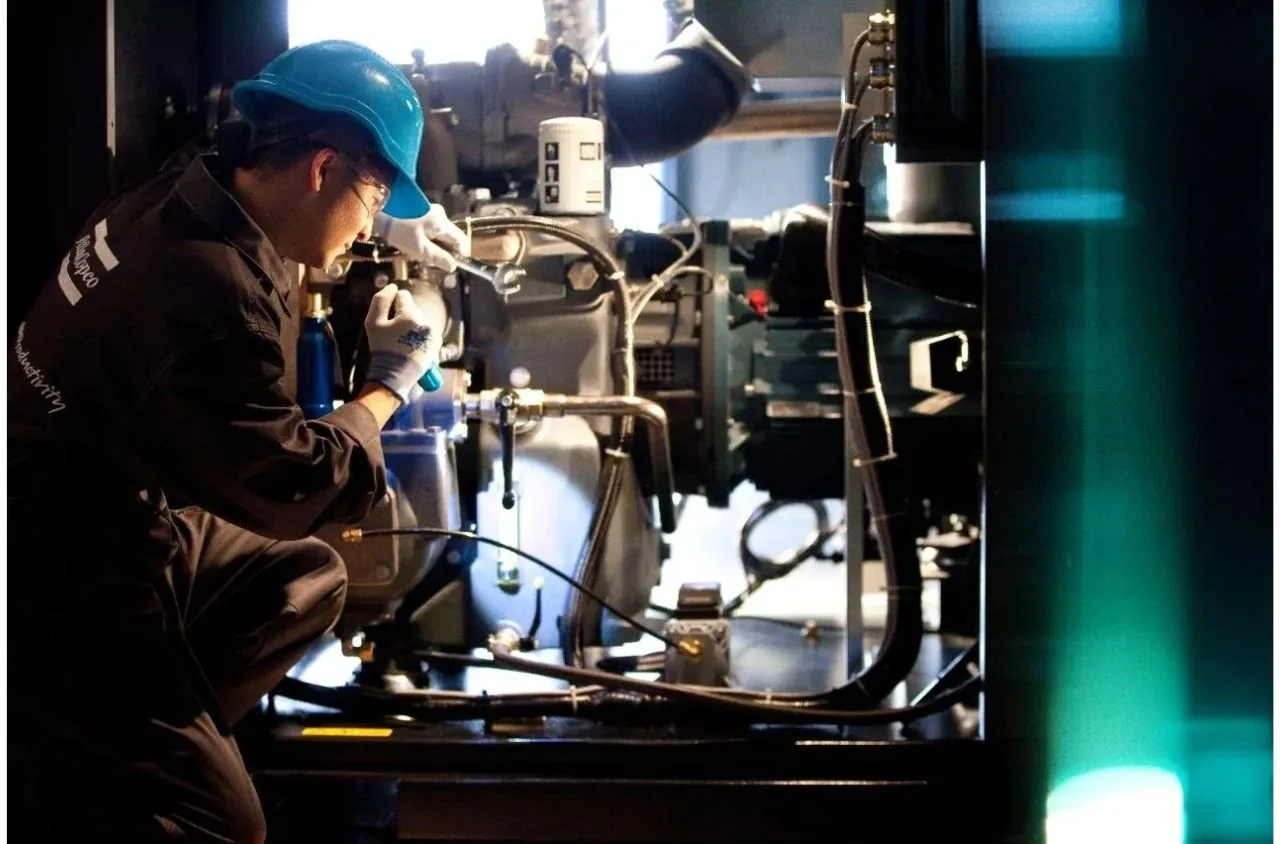
Site survey
Plan the temporary air system before the outage, not during it
Design Air can walk the site with your maintenance team and set the connection point, isolation valve, hose route and condensate handling before a shutdown begins, allowing for access time, corrosion exposure and the availability of spares.
Specify Air Quality, Drying and Distribution from the Process Risk
Compressed air contains the water vapour and airborne contaminants present at the intake. Compression reduces the air volume and raises its temperature. When the air then cools through an aftercooler, receiver or pipework run, water can condense. That is why a dryer and drainage design cannot be separated from the compressor selection.
Pressure dew point is a design value
Pressure dew point describes the temperature at which water vapour will condense at the system pressure. The lower the pressure dew point, the less water remains in the air. The right target is driven by the coldest point in the distribution system, not the temperature beside the compressor. An unheated service area, an outdoor drop or a coastal installation can need a different drying approach from a conditioned production hall. Atlas Copco’s instrument-air guidance provides a useful explanation of the relationship between pressure dew point, ambient conditions and ISO 8573-1.

Distribution is part of the air-treatment system
A well-specified dryer can still be defeated by poor distribution. Arrange pipework so condensate can be drained, take drops from the top of a main where practical, protect critical users with suitable point-of-use treatment and avoid dead legs where water can collect. Where the process is sensitive, verify the air quality where it is consumed, not only at the compressor room outlet. This approach gives a facilities engineer evidence for the specification and a maintenance team clear inspection points.
Energy
Control Energy Use Before Choosing a Compressor
Compressed air is an expensive utility because every litre delivered has first been compressed, cooled, treated and moved through pipework. A renewable energy project does not automatically make the compressed-air system energy efficient. Oversized equipment, artificial demand, pressure loss and leaks waste electricity whether the site is a factory, a construction compound or an operations base.
Pressure and load profile come first
As a planning rule, each unnecessary bar of system pressure can add about 7% to compressor energy use. The mechanism is straightforward: higher discharge pressure requires more work from the compression stages, and leaks pass more air at the higher pressure. Raising a setpoint to compensate for an undersized pipe, a blocked filter or a poor control sequence treats the symptom and increases the operating cost.
Record flow, pressure, power and operating hours over a representative production or construction period. The useful result is not an average figure alone. It is the shape of demand: the base load, the short peaks, the quiet periods and the point at which a second machine is needed. An energy audit can expose leakage and artificial demand before capital is committed, which is why Design Air’s Energy package includes measured energy auditing, ultrasonic leak detection and pressure optimisation.
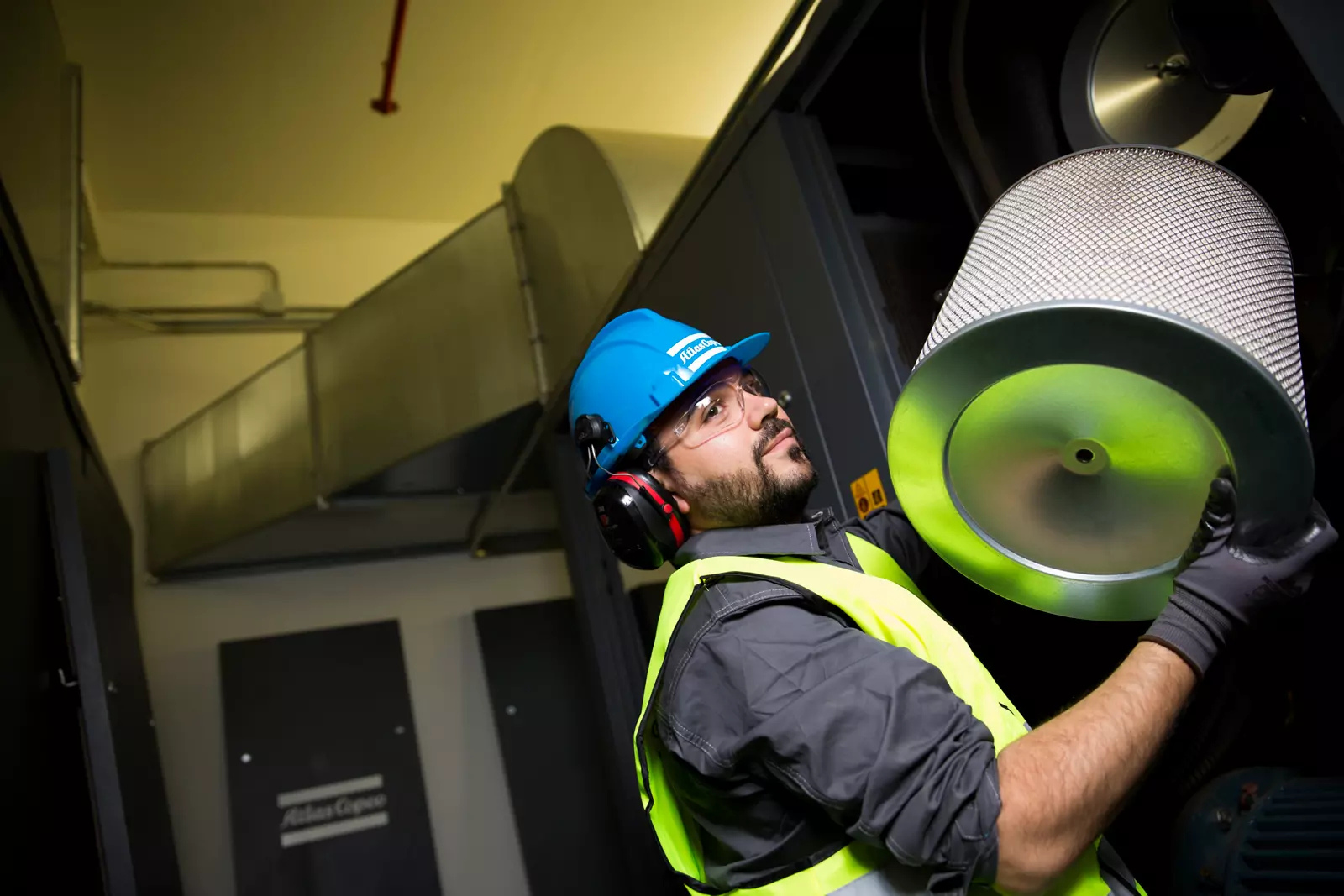
Energy
Expose leakage and artificial demand before capital is committed
Design Air’s Energy package includes measured energy auditing, ultrasonic leak detection and pressure optimisation, recording flow, pressure, power and operating hours over a representative production or construction period.
Fixed speed, variable speed and recoverable heat
A fixed-speed rotary screw compressor can suit a stable, high load. A variable-speed machine is valuable where demand changes because it can reduce motor speed instead of repeatedly moving between loaded and unloaded running. The saving must be assessed from the compressor’s measured specific power and usable turndown. The cube relationship from the affinity laws is relevant to certain centrifugal applications, but it should not be copied blindly to a rotary screw compressor.
The electricity supplied to a compressor ends up largely as heat in the compression and cooling process. Where a building has a coincident demand for space or process heat, a heat-recovery study can be worth considering. The calculation has to include hours of useful heat demand, temperature level, ducting or water connections and controls. Without that match, a heat-recovery proposal remains an idea rather than a saving.
Choose the Complete Compressed-Air System
Compressor selection is a balance between flow, working pressure, air quality, environment, resilience and service access. Different types of air compressors solve different operating problems. A portable machine may be appropriate for intermittent construction work. A rotary screw package may suit continuous industrial demand. An oil-free system is selected where the process air specification calls for it. A receiver may provide short-term storage and reduce cycling, but it does not correct an incorrectly sized compressor or a restricted distribution network.
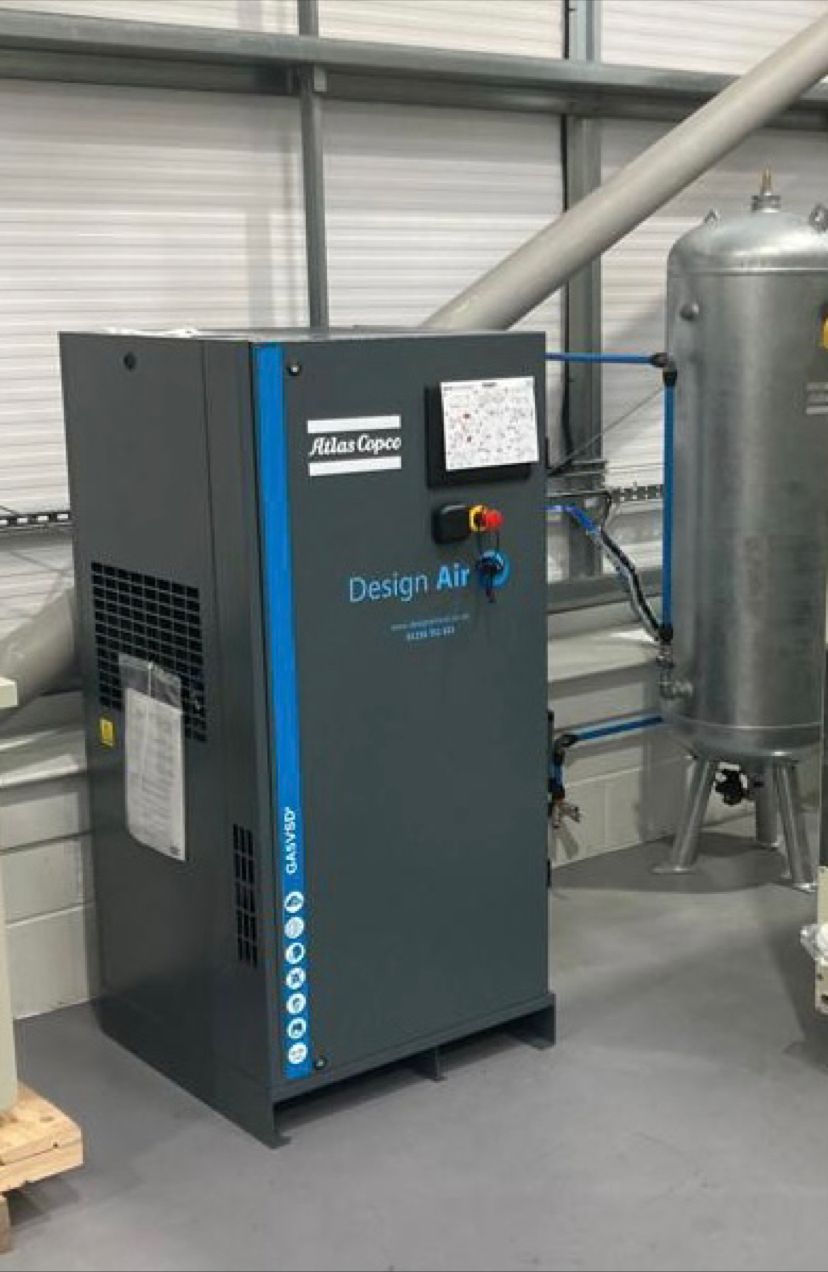
Build the selection from measured demand
Set out the minimum and maximum flow, the pressure required at the farthest user, the required air-quality class, the expected operating hours and the consequences of downtime. Then allow for pressure drop across filters, dryers and pipework. This is the point at which a plant manager can compare capital cost against electricity, service intervals and operational risk without treating each item as a separate purchase.
Design for access, service and change
A system that works on commissioning day can become restrictive when tools, shifts or processes change. Leave enough room to service filters and coolers, identify isolation points and retain drawings that show receivers, drains and protective devices. Remote monitoring can help identify changing load patterns and abnormal running hours, but it is only useful when alarm ownership and response procedures are clear. Maintenance planning should reflect the operating environment as well as elapsed calendar time.

Compressed Air Energy Storage Is a Separate, Grid-Scale Application
Compressed Air Energy Storage, often shortened to CAES, is not the same as an industrial air compressor serving a site. In a CAES system, electricity is used to compress and store energy in air, potentially in a suitable underground cavern or other purpose-designed storage system. When power is required, the stored air is released through an expansion and generation process. Wind-driven CAES is therefore a power-system and geological project, with thermal management, storage integrity and grid integration questions alongside compression.
It should not be confused with a conventional 7 or 8 bar distribution system for tools or process air. A company assessing air energy storage needs specialist project expertise for the reservoir, heat management, power conversion and consenting work. The practical lesson for an industrial site is simpler: use the phrase CAES accurately, but specify its local compressed-air utility on its own measured demand and safety requirements.
Compliance
PSSR 2000, Safe Operating Limits and Change Control
Compressed or liquefied gas, including air above 0.5 bar gauge, is a relevant fluid under the Pressure Systems Safety Regulations 2000. The exact duty for a particular assembly depends on the system and risk of danger, so it should be assessed by a competent person. HSE guidance states that a suitable Written Scheme of Examination must be in place before qualifying pressure equipment is used and that the equipment must be examined in accordance with that scheme.
Treat modifications as an engineering change
Adding a receiver, changing the pressure limit, extending pipework or moving protective devices can change the pressure-system boundary. Review the safe operating limits, drawings, protective devices and Written Scheme of Examination before returning the system to service. This is a technical and legal control, not a paperwork exercise. Design Air’s Compliance package covers Written Schemes of Examination and statutory examinations under PSSR 2000, helping users establish the information needed for their particular system.
FAQs
Questions from Renewables and Wind Project Teams
What type of air compressor is right for a wind-related project?
Does wind power always need oil-free air?
How can a site reduce compressed-air energy use?
Arrange a Technical Review for Your Scotland Project
Design Air is based in Airdrie and works across Scotland on industrial compressed-air systems. If compressed air forms part of a wind, renewable manufacturing or construction project, contact Design Air for a site survey or system assessment. The starting point is a technical review of demand, environment, air quality, distribution and PSSR implications, followed by a specification that fits the work rather than an assumed sector template.