



Air Compressors for the Construction Industry
Electricity, water, and gas are the lifeblood of any construction site in the 21st century. However, there is a fourth utility that is just as vital to most operations – compressed air. Used on projects from urban regeneration to rural infrastructure upgrades, compressed air powers tools, protects operatives, and helps keep building projects on time and on budget.
Choosing the right compressed air solution is a crucial decision for site managers across Scotland, as it can significantly impact efficiency, productivity, costs, and regulatory compliance. This guide covers the essential uses of air compressors in the construction industry, including how to choose the right solution and the regulatory requirements for using them on-site. It also explains how partnering with a specialist can help you minimise risk and maximise productivity.
Core Applications of Compressed Air in Construction
One compressor can supply air to a wide range of tools and equipment at every stage of the job, from the initial dig to the final coat of paint.

Site Preparation and Demolition
The early stages of construction require a great deal of effort. Compressed air provides the power needed to tear down and dig out.
- Pneumatic Breakers & Jackhammers – Applied to concrete, asphalt, and rock to pulverise the surface with high frequency, high-energy impact.
- Rock Drills – Applied for bulk drilling, whether for making blast holes or preparing ground for footings.
Foundation and Structural Work
Compressed air can also be used to provide the structural integrity of a project.
- Grundomat Piling – A pneumatic mole pushes steel tubes into the ground. This system is suitable for congested or environmentally sensitive sites where vibration is limited.
- Shotcrete (Sprayed Concrete) – Projected high velocity concrete placed for supporting tunnel linings, stabilising slopes, and constructing curved structures.

Assembly and Finishing
During the construction, a constant supply of compressed air is needed to power a variety of tools used for assembly and finishing operations.
- Nail Guns – For fastening quickly and securely in applications such as timber framing, roofing, and siding.
- Impact Wrenches – For tightening and loosening large nuts and bolts on steel frame construction.
- Grinders, Sanders & Saws – Appreciated for their power-to-weight ratio for cutting metal, polishing concrete, and smoothing surfaces.
Specialist Applications
In addition to its common uses, compressed air is also utilised in highly specialised ways to enhance safety and minimise environmental impacts.
- Tunnel Ventilation – Vital for worker safety, providing fresh air and removing dust and fumes after blasting.
- Bubble Curtains – Sound barriers used in marine construction to protect aquatic life from underwater noise from piling.
- Breathing Air – Filtered, oil-free air is a legal requirement for workers who use breathing apparatus when working in paint booths or confined spaces.
A reliable air supply is key to operating almost all types of heavy-duty equipment, from demolition to precise finishing

Selecting the Right Compressor for the Job
Selecting the right air compressor ensures that your tools perform optimally, use fuel efficiently, and avoid costly downtime. Consider technology, power supply, air quality, and accurate sizing.
Compressor Technology
- Rotary Screw Compressors – These are the workhorses of the industry for good reason. Built to handle continuous heavy-duty applications with an internal cooling system that can run for long hours at a time. Ideal for running multiple tools at once.
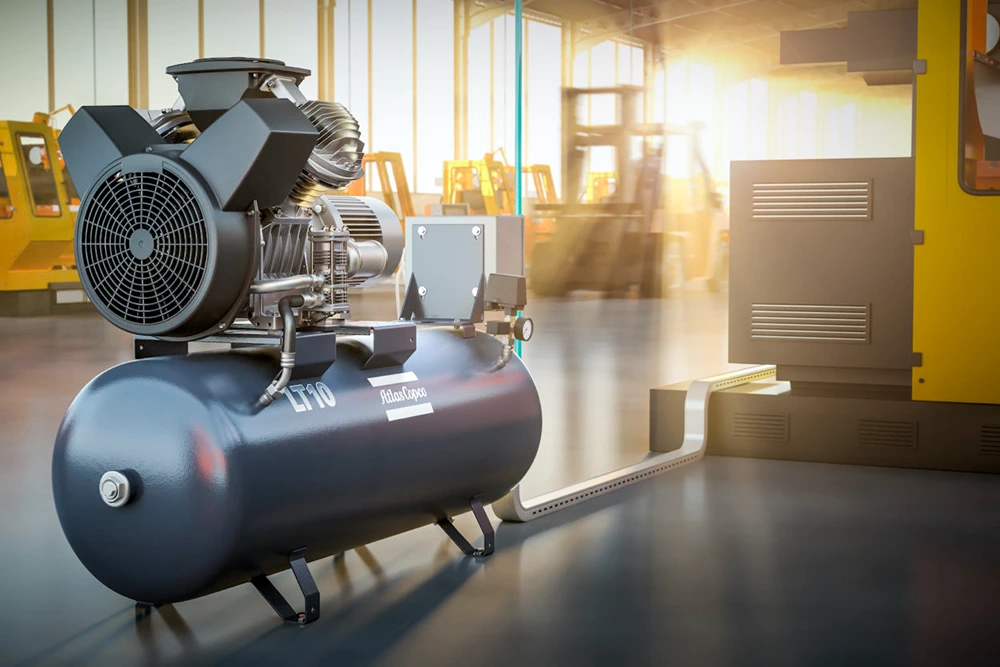
- Piston (Reciprocating) Compressors – These are for on and off duty or smaller applications that don’t require continuous air.
Power Source: Diesel vs. Electric
- independence from the electricity network. These portable air compressors offer unrivalled mobility for remote, roadside, or new build locations, but are governed by increasingly stringent emissions legislation.
- Electric Compressors – Ideal for urban or environmentally sensitive sites. Electric compressors offer zero emissions at the point of use, have significantly lower noise levels and running costs, but do require a reliable 3-phase power source.
Air Purity: Oil-Lubricated vs. Oil-Free
- Oil-Lubricated Compressors – The industry norm for the overwhelming majority of power tools. A small quantity of oil lubricates the moving components. Any residual oil in the air supply does not affect breakers, nail guns, and similar applications.
- Oil-Free Compressors – Necessary for applications where air cleanliness is paramount. Oil-free compressors are designed to prevent any oil from coming into contact with the air, as is legally required for breathing air and for sensitive applications such as high-specification paint spraying or use in cleanroom environments.
Sizing: Understanding PSI and CFM
Correct sizing is the most critical factor for site productivity.
- PSI (Pounds per Square Inch) – Measures air pressure. Every pneumatic tool has a specified operating pressure range, and the compressor must meet or exceed this range.
- CFM (Cubic Feet per Minute) – Measures air volume. To determine the site’s total requirement, you must sum the CFM ratings of all tools that will operate simultaneously.
An undersized compressor causes pressure drops and sluggish tool performance, leading to project delays. An oversized compressor wastes capital and fuel. This is crucial, as compressed air can represent 10-30% of a site’s total energy consumption, making efficiency a direct contributor to your bottom line. A specialist can help match your site’s aggregate air demand to the most efficient machine, whether that requires a new purchase of Air Compressors or flexible Hire Equipment.
✅ Choosing the right compressor type and power source ensures optimal tool performance, avoids fuel waste, and prevents costly delays.


Navigating On-Site Challenges & UK Regulatory Compliance
Operating compressed air systems involves managing a strict framework of health, safety, and environmental regulations. Failure to comply can result in fines, site shutdowns, and serious risk to workers.
PSSR 2000 (Pressure Systems Safety Regulations)
This is the most important legislation for compressed air. Any system with a pressure vessel over 250 bar-litres must have a Written Scheme of Examination (WSE) drawn up by a “competent person.” It must also undergo periodic statutory inspections. The legal responsibility lies with the equipment owner or user, typically the main contractor.
NRMM (Non-Road Mobile Machinery) Emissions Standards
Many major construction projects, particularly in urban areas, mandate that all diesel engines on site meet Stage V emission standards. Using non-compliant machinery can result in being denied access to the site.
Control of Noise at Work Regulations 2005
Employers are legally required to protect workers from excessive noise. When noise levels exceed 85dB, hearing protection is mandatory. Modern, silenced compressors are essential for minimising noise, especially in dense urban environments.
DSEAR / ATEX for Hazardous Environments
On sites with a risk of explosion, such as petrochemical facilities or certain tunnelling operations, only ATEX/UKEX-certified equipment is permitted to prevent ignition sources.
✅ Proactive management of PSSR, emissions, and noise regulations is a legal requirement that protects your workers, your project, and your business.
Your Partner in Central Scotland: Design Air (Scotland) Ltd
Managing compliance while delivering a project on time and on budget is a significant challenge. Design Air (Scotland) Ltd acts as a specialist partner, shifting the focus from simple equipment supply to a total site compliance solution.


A Full-Service Advantage
- Total Compliance Management – Our competent engineers create and certify your WSE and conduct all required PSSR statutory inspections, removing the compliance burden from you.
- Modern, Compliant Fleet – We supply and hire a full range of Atlas Copco equipment, all of which meets Stage V emissions standards, ensuring access to any UK construction site.
- 24/7 Emergency Support – Downtime costs money. From our base in Airdrie, we provide a 4-hour guaranteed response time across the Central Belt. If a breakdown occurs, our Compressor Repair Service gets you back online fast.
- Expert Installation – For long-term projects, we provide comprehensive pipework and installation services, designing efficient systems to distribute air throughout your site.
- Efficiency and Cost Savings – An Energy Audit using ultrasonic leak detection can:
- Identify and quantify compressed air leaks
- Highlight energy inefficiencies and fuel waste
- Provide actionable recommendations to cut operating costs
In Central Scotland’s high-pressure construction environment, compressed air isn’t just another service, it’s a risk, cost, and compliance factor. That’s why Design Air (Scotland) Ltd is more than a supplier. We’re a strategic partner, offering compliant, efficient, and site-specific compressed air solutions tailored to your specific project needs. From Stage V-compliant towable compressors to complete PSSR compliance support, we help you power through delays, avoid regulatory setbacks, and keep your teams working safely.
Contact Design Air (Scotland) Ltd today to discuss your project’s compressed air requirements with one of our specialists.
Our engineers are ready to help you select the ideal solution and keep your site running smoothly, compliant, and productive.