
Industries · Automotive
Air Compressors for the Automotive Industry
Automotive production does not tolerate an unstable air supply for long. Torque tools begin to behave differently, paint defects appear, pneumatic controls slow down, and the cause is often upstream of the point where the problem is seen. Air compressors for the automotive industry need to be specified as part of the production process, not bought as an isolated machine.
Design Air, Atlas Copco Premier Distributor in Scotland, designs, installs and maintains industrial compressed air systems from Airdrie. For a Scottish automotive site, the useful starting point is simple: define what each application needs for flow, pressure, purity and continuity, then build the compressor room and distribution network around those conditions.

Where Automotive Compressed Air Is Used
Compressed air has different jobs across an automotive facility. A vehicle assembly line may use it to power tools, actuate clamps and cylinders, and support robotic handling. A body repair and refinishing operation depends on stable, clean air at the spray booth. A tyre and maintenance bay needs sufficient delivered flow at the tool, particularly when several high-demand tools are used at once. The same air system may serve all three, but the specification should follow the most sensitive point of use rather than the compressor nameplate.
Assembly, Robotics and Production Tools
Pneumatic tools and automated equipment are sensitive to pressure loss and water carryover. Pressure falls when the compressor capacity is too low, the receiver is too small for a transient peak, or the pipework creates excessive resistance. Water then adds a second failure mode: it displaces lubrication inside air tools, increases friction and can affect repeatability. A plant manager should separate the steady base demand from short peaks caused by simultaneous tool use, then check the pressure at the furthest working point.

Paint, Preparation and Rework Risk
Paint shop applications make air treatment part of finish control. Particles can mark a coating, liquid water can disrupt atomisation, and oil aerosols or vapour can affect adhesion. The practical question is not whether the compressor can make air. It is whether the delivered air meets the paint-process specification at the gun, after it has passed through the dryer, filters, pipework and any point-of-use equipment.
That distinction matters in the automotive industry because a defect found after curing has already consumed labour, materials and booth time. Air quality testing and filter maintenance should be treated as production controls, with the required purity documented against the process rather than assumed from the compressor type.
Specify the Air Before Selecting the Compressor
The highest-value design work happens before a compressor is selected. A specification based only on motor size or the output of the machine being replaced can repeat the original fault. Measure demand across normal production, peak operation and shutdown periods, and record the lowest acceptable pressure and the required pressure dew point at each sensitive application.
The following inputs give an engineering team enough information to propose automotive air compressors that suit the actual operating conditions.
Flow Demand, Storage and Pressure
A receiver is not a storage vessel beside the compressor. It buffers short demand events and gives the control system time to respond. If a large tyre inflator, blast operation or tool bank starts together, the receiver helps hold pressure while the compressor increases output. The receiver cannot make up for a sustained capacity shortfall, so it must be sized with the measured flow profile, permissible pressure band and compressor control response in mind.
Delivery pressure needs the same discipline. Raising the compressor setpoint to compensate for a restriction often hides the real cause, which may be a blocked filter, a poorly sized ring main, a long flexible hose or a leaking branch. A pressure survey should begin at the compressor room and end at the tool or process that is reporting the problem.
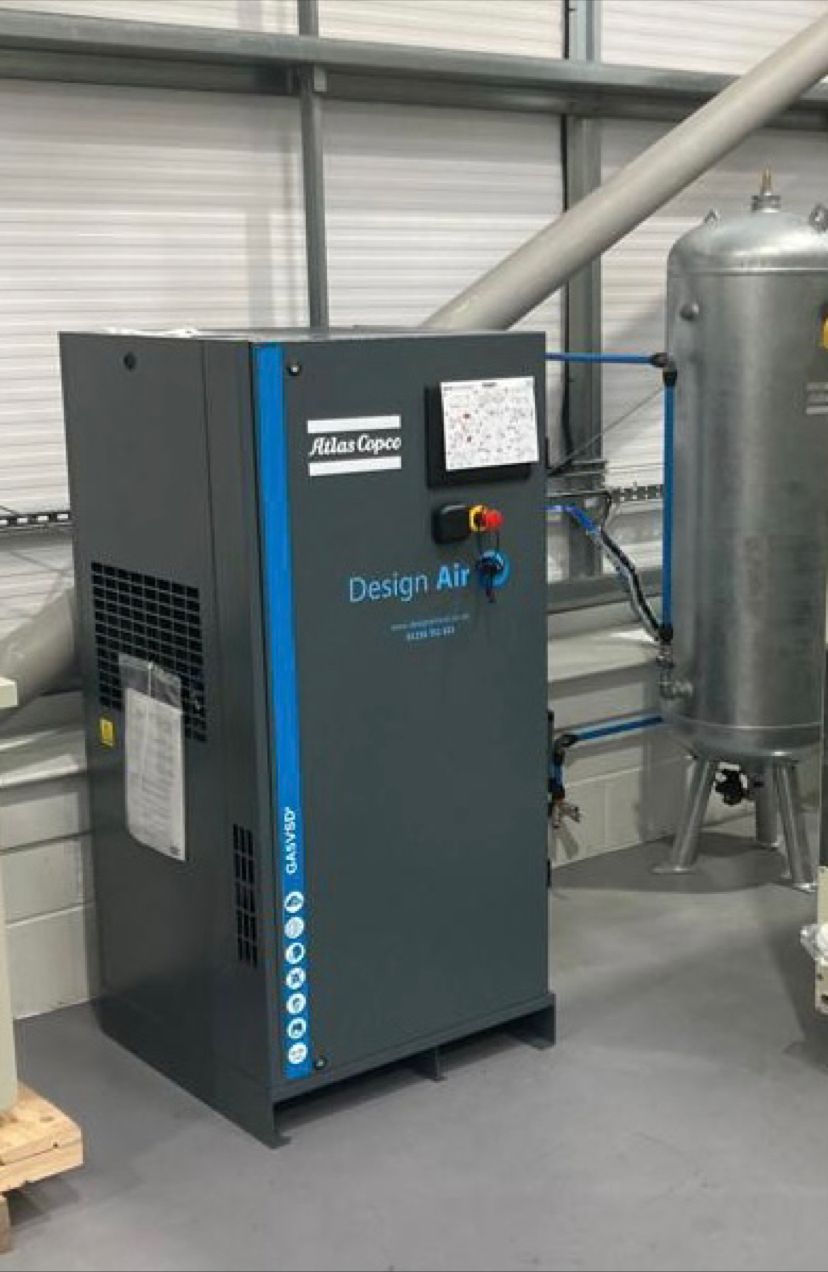
Site survey
Run the pressure survey from the compressor room to the tool
Design Air can measure demand across normal production, peak operation and shutdown periods, then record the lowest acceptable pressure and the required pressure dew point at each sensitive application.

Dew Point and Contaminant Limits
Pressure dew point, usually shortened to PDP, is the temperature at which water vapour in compressed air begins to condense at system pressure. A refrigerant dryer removes moisture by cooling the air and is commonly appropriate for general plant air. A desiccant dryer removes water vapour by adsorption and is used where the required PDP is lower or the pipework can experience colder conditions. The selection must follow the lowest temperature and the quality requirement at the application, not the ambient temperature in the compressor room.
ISO 8573-1 provides a common way to specify compressed-air contamination by particles, water and oil. It is a classification system, not a universal automotive paint-booth setting. The paint manufacturer, process owner or customer quality plan should set the target class. Design Air can then match dryer performance, multi-stage filtration and test points to that requirement. See the BCAS air quality publications (bcas.org.uk) for the classification framework.
Choosing Compressor Technology for Automotive Work
There is no single best automotive compressor. The correct choice depends on duty cycle, demand stability, required air quality, space, maintenance access and the financial cost of interruption. Atlas Copco’s industrial range includes oil-injected and oil-free compressor technologies, but the process requirement must lead the decision.
Rotary Screw Compressors for Continuous Demand
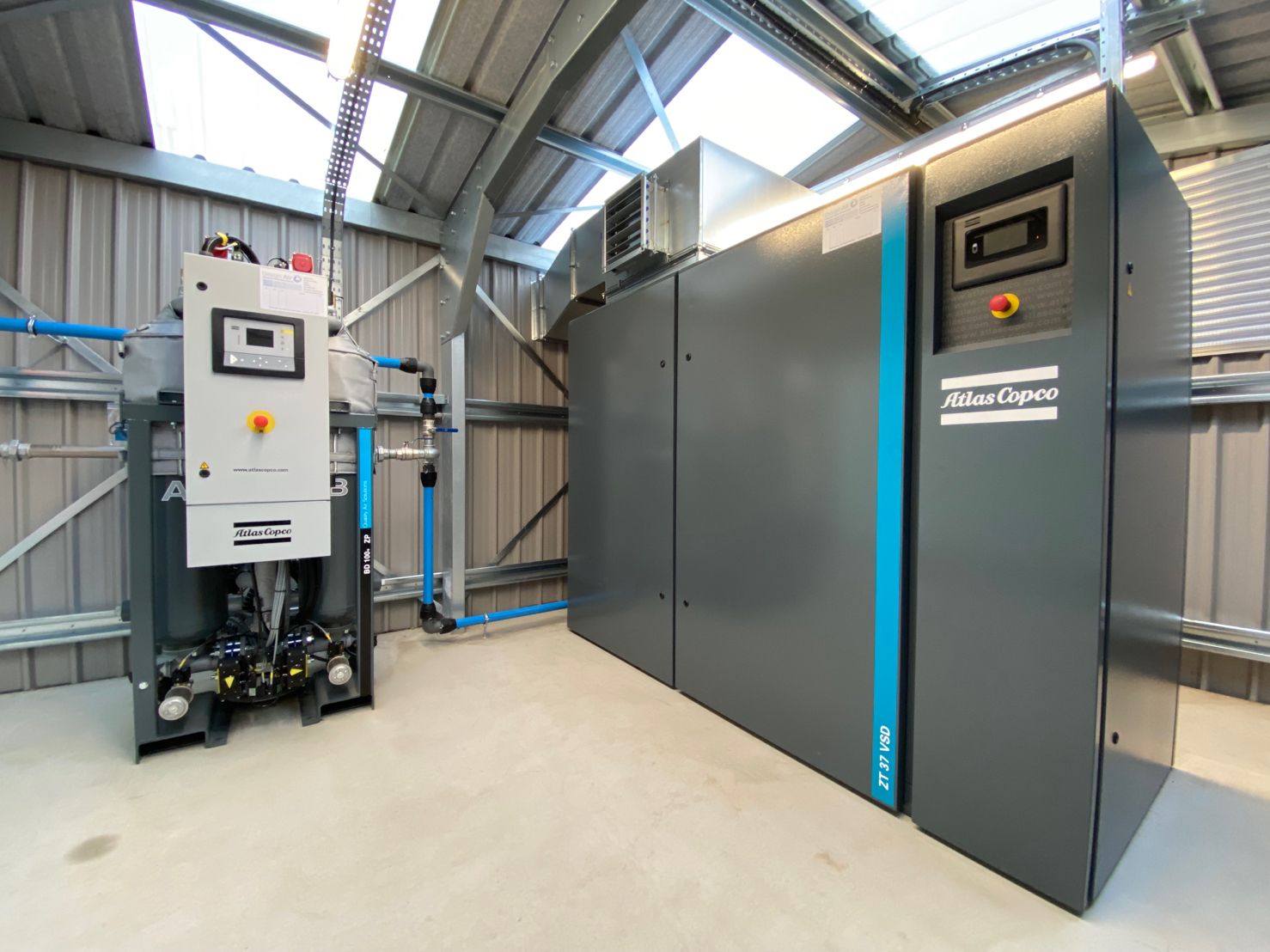
A rotary screw compressor is usually the sensible starting point for a production line or a busy automotive service centre with sustained demand. The screw element delivers a continuous flow, which suits intensive work cycles better than frequent stop-start operation. An oil-injected GA rotary screw package may be appropriate where the application permits it and the air treatment train is designed to the required purity.
Variable speed control has value when demand changes. A variable-speed compressor adjusts motor speed to maintain system pressure instead of repeatedly switching between loaded and unloaded states. The energy result depends on the measured demand profile, the compressor control range and the rest of the system. It should be demonstrated with logged flow, power and pressure data, not assumed from a brochure figure.
Fixed-Speed and Variable-Speed Control
A fixed-speed compressor can be the better fit where demand is close to constant for most of the shift. It reaches its efficient loaded condition and stays there. Variable-speed control is more useful where demand changes materially between production cells, shifts or product runs. The decision can be made from the load profile: a long spell of unloaded running, frequent start-stop events or pressure hunting shows that the control arrangement deserves investigation.
More than one compressor adds another control question. A base-load machine can handle the steady requirement while a trim machine follows changeable demand. Without coordinated setpoints, two air compressors can fight each other, with one unloading while another accelerates. The system should be commissioned around a common pressure band and reviewed after a process change.
Oil-Free Compression for Sensitive Processes
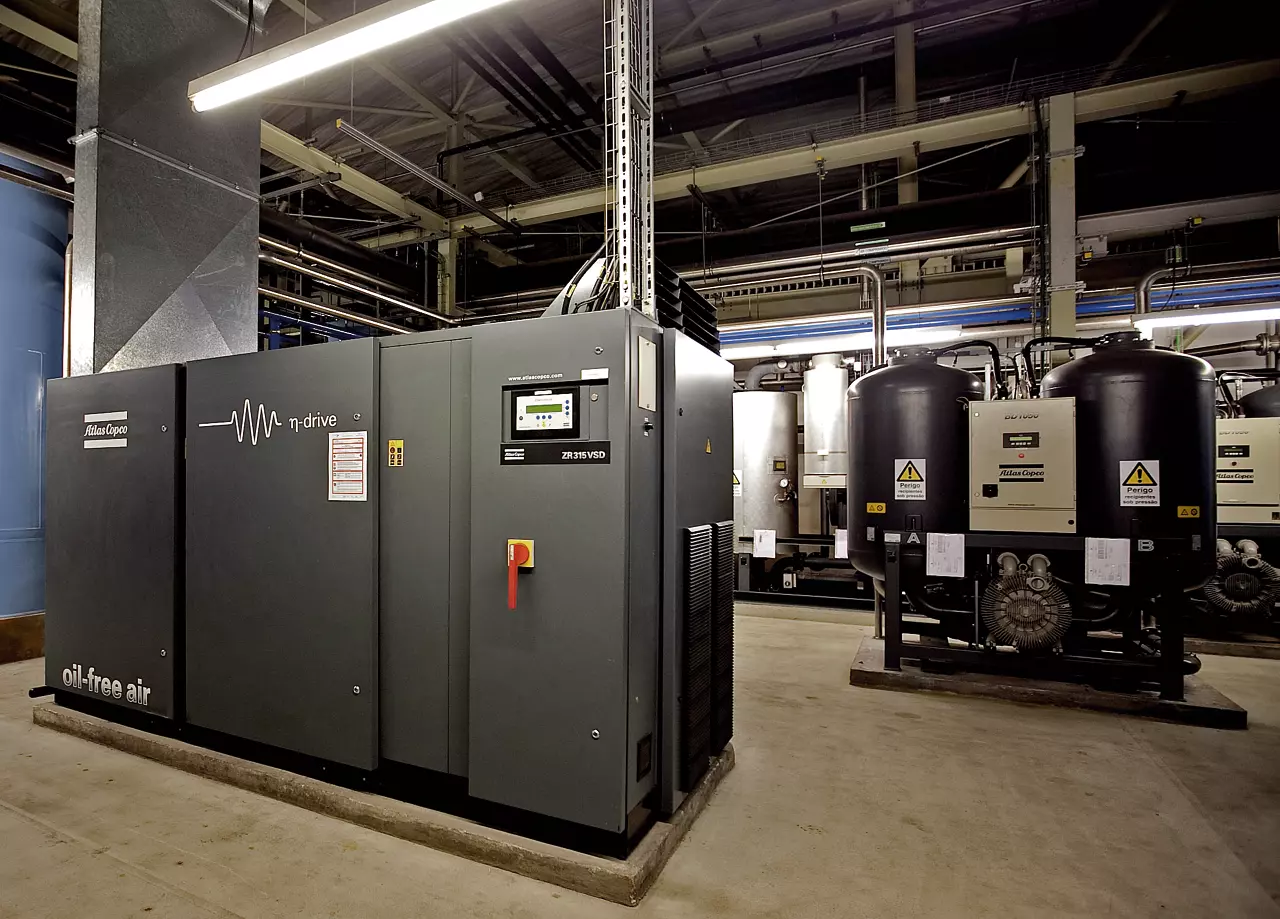
Oil-free compressors should be assessed where the process risk from lubricant carryover is unacceptable, particularly in paint, adhesive, electronics or instrument-air applications. Atlas Copco ZR and ZT machines are examples of oil-free compressor technologies. An oil-free design reduces one contamination source, but it does not remove the need to control particles, moisture or intake-air contamination. The filter and dryer arrangement still needs to be specified at the point of use. Atlas Copco oil-free compressor guidance (atlascopco.com) explains the technology boundary.
Piston and Portable Compressors
A piston compressor remains a practical choice for low-duty or intermittent industrial tasks. The question is whether its capacity, noise, maintenance interval and start-stop behaviour suit the working pattern. For temporary support or a mobile task, portable compressors can be useful. They are not a substitute for a properly sized fixed installation when several operations depend on stable compressed air throughout a shift.
Air Treatment That Protects the Finish and the Equipment
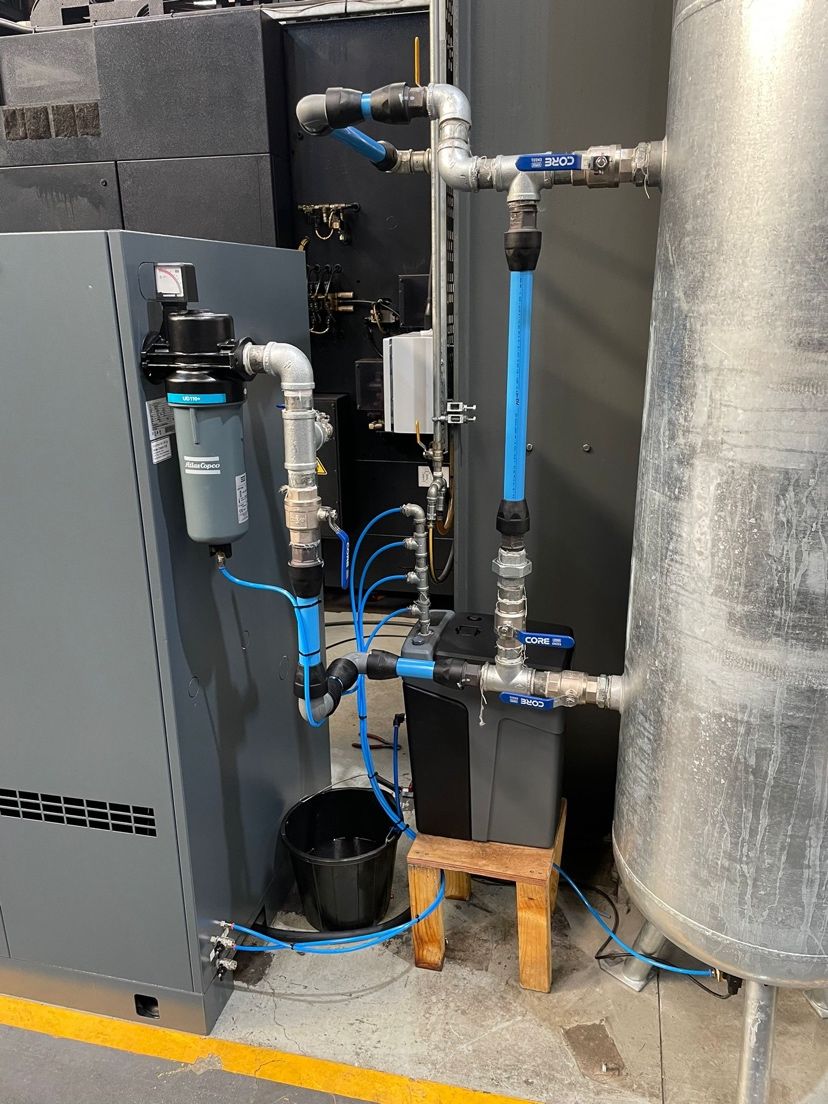
Air treatment works as a sequence. The aftercooler and water separator remove bulk condensate. The dryer controls residual moisture. Filters then remove particles, oil aerosols and, where required, oil vapour. Each component has a pressure drop, a service interval and an operating limit. Omitting one stage or leaving a saturated element in service shifts contamination further downstream.
Drying, Drainage and Dew Point
Dryer performance should be assessed under the conditions the system will see. A refrigerant dryer can perform well for indoor plant air while the downstream pipework remains above its specified pressure dew point. If a line passes through a cooler part of the building or serves an exposed process area, the same air can reach saturation and produce condensate later in the system. That is why the dryer selection needs a documented PDP target and a proper drainage plan, not a generic statement that the system has a dryer.
Automatic drains need inspection because a stuck-open drain wastes compressed air and a stuck-closed drain sends water downstream. Drain location, separator capacity and condensate treatment are part of the air system. In a Scottish facility, those details should be checked before winter operating conditions expose a weakness in pipework or drying capacity.
Filtration and Point-of-Use Verification
A coalescing filter captures fine liquid aerosols and particles, while activated carbon is used where oil vapour control is required. Filter elements do not work indefinitely. As they load, pressure drop rises and the element can cease to provide the documented protection. Record the filter grade, differential-pressure limit and replacement interval, then test at the process point. A clean sample at the compressor room does not prove a clean air supply at the spray booth.
This is why an air-quality problem should be investigated at the process, not guessed from a compressor-room inspection. Take samples or measurements after the final treatment stage and at the critical point of use. If the result is out of specification, trace the failure path through drainage, dryer performance, differential pressure across filters, pipework condition and point-of-use equipment.
Energy
Distribution, Energy Use and Maintenance
A compressor can perform correctly while the system wastes energy. Leaks create permanent demand, restrictive pipework forces a higher setpoint, and a poorly arranged header can make one production area starve while another receives surplus pressure. The most useful energy audit is measured over a representative operating period. It records flow, pressure and power together, so the site can see whether the loss comes from demand, control strategy or distribution.
Finding the Cause of Pressure Loss
Start with a simple comparison: record pressure at the compressor discharge, after the treatment train and at the busiest point of use while the process is running. A large difference across the treatment equipment points to restricted components. A difference that grows along the distribution network points to pipe sizing, a branch restriction or demand that has outgrown the original installation. The measurement makes the next action clear and avoids buying compressor capacity to compensate for a distribution fault.
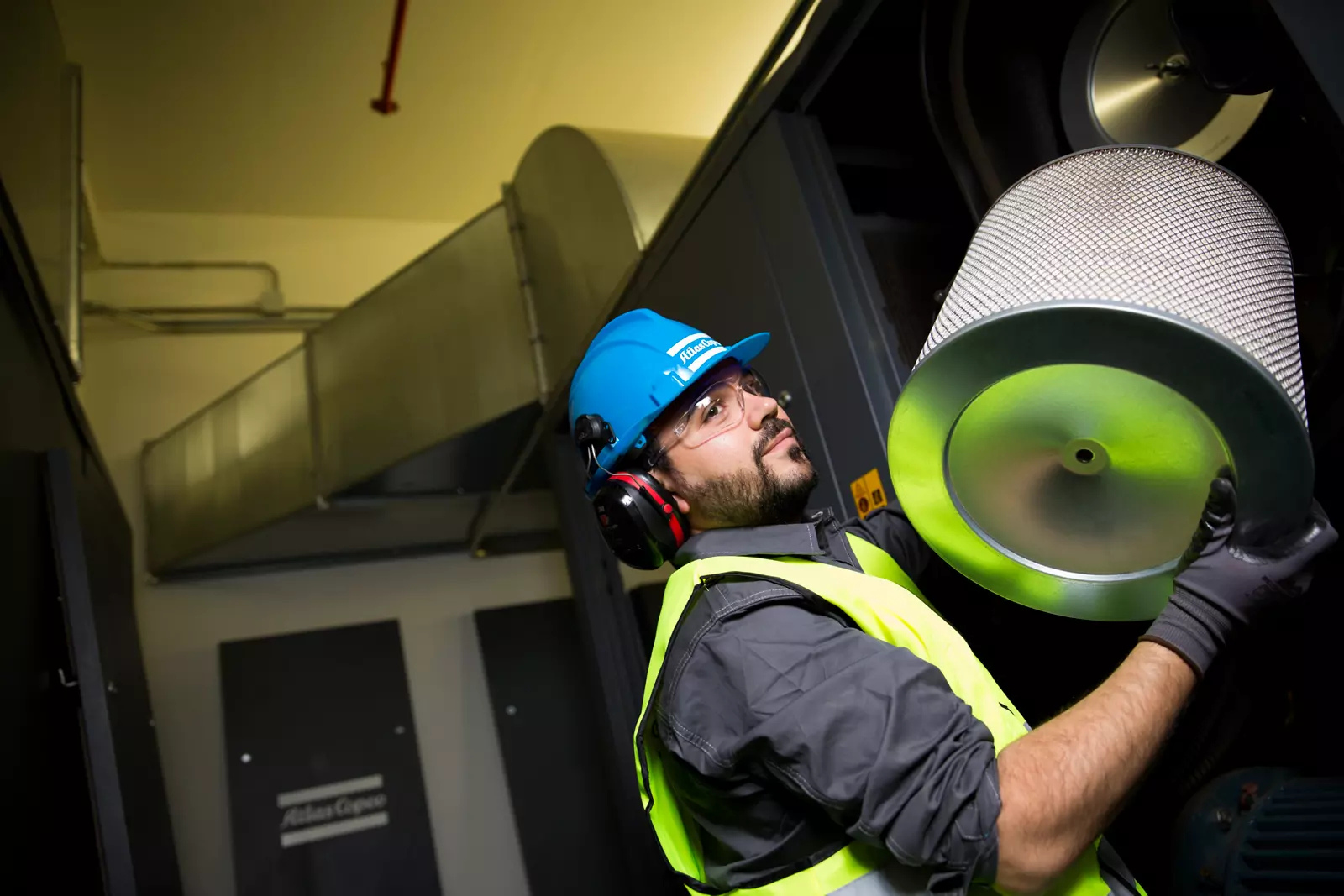
Design Air’s Energy package covers measured energy auditing, ultrasonic leak detection and pressure optimisation. For an automotive facility, the output should be a prioritised list of actions: repair a leak, change a filter element, alter a pressure band, increase storage, modify a branch or change the control arrangement. The figures need to be based on the site’s own electricity tariff and running hours.
Energy
Measure whether the loss is demand, control or distribution
Design Air’s Energy package covers measured energy auditing, ultrasonic leak detection and pressure optimisation, recording flow, pressure and power together over a representative operating period.
Pipework and Point-of-Use Pressure
Pipework is part of the compressor system. A ring main gives more than one flow path to a busy production area, which can reduce the pressure difference between the compressor room and the working point. Layout, pipe diameter, branch take-offs, drainage and future connections all matter. In coastal or damp Scottish locations, material selection and condensate management need the same attention as the compressor itself.
Planned Maintenance and Fault Diagnosis
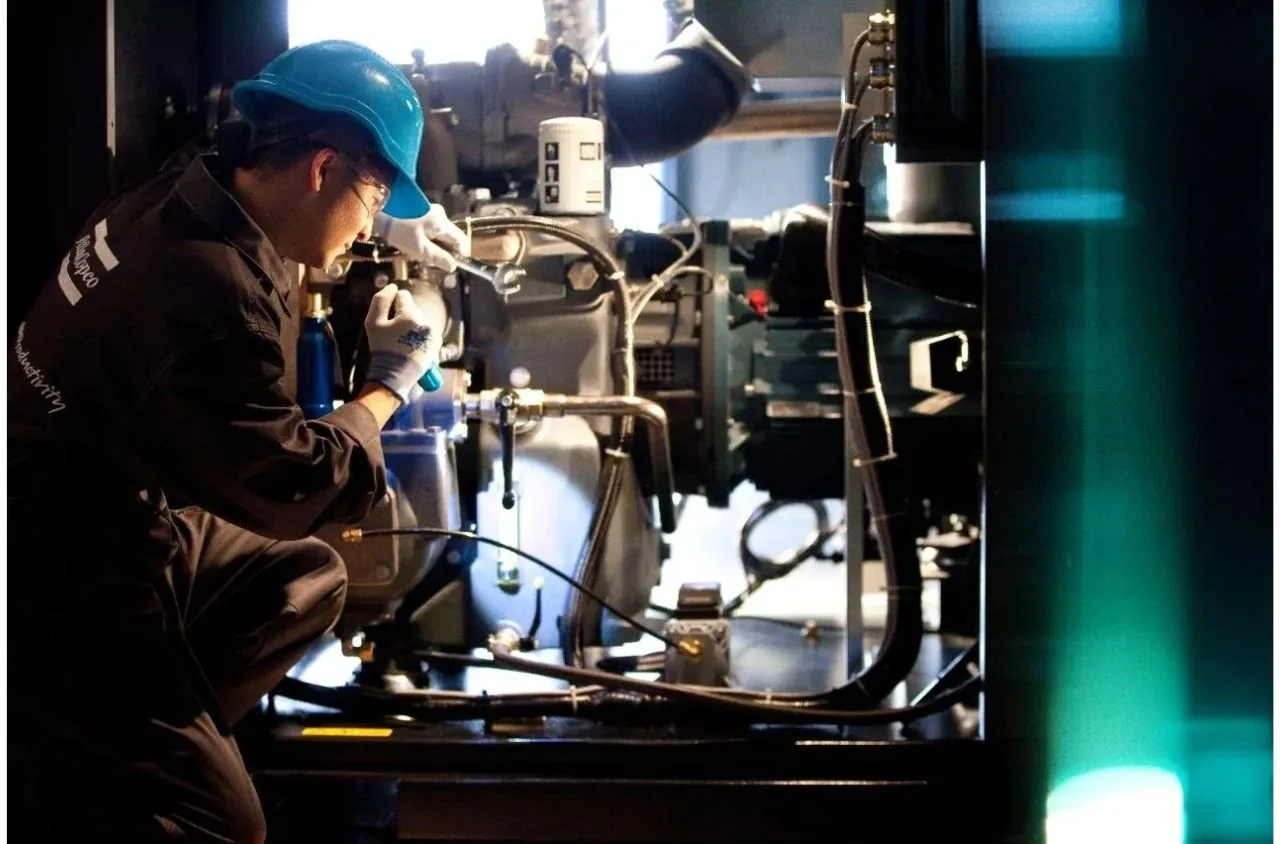
Maintenance protects performance only when it is tied to the equipment and the operating evidence. Filter differential pressure, drain function, lubricant condition, running hours and temperature trend can identify a developing fault before it becomes a production interruption. If pressure will not recover, an Isolate and Verify test helps separate a supply-side issue from demand-side use or leakage: isolate the plant distribution network, then observe whether the compressor reaches its cut-out pressure.
Design Air provides planned preventive maintenance and 24/7 breakdown cover through its Service package. Factory-trained engineers can investigate the compressor, air treatment and distribution network as a system. The four-hour response commitment applies within 50 miles of Airdrie.
Compliance
PSSR 2000 and Written Schemes of Examination
Compressed air is a relevant fluid under the Pressure Systems Safety Regulations 2000. For qualifying systems, the user must know the safe operating limits, have a suitable Written Scheme of Examination in place before operation, and ensure examination takes place in accordance with that scheme. HSE written scheme guidance (hse.gov.uk) explains the owner and user responsibilities in detail.
The practical scope can include the receiver, protective devices and relevant pipework. A change to the system, such as adding storage, altering the safe operating limit or extending the distribution network, should prompt a review of the Written Scheme of Examination rather than being treated as a routine installation change.
What a Written Scheme Covers
A Written Scheme of Examination identifies the parts of the pressure system to be examined, the nature of the examination and the interval. Keep the scheme aligned with the equipment in service, including alterations that affect stored energy, protective devices or connected pipework. This is particularly relevant where an automotive site adds a receiver or changes a production cell and the compressed-air demand moves with it.
Design Air’s Compliance package covers Written Schemes of Examination and statutory examinations under PSSR 2000.
At commissioning, retain the equipment details, safe operating limits, safety-device settings, drawings and examination records with the site engineering documents. That record gives the facilities team a controlled starting point when a production line changes or a receiver is replaced.
FAQs
Frequently Asked Questions
What Is the Best Air Compressor for Automotive Work?
Which Compressor Is Suitable for an Automotive Service Centre?
How Do I Prevent Moisture Problems in Automotive Compressed Air?
For an automotive compressed air assessment in Scotland, contact Design Air for a site survey covering demand measurement, air treatment, distribution pressure, energy use and PSSR requirements.