



Air Compressors for the Packaging Industry
Air compressors for the packaging industry are a non-negotiable asset.
Often called the “fourth utility” alongside electricity, water, and gas, it’s the invisible force behind modern packaging – driving speed, precision, and hygiene.
Our engineers handle everything – from design and installation to ongoing maintenance – for packaging plants right across Scotland.
The goal is clear and straightforward – we want to keep your systems running smoothly, cut down on energy waste, and make sure everything meets the right regulations.
What Are the Core Applications of Compressed Air in Packaging?
Many processes need compressed air, and they often need different levels of pressure and purity in the same building. It powers the main automation of a line, which includes the pneumatic cylinders that fill, seal, strap, and cap at high speeds.
It’s also used to make packages, like plastic containers that are blow-moulded.
This is especially hard when blowing PET bottles, which need a two-pressure system: a low-pressure (10–25 bar) pre-blow and a high-pressure (up to 40 bar) final blow to shape the bottle.
Compressed air also powers pneumatic conveying – moving powders or grains through sealed pipework to keep your processes clean and hygienic.
Finally, it’s vital for product integrity: powering “air knives” for cleaning, drying washed products, and providing the source air for Modified Atmosphere Packaging (MAP) via on-site nitrogen generation systems to extend product shelf life.
What Contaminants Risk Compromising Your Packaging Line?
The air drawn into your compressor carries impurities that get concentrated as pressure builds. Without the right air treatment in place, those contaminants can slip into your packaging line – leading to spoiled products, costly recalls, and lasting harm to your brand.
The Four Main Contaminants
- Solid Particles: Dust, dirt, and rust – or bits of pipe scale from older systems – can all make their way in. Once inside, they risk contaminating the final product.
- Water: The moisture drawn in with the air condenses into liquid and mist once compressed. Inside the system, that damp environment lets bacteria and mould thrive, causes products to clump together, and slowly corrodes equipment.
- Oil: Hydrocarbon vapours from ambient air and oil carry-over from oil-lubricated compressors. Oil brings its own problems – unwanted tastes, bad smells, and the risk of products being rejected altogether.
- Microorganisms: Tiny organisms such as bacteria, yeasts, and mould spores often enter with the intake air. Inside the compressor system – where it’s warm and damp – they can grow fast and spread through the pipework.
How Do You Ensure Your Compressed Air is Compliant?
In the packaging industry – especially in food, drink, and pharmaceuticals – any compressed air that touches the product or its packaging is treated as an ingredient in its own right.
Its purity is governed by strict UK standards.
The Standards That Govern Compressed Air in Packaging
ISO 8573-1: The Air Purity Standard
This is the international standard that defines compressed air purity. It classifies air based on the allowable concentration of particles, water, and oil.
- Class 1: A very high standard used in sensitive applications.
- Class 0: The most stringent class available. It guarantees that zero oil aerosols or vapour are added by the compressor itself. Class 0 air is mandatory for food, beverage, and pharma packaging compliance.
UK Regulatory Requirements
Packaging facilities must also adhere to two key UK regulations:
- HACCP & BRCGS: The BRC Global Standard (BRCGS) and other food safety standards say that compressed air must be marked and handled as a Critical Control Point (CCP) in your HACCP plan.
- PSSR 2000: It is against the law not to follow the Pressure Systems Safety Regulations 2000 (PSSR). It says that any system with a pressure (in bar) and volume (in litres) product of more than 250 bar-litres must have a “Written Scheme of Examination” (WSE) made and checked on a regular basis by a “competent person.”
These rules and standards mean that food-grade compressed air compliance and documented air quality testing are both very important parts of your maintenance plan to keep your products safe and pass important audits.
What Is the Right Technology for Packaging Applications?
Achieving compliant, efficient air requires selecting the right compressor technology and, just as importantly, the correct air treatment system.

1. Oil-Free Compressors
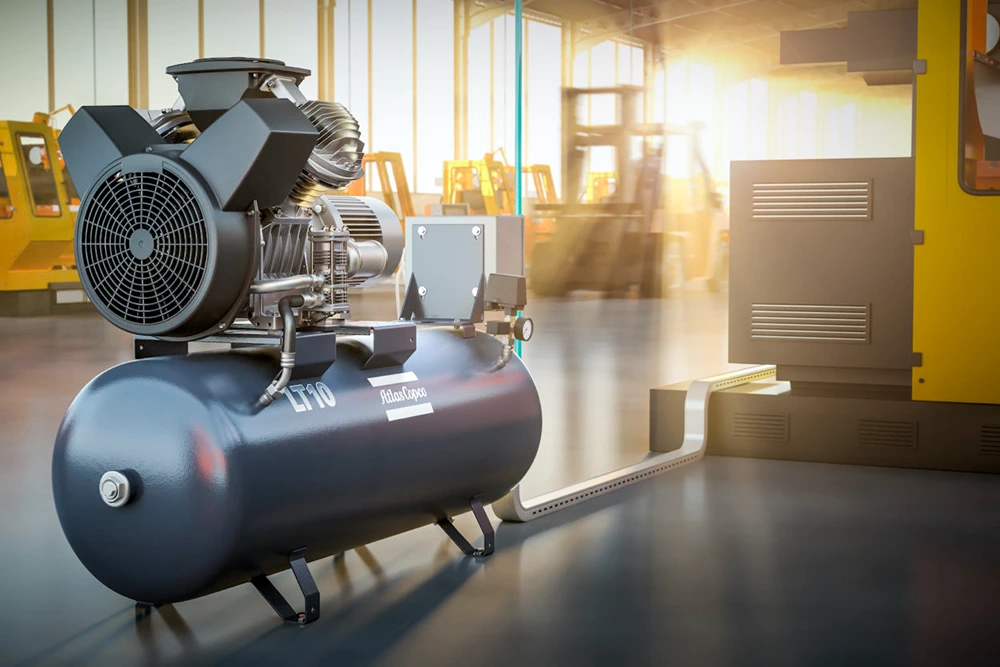
Meeting Class 0 standards requires Oil-Free Air Compressors. These systems are built so that no oil ever reaches the compression chamber – stopping contamination before it can even start.
We supply and install Atlas Copco’s industry-leading oil-free range, including:
- ZT/ZR Oil-Free Rotary Screw Compressors: Ideal for medium to large-scale operations.
- SF Oil-Free Scroll Compressors: Perfect for smaller or point-of-use applications.
2. Variable Speed Drive (VSD)
Packaging lines don’t use air at a steady rate – demand rises and falls throughout the day. A traditional fixed-speed compressor keeps running at full power regardless, wasting a large amount of energy when demand drops.
A Variable Speed Drive (VSD) compressor – such as the Atlas Copco GA VSD⁺ – tackles this issue directly.
It automatically changes its motor speed to match the actual air demand in real time, reducing energy use by as much as 35–60%. That makes a big difference, considering energy can make up around 80% of a compressor’s total lifetime cost.
When paired with energy recovery and monitoring, Atlas Copco compressors offer among the lowest total cost of ownership in the sector.

3. Air Treatment Systems
A compressor alone does not guarantee clean air. A complete air treatment system is required to remove contaminants.
- Air Dryers:
- Refrigerant Dryers: Cool the air to +3°C, suitable for general plant air.
- Desiccant Dryers: Use adsorbent material to achieve a pressure dew point of -40°C or lower. This level of dryness is what you need for air compressors for food and beverage production to inhibit all microbial growth.
- Filtration: A multi-stage filtration train is crucial. This includes general-purpose filters, high-efficiency coalescing filters to remove oil aerosols, and activated carbon filters to remove oil vapour. For food-contact points, a final sterile filter is used to remove microorganisms.
What Common Challenges Do Packaging Plants Face?
A poorly designed or maintained packaging plant compressed air system creates significant operational and financial problems.
- High Energy Costs: Leaks are a primary source of waste; an unmanaged system can lose 20-30% of its compressed air through leaks alone.
- Artificial Demand: Many sites operate their entire system at the high pressure required by a single machine (like a PET blower). This creates what’s known as artificial demand – driving up energy use and putting extra strain on equipment.
- Unplanned Downtime: Fluctuating air pressure can cause machines to jam or seals to fail – and sometimes it can bring an entire line to a halt. A serious compressor fault might even stop the whole facility.
- Product Contamination: When moisture or oil gets into the air lines, products can spoil – and recalls can follow. The result is wasted stock, high costs, and long-term damage to your brand’s credibility.


How Does Design Air Support Scottish Packaging Facilities?
As your trusted local partner, we support packaging facilities across the entire Central Belt – from Glasgow to Edinburgh and beyond – from our base in Airdrie.
We are an Authorised Distributor for Atlas Copco, providing specialist installation and support for their Class 0 and VSD technologies. We also offer expert multi-brand servicing for all major compressor brands, including Ingersoll Rand, Kaeser, and Boge.
Our key services for the packaging industry:
- We keep downtime to a minimum with round-the-clock emergency support – aiming to be on-site within four hours anywhere across the Central Belt. This is a core part of our Scottish packaging facility maintenance pledge.
- We help you pass audits with the official ISO 8573 Air Quality Test (with certification) and by acting as your “competent person” for PSSR 2000.
- We find your energy savings using ultrasonic leak detection and data logging to quantify waste and show you a clear ROI for repairs.
- We cut your fuel bills by installing energy recovery systems that capture up to 94% of waste heat, turning it into hot water (up to +90°C) for cleaning or boiler pre-feed.
- We build your system correctly from day one with bespoke Pipework and installation services and full, energy-efficient air compressor installation using AIRnet aluminium piping.
- We prevent failures before they happen by implementing Atlas Copco’s SMARTLINK, a remote monitoring system that tracks performance 24/7 and enables predictive maintenance.
Every system we design is built to boost reliability, meet compliance standards, and deliver long-term energy efficiency.
Whether you’re making PET bottles, carton packs, or sealed food products, dependable compressed air is essential for both safety and profit.
Get in touch with our engineers to book a full compressed air audit.
We’ll work with you to cut costs, stay compliant, and keep your packaging lines operating efficiently – without unplanned interruptions.
Frequently Asked Questions
For any food packaging where the air touches the product – directly or indirectly – ISO 8573-1 Class 0 is required. This standard ensures the compressor introduces no oil at all, removing the risk of contamination at the source.
In most cases, air quality testing should be carried out once a year as part of your HACCP or BRCGS programme. However, the exact interval depends on your setup – a “competent person” should determine how often testing is needed based on system age, usage, and overall risk level.
Class 1 sets a strict limit on oil concentration (≤0.01 mg/m³). Class 0 is a more stringent, custom class where the user and supplier agree to contamination levels stricter than Class 1. In practice, “Class 0 certified” compressors guarantee zero oil is added during compression.