
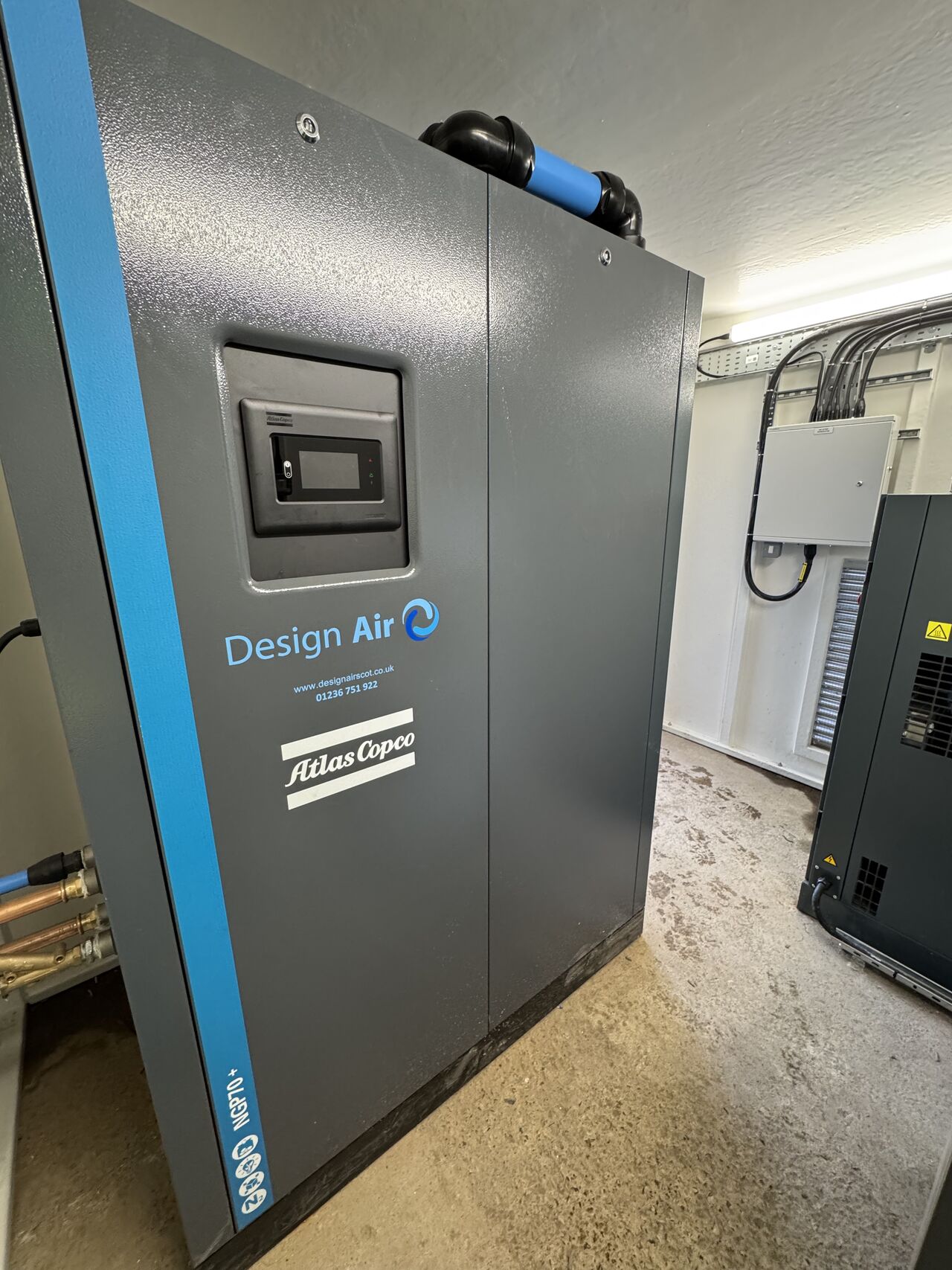
A low-pressure alarm at a hatchery or sea-farm feed system is not simply a plant fault. It can interrupt aeration, oxygen dosing, control air or feed delivery, with consequences for stock welfare and production continuity.
That changes how the system should be specified. Average air demand is not enough. The design must account for pressure at the actual point of use, air purity, peak flow, standby capacity, monitoring, oxygen safety and the practical difficulty of maintaining equipment at remote Scottish sites.
Design Air, Atlas Copco Premier Distributor in Scotland, approaches aquaculture compressed air as a complete system rather than a compressor selection exercise. The compressor, blower, receiver, air treatment, pipework, controls and maintenance plan must all support the biological or process duty they serve.
Begin With the Duty, Not the Machine
Aquaculture sites can use gas systems for several distinct duties. Treating them as one demand leads to excessive pressure in some branches and inadequate flow in others.
| Duty | Typical system characteristic | Main specification question |
|---|---|---|
| Tank or pond aeration | Continuous flow at comparatively low pressure | What pressure reaches the diffuser under the worst operating condition? |
| Pneumatic feed conveying | High flow with changing demand | What are the peak transfer rate, conveying distance and operating sequence? |
| Instrument and control air | Stable pressure and controlled cleanliness | What quality is required at valves, actuators and instruments? |
| On-site oxygen production | Treated compressed air supplied to specialist oxygen equipment | What inlet pressure, flow and air quality does the equipment manufacturer require? |
| Oxygen injection | Controlled oxygen flow into water | What dissolved-oxygen target and transfer method govern the dose? |
A blower can be appropriate for a high-volume, low-pressure duty, while a compressor may be required for controls or specialist process equipment. Selecting one pressure level for every user often creates an inefficient system of throttling valves and local regulators.
Specify each duty separately. Record minimum, normal and maximum flow, the pressure required at the point of use, operating hours, acceptable interruption time and expected future demand. Only then should the duties be combined into a plant configuration.
Translate Aquaculture Demand Into a Pressure And Flow Specification
Compressor or blower discharge pressure is not the same as useful pressure at the outlet. The machine has to overcome every resistance between its discharge and the final point of use.
Build the pressure requirement from the endpoint
For submerged aeration, the calculation begins with the water pressure at the diffuser. The design must then allow for diffuser resistance, pipe friction, fittings, control valves, elevation changes and the additional resistance created by fouling.
Those losses are not fixed for the life of the installation. Biofouling can raise diffuser resistance, while an extended pipe route or undersized branch can increase pressure loss as flow rises. A specification based on clean equipment and a single operating point may therefore meet its commissioning test but miss the required flow after months of operation.
The correct margin depends on the equipment and process. A very generous pressure allowance is not automatically safer because excess pressure increases energy demand and can make control less stable. Measure or obtain each component’s pressure-flow data, then test the calculation at the maximum credible demand.
Separate average demand from coincident demand
Feed conveying, tank filling and cleaning processes may run intermittently. Their average consumption can appear modest even though several simultaneous operations produce a short but substantial peak.
The demand study should identify which users can operate together and which can be sequenced. Where a brief peak can be supplied from stored air, correctly sized air receivers can reduce rapid compressor cycling and stabilise pressure. The receiver is not a substitute for inadequate compressor capacity. Its usable storage depends on its volume, operating pressure band and the duration of the demand event.
For critical life-support duties, the study must also define the response to a failed machine, power interruption, blocked intake or closed valve. Standby capacity only protects the process if it can start, isolate the failed equipment and supply the required duty before the biological limit is reached.
Specify Air Purity As Three Measurable Values
Compressed air can carry particles, water and oil from the intake air, compressor, pipework or previous contamination. The appropriate limit depends on where the air goes and what happens if a contaminant reaches the water, stock, feed or analytical equipment.
ISO 8573-1:2010 (iso.org) classifies compressed-air purity for particles, water and total oil. It does not prescribe one universal class for aquaculture.
A usable specification should state:
- the particle class
- the water class
- the total oil class
- the pressure and operating condition
- the sampling location
- the relevant ISO 8573 test method
- the required test frequency and acceptance record
Writing “air to ISO 8573-1” is incomplete because it does not define any of the three classes. Writing only one class number is equally ambiguous.
Put the sampling point where the risk exists
Air measured at the compressor outlet may pass through a receiver, dryer, filters and several hundred metres of distribution pipe before reaching the process. Corrosion, wet pipework, failed drains or an incorrect filter arrangement can change the result downstream.
If the risk is contamination at the tank, conveying line or oxygen-generation inlet, that is where the acceptance plan should place its final sampling point. An upstream sample may still be useful for fault diagnosis, but it cannot describe the whole distribution system.
Particulate filtration also needs to be selected and maintained as part of a sequence. Our guide to how particulate filters work in air compressor systems explains how filtration grade, pressure drop and loading affect performance.
Match treatment to the actual hazard
Oil-free compression may remove one potential source of oil, but it does not remove particles, atmospheric hydrocarbons, moisture or contamination already present in the pipework. Conversely, an oil-injected compressor with downstream treatment should not be assumed to meet a target without testing.
The site’s hazard assessment should determine the required classes. The treatment train can then be selected around the inlet conditions, air demand and consequence of an excursion. This is one area where the recommendation can reverse. A system that is acceptable for an isolated actuator may be unsuitable when the air can contact process water or supply analytical equipment.
Treat Dissolved Oxygen And Oxygen Purity As Different Measurements
Oxygen purity describes the gas supplied by a cylinder, vessel or generator. Dissolved oxygen describes how much oxygen is present in the water. One does not establish the other.
Transfer performance depends on the injection method, bubble size, contact time, water depth, temperature, salinity, stock loading and water circulation. A compliant oxygen source can still deliver a poor biological result if the distribution arrangement allows gas to escape before it dissolves.
Temperature is particularly important. A controlled post-smolt study found that limiting oxygen saturation increased from approximately 30% to 55% as temperature rose from 6°C to 18°C, illustrating how warmer conditions can reduce the operating margin for fish at a given saturation level (Aquaculture study (sciencedirect.com)).
Separate Gas Quality From Dissolved Oxygen Controls
The specification should therefore separate three controls:
- Gas quality at the oxygen source.
- Gas flow and pressure at the injection equipment.
- Dissolved oxygen at the biologically relevant point in the tank, raceway or outlet water.
The dissolved-oxygen sensor also needs a defined calibration and verification routine. Guidance for portable polarographic metres recommends calibration before each use (aquaculture measurement guidance (freshwater-aquaculture.extension.org)). Fixed instruments require a maintenance plan based on their technology, installation and manufacturer’s instructions.
Design Oxygen Safety Around Both Enrichment And Depletion
Oxygen presents two different atmospheric hazards. Leakage can enrich an enclosed space and make materials easier to ignite. Displacement or consumption of oxygen can create an atmosphere that will not support safe breathing.
Control enrichment and fire risk
Normal air contains about 21% oxygen. The Health and Safety Executive warns that an atmosphere approaching 24% oxygen can become dangerous because ignition is easier and fire burns hotter and more fiercely (HSE oxygen safety guidance (hse.gov.uk)).
Plant-room design should address ventilation, leak detection, shutdown logic, compatible materials, cylinder or vessel location and separation from ignition sources. Oil and grease require particular control around oxygen equipment because materials that burn slowly in air can react much more aggressively in an oxygen-enriched atmosphere.
For Scottish non-domestic premises, duties under the Fire (Scotland) Act 2005 and Fire Safety (Scotland) Regulations 2006 include carrying out a fire-safety risk assessment (Scottish Government guidance (gov.scot)). Oxygen storage, generation and distribution need to be included in that assessment rather than treated as ordinary mechanical services.
Do not overlook oxygen-deficient spaces
A Scottish aquaculture prosecution followed fatalities in a feed-barge compartment where the oxygen concentration was measured at 13%, compared with normal air at 20.9%. The court record states that oxygen levels of 16% or less can cause unconsciousness and death (Scottish Sentencing Council case summary (scottishsentencingcouncil.org.uk)).
Ventilation and atmospheric monitoring must therefore be based on the credible release and depletion scenarios for the specific enclosure. An oxygen-enrichment alarm does not necessarily provide adequate protection against oxygen deficiency, and a monitor positioned for one release path may miss another.
Specialist oxygen equipment, storage vessels and distribution components should be designed and commissioned by parties competent for that scope. A compressed-air assessment alone does not establish that an oxygen installation is safe.
Place Animal Welfare Inside the Reliability Specification
The Animal Health and Welfare (Scotland) Act 2006 applies to fish. It makes it an offence for a responsible person to cause unnecessary suffering or fail to take reasonable steps to meet an animal’s needs. Those needs include a suitable environment and protection from suffering, injury and disease.
For life-support air and oxygen systems, reliability is therefore part of the welfare control, not only a production consideration.
The design basis should identify every single failure that could interrupt an essential duty. That review normally covers power supplies, controls, compressors or blowers, oxygen supply, treatment equipment, isolation valves, sensors and the distribution route. The appropriate response might include automatic standby, stored capacity, an independent emergency oxygen source or a documented manual intervention. The choice depends on how quickly conditions can deteriorate at that site.
Alarms need the same scrutiny. A signal is only useful if it reaches a responsible person, identifies the affected duty and leaves enough time for intervention. Our guide to air compressor monitoring systems covers the equipment data and alarm trends that can support maintenance decisions. Aquaculture controls should also monitor the process outcome, including dissolved oxygen where relevant, rather than relying solely on compressor status.
Define The PSSR Boundary Before Installation
The Pressure Systems Safety Regulations 2000 apply to workplace pressure systems containing a gas or gas mixture above 0.5 bar gauge, including compressed or liquefied air (PSSR 2000 (legislation.gov.uk)).
An aquaculture installation may include compressors, receivers, dryers, filters, pipework, safety devices and connected process equipment. The system boundary, safe operating limits and examination requirements should be established before commissioning, not reconstructed after the equipment is operating.
Where PSSR requires a Written Scheme of Examination, it must be drawn up or certified by a competent person before the system is used. The scheme identifies which parts require examination, the nature of that examination and the intervals involved. Regulation 2 defines the competent person as a competent individual other than an employee, or a competent body of persons (PSSR definition (legislation.gov.uk)).
The Written Scheme does not replace maintenance. Examination looks for deterioration or defects relevant to pressure-system safety. Servicing addresses operating condition, efficiency and reliability. Both must be planned, but they serve different purposes.
Modifications also need control. Adding a receiver, altering maximum pressure or extending pipework can change the system boundary and operating conditions. The competent person should determine whether the existing scheme remains suitable before the altered installation enters service.
Install For Scottish Site Conditions
Aquaculture plant can operate beside salt water, in exposed coastal locations or on sites with restricted access. Those conditions affect enclosure selection, intake position, corrosion protection, pipe supports and maintenance space.
A compressor or blower should have access to clean intake air and sufficient ventilation for its declared operating conditions. Locating an intake near diesel exhaust, salt spray or oxygen vents creates avoidable contamination and reliability problems. Drainage also needs a defined route, particularly where compressed-air treatment produces condensate.
Pipework should be sized for the calculated flow and acceptable pressure loss, with isolation arranged so that one branch can be maintained without disabling every essential duty. Materials and supports must suit the environment and the gas being carried. Oxygen pipework requires its own material, cleanliness and compatibility assessment.
Receiver location, lifting access and filter clearance are easy to overlook on compact sites. They determine whether routine work can be completed safely without dismantling adjacent equipment. Our complete factory fit out shows how equipment layout, distribution and commissioning need to be coordinated as one installation.
Commission Against Measured Performance
Commissioning should prove that the delivered system meets its duty under representative load. A successful no-load start does not demonstrate adequate pressure at the furthest diffuser or correct air quality at the oxygen equipment inlet.
The commissioning record should include:
- compressor or blower operating pressure and delivered flow
- pressure at critical endpoints under coincident demand
- air-quality results at the specified sampling locations
- receiver, relief-device and control settings
- oxygen alarm and ventilation interlocks
- standby changeover and power-failure tests
- dissolved-oxygen instrument calibration records
- baseline power, temperature and pressure data
- PSSR documentation where applicable
ISO 1217:2009 (iso.org) provides acceptance-test methods for displacement compressors, including volume flow and power. Supplier performance data should state the applicable test conditions so that procurement teams can compare like with like.
The baseline also makes deterioration visible. If endpoint pressure later falls while compressor discharge pressure remains stable, the cause may be increasing distribution resistance, a blocked filter or a changing demand profile. Without commissioning data, the same symptom can be mistaken for insufficient compressor capacity.
Maintain The System Around Consequence And Access
Remote Scottish sites need a maintenance plan that reflects travel time, weather exposure, spare-part availability and the maximum acceptable loss of service. A calendar interval alone does not capture those risks.
Routine work should cover the compressor or blower, intake filtration, cooling surfaces, drains, dryers, downstream filters, receivers, pipework, safety devices, oxygen alarms and dissolved-oxygen instruments. Filter differential pressure and treatment performance should be recorded, not inferred from service age.
Condition monitoring can reveal longer run hours, rising discharge temperature, unstable pressure or repeated loading cycles before a complete failure occurs. The response threshold should relate to the protected duty. A trend that is tolerable on a workshop airline may justify immediate investigation when it supports fish aeration or oxygen production.
Standby equipment must be tested under load. A machine that starts during a weekly test may still have a closed discharge valve, expired service item or insufficient capacity for the current site demand. Periodic changeover also prevents the duty machine from accumulating all operating hours while the standby unit remains mechanically idle.
Prepare The Information Needed For A Site Assessment
Generic equipment schedules cannot resolve diffuser condition, actual peak demand, oxygen-equipment inlet requirements or the time available after a failure. Those decisions need site measurements and a defined process basis.
For a useful assessment and quotation, provide:
- each air and oxygen duty with operating hours
- minimum, normal and peak flow
- required pressure at each endpoint
- current dissolved-oxygen limits and alarm settings
- water temperature, salinity and expected seasonal range
- tank, raceway or pen configuration
- existing compressor, blower, receiver and treatment details
- pipe routes, diameters and materials
- available electrical supply and backup arrangements
- plant-room drawings, ventilation and access constraints
- current maintenance records and PSSR documentation
- the oxygen-equipment supplier’s verified inlet specification
Design Air can use that information to assess the compressed-air demand, equipment duty, treatment, receivers, pipework, controls, monitoring and PSSR boundary. Our factory-trained engineering team can then produce a specification that procurement, operations and the competent person can review against the same measured requirements.
To arrange an aquaculture compressed-air system assessment in Scotland, contact Design Air with your site drawings, operating profile and critical-duty information.