
The first evidence of coastal corrosion is rarely a dramatic compressor failure. It may be a rising intake pressure drop, a drain that repeatedly blocks, rust-coloured condensate, oxidised terminals or a pneumatic valve that has started sticking. Each symptom appears local, but the underlying cause may extend from the air intake to the furthest point of use.
Salt exposure and persistent moisture can affect the compressor package, receiver, treatment equipment, distribution pipework, controls and supporting structure. Internal condensate adds a second corrosion mechanism, even when the compressor room itself appears dry.
At Design Air, Atlas Copco Premier Distributor in Scotland, our engineering team approaches coastal installations as complete compressed air systems. The specification must account for the actual site exposure, the consequences of each failure, the required air quality and the inspection duties attached to pressure equipment. Distance from the shoreline is only the starting point.
Why Distance From the Sea Is Not a Specification
Two facilities located the same distance from the coast can experience markedly different conditions. A compressor room facing the prevailing wind may receive regular salt-laden air, while another plant room behind a substantial building remains sheltered. Conversely, a sheltered external surface may retain deposits because rain cannot wash them away.
Map the Routes Taken by Salt and Water
Record the following before specifying equipment or pipework:
- Prevailing wind direction and seasonal changes
- Topography, including raised ground and exposed quayside positions
- Buildings, bunds or screens that shelter some surfaces while creating turbulent air elsewhere
- Intake louvre direction and height
- Areas exposed to rain washing
- Sheltered ledges, supports and enclosure joints where wet deposits remain
- Local sources of salt spray, saline process water or salt handling
- Lowest ambient temperatures around external pipework
- Washdown practices and cleaning chemicals used near the installation
The assessment should divide the site into zones. The intake face, compressor room, external distribution line and production area may each require a different material, coating or inspection strategy.
Establish What Has Already Changed
On an existing installation, inspect patterns rather than isolated blemishes. Compare the windward and sheltered sides of enclosures. Check whether filter restriction rises after particular weather conditions. Look for recurring drain faults, coating breakdown at cut edges, corroded supports and contamination at remote points of use.
Trend data can reveal deterioration before it produces a shutdown. Our guide to air compressor monitoring systems explains how pressure, temperature, running hours and alarm history contribute to that baseline. Monitoring cannot measure every corrosion mechanism, but it can show where system behaviour is changing.
Which Components Are Most Likely to Fail?
A useful corrosion assessment connects each exposure route to a credible failure and its operational consequence. “Use corrosion-resistant materials” is too broad to support a procurement decision.
| Component | Likely corrosion route | What the site should look for |
|---|---|---|
| Intake louvre and filter housing | Wet salt deposits on exposed surfaces | Coating failure, damaged seals and accelerated filter restriction |
| Compressor cooler | Deposits on the air side and deterioration of exposed materials | Higher discharge temperature or reduced cooling performance |
| Moisture separator and drains | Persistent contact with condensate and debris | Restricted drains, water carryover and repeated drain alarms |
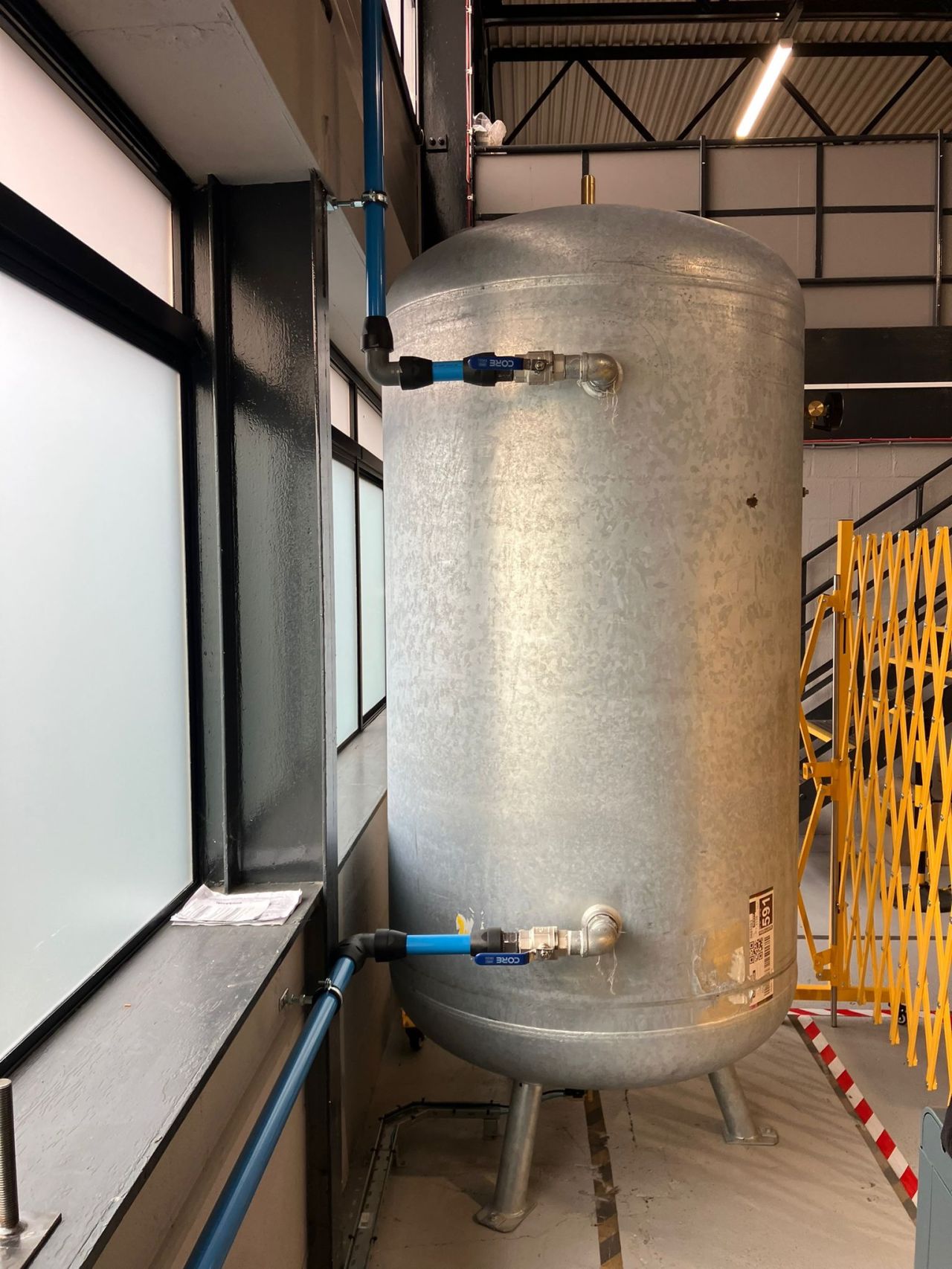
| Air receiver | Accumulated internal water or external coating damage | Internal deterioration, wall-loss concerns or corrosion around supports |
| Distribution pipework | Condensate retained in low points | Corrosion products, leaks, restricted fittings and contaminated downstream air |
| Supports, brackets and fasteners | Wet deposits held in crevices | Localised attack, loose supports and coating damage around contact points |
| Electrical enclosures and terminals | Saline moisture entering through failed seals or cable glands | Intermittent signals, trips, heating connections and control faults |
| Point-of-use filters and valves | Water and corrosion particles arriving from upstream | Rising pressure drop, sticking valves and inconsistent actuator operation |
This list also shows why replacing a visibly corroded pipe section may not solve the problem. If the intake continues to admit saline contamination and the treatment system allows liquid water into the main, deterioration will reappear elsewhere.
How Should Intake Air Be Managed?
The compressor intake is the first engineering control. As a siting principle, incoming air should be as dry and free from contaminants as site conditions allow. On an exposed site in Aberdeen, Fife or the north-east fishing ports, intake position can materially affect the salt and rain reaching the package.
Select the Position Before Selecting the Filter
Locate the intake away from direct spray, roof drainage, vehicle exhausts, process discharges and recirculated hot cooling air. Raising or redirecting an intake may reduce contamination, but only if the proposed position has been checked against prevailing wind and building airflow.
Long intake ducts create their own constraints. Added resistance can reduce compressor performance, while poorly drained ductwork can collect water. Any relocation therefore needs an airflow calculation, drainage provision and a maximum permitted pressure drop agreed with the compressor manufacturer.
Specify Filtration by Duty
An intake filter should be selected for the expected particle and aerosol loading, not merely by matching a connection size. Record the clean-filter pressure drop and define the replacement trigger. A differential-pressure indication is more informative than a fixed calendar interval when loading changes with weather.
Do not make the plant room airtight to exclude salt. The compressor still needs sufficient clean ventilation air and a reliable route for rejected heat. A weather-protected, ventilated enclosure with controlled intake paths is normally more useful than an enclosure that traps warm, damp air.
What Materials Work in Coastal Installations?
Material selection should cover pipe, fittings, drains, supports, fasteners, enclosures and interfaces between them. A corrosion-resistant main does not compensate for an unsuitable bracket or an unprotected cut edge.
For compressed air distribution, a modular aluminium system such as AIRnet removes the red-rust mechanism associated with ferrous pipe interiors. It also allows the route to be altered without hot work. Aluminium is not permission to ignore exposure, however. External deposits, incompatible supports and damaged joints still require inspection.
Stainless steel may be appropriate in persistently wet areas or where the process demands it. The grade and finish must be selected against chloride exposure and any cleaning chemicals. “Stainless” on its own is not a complete material specification.
Receivers and package frames may use coated carbon steel. For these components, specify surface preparation, coating system, repair procedure and inspection access. ISO 12944-2:2017 provides environmental classifications used when selecting protective paint systems. A nominal paint thickness without an exposure category and preparation standard gives procurement very little control.
Treat Interfaces as Part of the Material Choice
Where dissimilar metals meet, check the manufacturer’s approved joint arrangement and any required isolation. Water-retaining crevices around clamps, bolts and baseplates deserve particular attention. Fasteners should be included in the material schedule rather than left to the installer’s usual stock.
The recommendation can change in a food production area where aggressive washdown chemicals are present. A material that performs well against atmospheric salt may be unsuitable for repeated chemical cleaning. That decision cannot be closed from the coastal exposure assessment alone. It requires the cleaning regime and process chemistry.
How Clean and Dry Must the Compressed Air Be?
External corrosion is only half of the problem. Atmospheric air contains water vapour. Compression concentrates that moisture, and cooling in the aftercooler, receiver and distribution system causes liquid condensate to form. Once water remains in contact with internal ferrous surfaces, corrosion can continue beyond the coastal intake zone.
ISO 8573-1:2010 provides purity classes for particles, water and oil. Specify each contaminant at the point where the air is used. A general statement such as “clean, dry air” does not tell a supplier what the dryer, filters and drains must achieve.
Set the Dew Point Against the Coldest Pipe
The dryer specification should consider the lowest temperature experienced by the downstream pipework, including external sections and unheated buildings. If compressed air cools below its pressure dew point, water can condense in the distribution system even when the compressor room remains warm.
A refrigerant dryer may suit pipework kept above its specified pressure dew point. Lower-temperature or critical applications may require adsorption drying. The decision depends on the actual winter exposure and the process requirement, not the average compressor-room temperature.
Give Each Treatment Stage a Defined Job
An effective treatment arrangement may include an aftercooler, moisture separator, receiver, correctly selected dryer, filtration and automatic drains. The sequence depends on compressor type and required air quality.
Correctly sized air receivers provide storage and can support condensate separation, but they also create a location where water can collect. Drain performance and receiver condition therefore belong in the same maintenance plan.
Particulate filtration controls solid contamination, including debris released by deteriorating upstream pipework.
Our explanation of how particulate filters work in air compressor systems covers filtration grades and pressure-drop considerations. A particulate filter does not remove water vapour, so it cannot compensate for an underspecified dryer.
Which Installation Details Prevent Repeat Corrosion?
Installation quality determines whether water reaches drains or sits in low points. Pipework should follow the engineered fall, with drainage at identified low points and no unintended pockets created by later alterations. Branch take-offs and isolation arrangements should prevent accumulated water being swept towards sensitive equipment.
External pipework needs secure supports that do not damage its surface or retain water. Weather protection should shed water without blocking ventilation or inspection access. Coating damaged during lifting, drilling or assembly should be repaired using the specified system before commissioning.
Commissioning should leave a usable baseline, including:
- Material and component schedules
- Pipe route and drain locations
- Filter differential pressure
- Dryer pressure dew point under recorded conditions
- Drain function tests
- Compressor temperature and pressure readings
- Photographs of exposed supports, joints and enclosure penetrations
- Safe operating limits and alarm settings
- Maintenance responsibilities and initial inspection intervals
Acceptance testing should be completed at representative load. A dryer reading taken with little or no airflow may not demonstrate performance under production conditions.
How Should Maintenance Change Near the Coast?
A fixed annual visit is not a corrosion strategy. Maintenance frequency should respond to exposure, operating hours, manufacturer instructions and the deterioration found during previous inspections.
Daily or shift checks can identify standing condensate, drain alarms, unusual discharge temperatures and visible salt deposits. Planned inspections should include intake louvres, filter restriction, cooler cleanliness, enclosure seals, coating condition, supports, drains and exposed electrical connections. Deterioration should be photographed consistently so that progression can be distinguished from an old, stable defect.
Remote monitoring can highlight a rising temperature, pressure change or repeated alarm, but it cannot inspect a receiver interior or identify coating failure behind a support. Physical inspection and condition data serve different purposes.
Do Not Apply One Schedule to Every Compressor
One example schedule for reciprocating compressors calls for accumulated oil and water to be drained from the receiver, intercooler, aftercooler and main pipes at the end of each day. It also includes cooler cleaning and internal receiver examination after 2,000 running hours or annually, whichever comes first.
That schedule should not be transferred blindly to a rotary screw installation. Current manufacturer instructions, the equipment’s duty and the Written Scheme of Examination remain controlling inputs. The value of this example is its treatment of drains, coolers and receiver condition as defined tasks rather than a generic instruction to “check for corrosion”.
A planned compressor service should record findings, corrective work and any change to the inspection interval. Repeated drain blockage or rapid coating deterioration is evidence that the system design or maintenance frequency needs review.
Where Do PSSR and PUWER Fit?
Maintenance, workplace inspection and statutory examination are related, but they are not interchangeable.
Pressure Systems Safety Regulations
For a pressure system within the scope of the Pressure Systems Safety Regulations 2000, the user of an installed system or owner of a mobile system must establish safe operating limits before operation. They must not operate the system without a suitable Written Scheme of Examination covering the relevant parts and certified by a competent person. HSE states that a WSE must be in place and an examination undertaken before qualifying pressure equipment is used. The current responsibilities are summarised on the HSE PSSR page (hse.gov.uk).
The competent person determines or certifies the scheme and carries out examinations in accordance with it. The scheme should reflect the actual system and credible deterioration mechanisms. Coastal corrosion may therefore be relevant when deciding which parts require examination, by what method and at what interval.
PSSR Regulation 12 requires the system to be “properly maintained in good repair, so as to prevent danger (legislation.gov.uk)”. Routine servicing does not replace examination under the WSE, and a satisfactory statutory examination does not replace maintenance between examination dates.
Provision and Use of Work Equipment Regulations
PUWER addresses the suitability, condition and safe use of work equipment. Work equipment must be suitable for its intended use, maintained in a safe condition and inspected where required.
For the facilities team, this means keeping operating, maintenance and inspection controls aligned. PSSR governs specific pressure-system duties, while PUWER continues to apply to the wider work equipment and its safe use. Neither should be treated as an equipment supplier’s paperwork exercise.
What Should the Procurement Specification Contain?
A coastal compressed air specification should give tendering suppliers enough information to design against the real conditions. Include:
- Site exposure: location, intake orientation, prevailing wind, shelter, rain exposure, nearby salt sources and washdown practices.
- Operating duty: required flow, pressure profile, operating hours, standby philosophy and expected future demand.
- Failure consequences: equipment whose loss would stop production, compromise safety or affect product quality.
- Air quality: required ISO 8573-1 particle, water and oil classes at each critical point of use.
- Temperature range: compressor-room conditions and the lowest temperature encountered by downstream pipework.
- Material schedule: pipe, fittings, supports, fasteners, drains, enclosures and approved interfaces between dissimilar materials.
- Coating specification: exposure classification, surface preparation, application and repair requirements.
- Condensate management: separation, drainage points, drain type, monitoring and safe disposal route.
- Inspection access: clearance for cooler cleaning, filter replacement, receiver examination and visual inspection of vulnerable joints.
- Compliance responsibilities: safe operating limits, WSE interfaces, examination records, PUWER controls and handover documentation.
- Acceptance criteria: pressure, flow, pressure dew point, filter pressure drop, drain tests, alarm checks and baseline condition records.
- Maintenance plan: task ownership, initial intervals, condition triggers and the process for revising frequencies.
This schedule allows procurement to compare engineering content rather than comparing package prices that conceal different assumptions.
Arrange a Coastal System Assessment
Generic guidance cannot determine whether a particular intake should be relocated, which material is compatible with the site’s cleaning regime or what dew point is required at the coldest point of use. Those decisions require operating data and a physical site assessment.
Design Air can assess the compressor room, intake route, treatment equipment, air receivers, distribution pipework and maintenance records. To prepare a useful quotation, provide the site location, equipment list, operating pressure, demand profile, required air quality, lowest pipework temperature, existing drawings and any recent corrosion, condensate or filter problems.
Our factory-trained engineering team can then define the appropriate equipment, pipework installation, treatment duty and service requirements for an industrial site in Scotland. Contact Design Air to arrange the assessment and receive a specification-led quotation.